
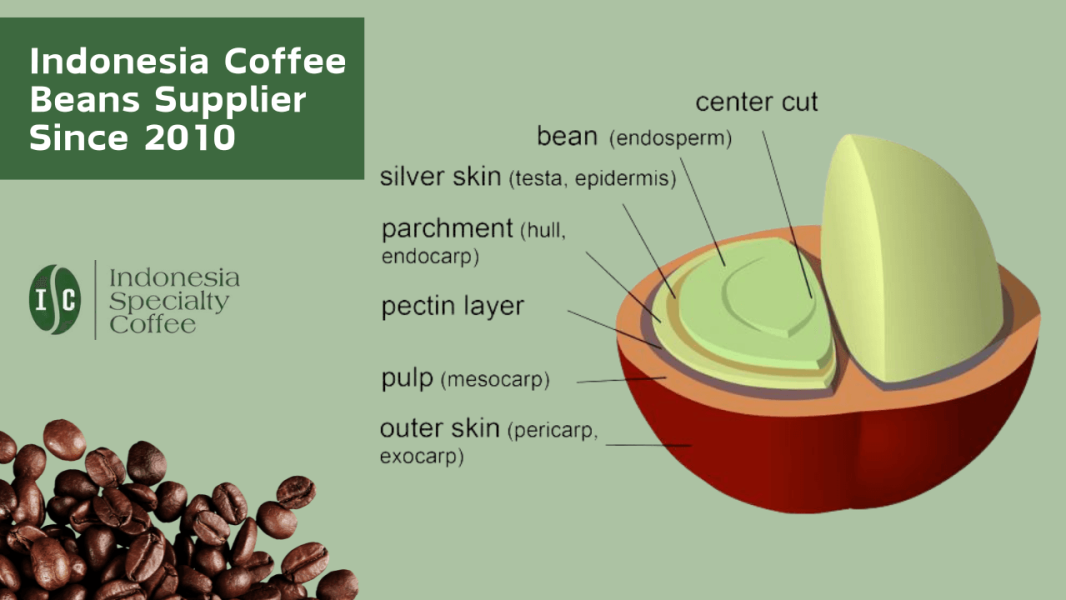
The chemical composition of coffee beans decides how a lot roasts, how it cups, and what it is worth per kilogram. Green Arabica is roughly 50 to 60% carbohydrates, 15 to 20% lipids, 10 to 15% protein, and about 1% caffeine on a dry weight basis. Every one of those figures moves with species, origin, altitude, and post-harvest processing.
This guide covers what sits inside a green bean, where Arabica and Robusta diverge, and how Indonesian processing rewrites the numbers before a lot ever reaches your roaster.
Last updated: 23 September 2026
What Is the Chemical Composition of Coffee Beans?
A green coffee bean is mostly carbohydrate, and most of that carbohydrate is structural cell wall material rather than sugar you can taste. The published dry weight ranges for green Arabica look like this.
| Component | Share of dry weight | What it does |
|---|---|---|
| Carbohydrates | 50 to 60% | Cell wall structure, plus 5 to 9% sucrose as roast fuel |
| Lipids | 15 to 20% | Body, mouthfeel, crema stability, aroma carrier |
| Proteins and amino acids | 10 to 15% | Maillard partner, aroma precursor |
| Chlorogenic acids | 4.0 to 8.4% | Perceived acidity and astringency |
| Minerals | 3 to 5% | Potassium, magnesium, calcium, phosphorus |
| Caffeine | ~1% | Bitterness, stimulant load |
Note what is missing from that list: flavour. Green coffee has almost none. What a green bean holds is a set of precursors, and roasting is the reaction that converts them. A lot that cups flat rarely lost its flavour in your roaster. It arrived without enough sucrose and amino acid to build any.
Moisture sits outside the dry weight table and matters more than any single compound on it. Under SNI 01-2907-2008, ISC ships Grade 1 green coffee at 12.5% moisture or below.
Arabica vs Robusta: Where the Chemistry Diverges
Arabica and Robusta are not the same bean at different quality levels. They are different species with measurably different chemistry, which is why they behave differently in a roaster and price differently per kilogram.
| Compound | Green Arabica | Green Robusta | Consequence in the cup |
|---|---|---|---|
| Caffeine | ~1.0 to 1.5% | ~2.0 to 2.5% | Robusta reads harsher and more bitter |
| Lipids | 15 to 17% | 7 to 10% | Arabica carries more body and holds crema better |
| Chlorogenic acids | 4.0 to 8.4% | 7.0 to 14.4% | Robusta brings more astringency and woody bite |
| Sucrose | 5 to 9% | 3 to 7% | Arabica browns faster and sweetens more readily |
Roughly 75% of the oil fraction in both species is triacylglycerols. That lipid gap is the single clearest reason an espresso blend built for crema leans on Arabica green coffee beans while a blend built for crema volume and price leans on Robusta.
Every lot we ship is quoted with species, origin, process, and grade stated separately. Current figures sit on the ISC pricelist.
The Compounds That Decide How Your Lot Roasts
Four compound groups do most of the work between green bean and finished cup. If you are evaluating a sample, these are the ones worth thinking about.
- Sucrose is the roast’s fuel supply. At 5 to 9% of green Arabica dry weight, it drives both caramelisation and the Maillard reaction with free amino acids. Higher sucrose gives you a wider workable window between first crack and the point where sweetness starts burning off.
- Lipids do not evaporate during roasting, so a high-lipid lot delivers heavier mouthfeel and more stable crema. They also oxidise. This is why a 15 to 17% lipid Arabica ages faster in storage than a Robusta at 7 to 10%, and why you should not buy Arabica volume you cannot roast within a reasonable window.
- Chlorogenic acids degrade steadily through the roast, breaking down into quinic and caffeic acid. That degradation is why a light roast tastes sharp and a dark roast tastes flat and hollow rather than bright.
- Trigonelline breaks down into pyridines and niacin during roasting and contributes much of the roasted, nutty aroma most people identify as “coffee smell.”
One thing you learn handling green coffee daily: two lots with identical cupping scores can roast completely differently if their density and moisture differ. Chemistry on paper does not predict heat transfer through the bean.
How Origin and Processing Rewrite the Numbers
Species sets the range. Origin and post-harvest handling decide where inside that range a lot actually lands. Research on green coffee acid composition finds post-harvest processing to be the dominant factor, ahead of both origin and altitude.
Indonesian data shows how wide the origin variance runs. HPLC analysis of green Arabica from three West Java regions measured caffeine at 2.28% in Tasikmalaya, 1.57% in Pangalengan, and 1.45% in Garut. Same species, same island, and a caffeine spread of over half a percentage point.
Processing then adds a second layer, and in Indonesia it runs in two steps.
| Origin | Step 1: cherry method | Step 2: hulling method |
|---|---|---|
| Gayo, Mandheling, Lintong, Toraja, Flores | Semi-washed or full-washed | Wet-hulled (Giling Basah) at 35 to 40% moisture |
| Bali Kintamani, Java | Full-washed, honey, or natural | Dry-hulled at 12 to 13% moisture |
Wet-hulling strips the parchment while the bean is still soft at 35 to 40% moisture, then finishes the dry. That route consumes more of the residual sugars before the bean stabilises, which is a large part of why Gayo Arabica green coffee beans cup with low acidity and heavy body instead of the bright profile the same altitude produces elsewhere. The sugar available for the roast is decided at the mill, not in your roaster. How much mucilage stays on the bean during that stage is the variable doing the work.
Kopi Luwak Chemistry: What Lab Analysis Shows
Kopi Luwak is the one Indonesian coffee where chemistry, rather than marketing, explains the difference. Published analysis of green Kopi Luwak samples found composition broadly in line with normal green Coffea arabica, with two clear exceptions: caffeine at 0.48 g per 100 g and total chlorogenic acids at 5.09 g per 100 g, both notably lower than untreated Arabica. [Verify this citation against the primary paper before publishing.]
Lower caffeine and lower chlorogenic acid together account for the smooth, low-bitterness profile Luwak is sold on. Proteolytic activity during passage through the civet’s digestive tract breaks down some of the storage proteins and alkaloids before the bean is recovered and washed.
The same analysis found crop year, rather than location or post-harvest method, to be the strongest discriminator between Luwak samples. For your purposes as a buyer that makes harvest year the specification worth asking for, ahead of region. Indonesia Specialty Coffee supplies wild-certified Kopi Luwak green beans with the crop year stated on every lot you order.
Frequently Asked Questions
What is the chemical composition of coffee beans?
Green Arabica coffee beans are approximately 50 to 60% carbohydrates on a dry weight basis, including 5 to 9% sucrose, plus 15 to 20% lipids, 10 to 15% protein, 4.0 to 8.4% chlorogenic acids, 3 to 5% minerals, and about 1% caffeine. Roasting converts these precursors into flavour and aroma.
How much caffeine is in Arabica vs Robusta coffee beans?
Green Arabica contains roughly 1.0 to 1.5% caffeine by dry weight, while green Robusta contains roughly 2.0 to 2.5%. Robusta also carries almost double the chlorogenic acids, at 7.0 to 14.4% against 4.0 to 8.4%, which is why Robusta reads more bitter and astringent.
Does roasting change the chemical composition of coffee beans?
Yes, substantially. Sucrose caramelises and reacts with amino acids through the Maillard reaction. Chlorogenic, citric, and malic acids degrade while quinic acid rises. Trigonelline breaks down into aroma compounds. Caffeine and minerals remain broadly stable throughout the roast.
Does processing method affect coffee bean chemistry?
Yes. Research identifies post-harvest processing as the dominant factor in green coffee acid composition, ahead of origin and altitude. Indonesian wet-hulled lots, hulled at 35 to 40% moisture, retain less residual sugar than dry-hulled lots finished at 12 to 13%.
Why does Kopi Luwak have less caffeine?
Published analysis measured green Kopi Luwak at 0.48 g caffeine per 100 g, below the roughly 1 g typical of untreated green Arabica. Proteolytic activity in the civet’s digestive tract degrades part of the alkaloid and protein content before the bean is recovered, washed, and dried.
Buy Indonesian Green Coffee Beans from Indonesia Specialty Coffee
Indonesia Specialty Coffee grades and exports Grade 1 Indonesian green coffee from Medan, North Sumatra. Every lot ships at 12.5% moisture or below with a defect value of 11 or under under SNI 01-2907-2008, cupping at 82 to 88 SCA points against SCA protocol, FOB Belawan and Halal certified.
If you want the chemistry verified rather than described, request a sample and cup it yourself.
Order at 1 kg for cupping evaluation, 60 kg for microlot pricing, 350 kg for standard wholesale, or from 9 MT for container loads. Check the current pricelist or contact our team for a quote matched to your roast profile.