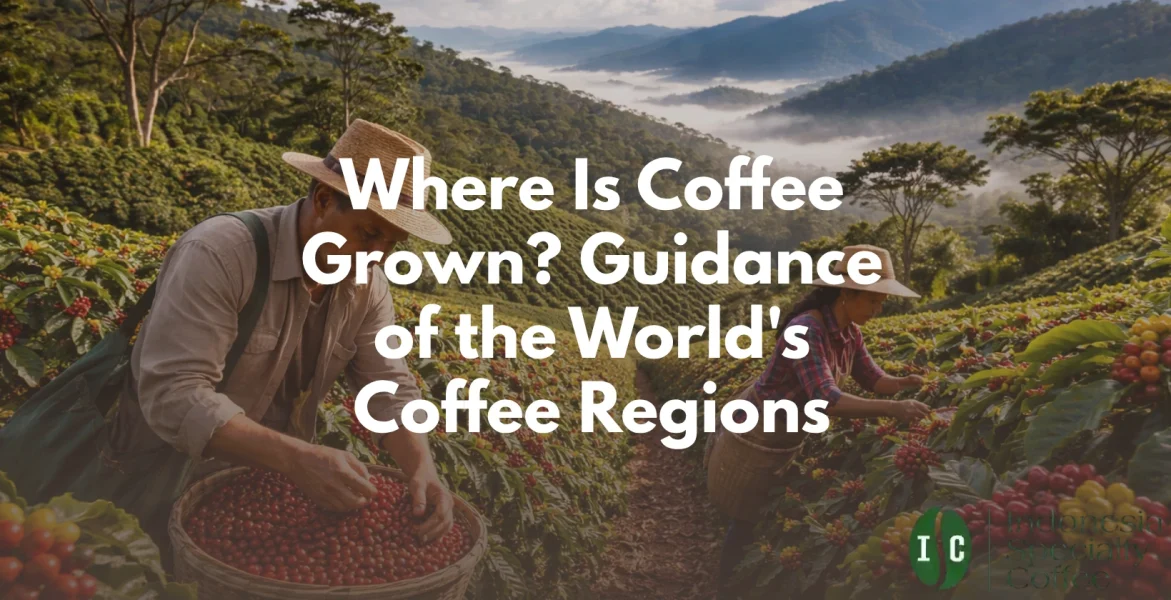
Most people reach for their morning cup without ever wondering: where is coffee grown, exactly? The short answer is almost everywhere between the Tropics of Cancer and Capricorn. But the longer answer is far more interesting, because the country, the altitude, and even the volcanic soil under the tree all shape what ends up in the cup. This guide breaks it down clearly, from the basics of the Coffee Belt to the flavor differences between regions.
What Is the Coffee Belt and Where Is Coffee Grown Within It?
Coffee grows in a band of land known as the Coffee Belt, sometimes called the Bean Belt, that wraps around the equator between roughly 25°N and 30°S latitude. This zone gives coffee plants what they need most: warmth, rainfall, and no frost. Understanding where is coffee grown starts with this belt, because virtually all commercial coffee production happens inside it.
The Coffee Belt spans three major continents: Africa, the Americas, and Asia-Pacific. Within each continent, specific countries have become famous for distinct styles and flavor profiles that specialty roasters and enthusiastic home brewers actively seek out.
The Growing Conditions That Define Every Origin
The table below summarizes the key conditions that make a coffee-growing region productive and flavorful. These factors explain why coffee cannot simply be grown anywhere, and why certain origins command premium prices.
| Factor | Ideal Condition | Why It Matters |
| Temperature | 15°C – 24°C year-round | Prevents stress on the cherry |
| Rainfall | 1,500 – 2,000 mm/year | Supports cherry development |
| Altitude | 800 – 2,200 masl | Slows ripening, builds complexity |
| Soil | Volcanic, well-drained | Rich minerals feed the plant |
| Sunlight | Dappled / partial shade | Avoids leaf scorch |
Altitude deserves special attention. High-grown coffees ripen slowly, which concentrates sugars inside the cherry and produces the bright acidity and complex flavors prized in specialty cups. That is a major reason Ethiopia, Colombia, and Yemen consistently top specialty auction rankings.
Where Is Coffee Grown by Country: The Major Producers at a Glance
The following table covers six of the most important origins. Each one answers a slightly different version of where is coffee grown, because the flavor, processing method, and price point differ dramatically across them.
| Country | Region | Altitude (masl) | Flavor Profile |
| Ethiopia | East Africa | 1,500 – 2,200 | Floral, berry, tea-like |
| Colombia | South America | 1,200 – 2,000 | Caramel, citrus, nut |
| Brazil | South America | 800 – 1,200 | Chocolate, low acid |
| Indonesia | Southeast Asia | 800 – 1,500 | Earthy, full body |
| Yemen | Middle East | 1,500 – 2,500 | Wine, tamarind, spice |
| Guatemala | Central America | 1,300 – 1,800 | Dark fruit, smoky |
Brazil alone accounts for roughly one-third of global supply, making it the single largest answer to the question of where is coffee grown at industrial scale. Ethiopia, on the other hand, is where arabica coffee originated, wild coffee trees still grow in its forests today, which gives Ethiopian beans a genetic diversity no other country can match.
Where Is Coffee Grown Best? Africa vs. the Americas vs. Asia
Africa: The Birthplace of Coffee
Africa is the continent where coffee cultivation began, and Ethiopia remains its spiritual home. Kenya, Uganda, Tanzania, and Rwanda all produce coffees with vivid fruit notes and wine-like complexity. The volcanic soils and high elevations across East Africa create growing conditions that are extremely difficult to replicate anywhere else. Anyone asking where is coffee grown for the most expressive, terroir-driven flavors will almost always point to Africa first.
The Americas: Volume, Consistency, and Variety
The Americas stretch from Mexico all the way down through Brazil, and the range of coffees produced across this region is enormous. Colombia delivers consistent, approachable cups year-round thanks to its two harvest seasons. Guatemala and Costa Rica produce smaller volumes of high-quality beans from steep, high-altitude farms. Brazil dominates lower-altitude production with natural-processed coffees that taste of chocolate and nuts, ideal for espresso blends. When coffee buyers want reliable supply at scale, this is where is coffee grown most efficiently.
Asia-Pacific: Earthy, Bold, and Unique
Indonesia, particularly Sumatra, Sulawesi, and Java produces coffees unlike anything from Africa or the Americas. The wet-hulled processing method used in Sumatra creates a heavy body, low acidity, and a distinctly earthy or herbal character. Papua New Guinea and Timor-Leste also produce interesting specialty lots. For coffee drinkers who prefer a full-bodied, savory cup over bright and fruity ones, this part of the world answers the question of where is coffee grown with a style all its own.
Why the Specific Farm Location Matters Within a Country
Even within a single origin, elevation, microclimate, and processing method create dramatic differences. Consider Colombia: a coffee from the Nariño region at 2,000 masl tastes nothing like one from Huila at 1,500 masl, even though both are Colombian arabica. This is why specialty buyers and roasters look beyond the country and ask where is coffee grown down to the specific farm, cooperative, or washing station.
The four key factors that determine cup quality at the farm level are:
- Altitude: Higher means denser, slower-ripening beans with more complexity
- Processing method: Washed coffees tend toward clarity and brightness; naturals toward sweetness and fruit
- Variety: Heirloom varieties like Ethiopia’s Heirloom or Colombia’s Castillo each carry distinct genetic flavor potential
- Harvest practices: Selective hand-picking of only ripe cherries versus strip-harvesting affects consistency dramatically
Indonesia: Why Where Is Coffee Grown Here Makes It Special
Indonesia deserves its own section because it sits directly within the target audience of specialtycoffee.id. The Indonesian archipelago stretches across the equator perfectly, placing islands like Sumatra, Java, Sulawesi, Flores, and Papua right in the heart of the Coffee Belt. Altitude ranges from 800 to 1,500 masl across these islands, producing coffees that range from earthy and full-bodied to brighter and fruit-forward depending on the region.
Some of Indonesia’s most celebrated growing areas include:
- Gayo, Aceh (Sumatra): Deeply complex, earthy, cedar, dark chocolate
- Toraja, Sulawesi: Dark fruit, balanced body, smooth finish
- Flores, Bajawa: Spiced, medium body, distinct terroir
- Java, Ijen: Clean, bright, more washed-style character
- Papua, Wamena: Wild, fruity, grown above 1,600 masl with minimal intervention
Understanding where is coffee grown within Indonesia reveals why local specialty roasters have such a rich range of flavors to work with all without leaving the country.
Conclusion
Understanding where is coffee grown changes the experience of drinking it entirely. Every origin, whether it is an Ethiopian highland farm, a Colombian mountainside cooperative, or a Sumatran smallholder plot, contributes something irreplaceable to the global coffee story. The altitude, the soil, the processing, and the people behind the harvest all arrive in the cup. Coffee drinkers who pay attention to origin do not just taste a beverage; they taste a place.
Specialtycoffee.id brings the best of Indonesian specialty coffee directly to the cup. Whether the preference runs toward the earthy complexity of Gayo Sumatra or the bright fruit notes of Papua Wamena, every bag is sourced with traceability and roasted to highlight what makes each origin extraordinary. Explore the full range at SpecialtyCoffee.id and order a bag that tells a story worth tasting.