Java ijen coffee grows on the volcanic Ijen Plateau at the eastern tip of East Java, in the Banyuwangi and Bondowoso Regencies of Indonesia. The Kawah Ijen crater complex, famous for its blue fire, burning sulfuric gas that ignites at up to 600°C, also deposits basaltic mineral-rich soil across the plateau. That same geology is what gives Ijen Arabica its clean, structured cup. This guide covers the origin, growing conditions, how it compares to Java Preanger, the flavor profile, processing method, and how to source Grade 1 green beans wholesale.
Last updated: August 2026
What Is Java Ijen Coffee?
Java Ijen coffee is an Arabica specialty sub-origin from the Ijen Plateau in East Java. It is one of several Java sub-origins, sitting geographically and stylistically apart from Java Preanger in West Java and Java Kayumas on the Central Plateau. Each is shaped by different altitudes, soil, and local climate conditions. For a broader look at how Ijen fits within Java’s single-origin range, see our guide to single-origin Java coffee.
The Ijen Plateau sits within the Kawah Ijen volcano complex, whose crater holds the world’s largest highly acidic lake. The sulfuric gases that produce the area’s famous blue fire also enrich the surrounding basaltic soil with minerals that directly benefit coffee cultivation. The same volcanic activity that draws tourists is what makes this plateau a serious growing region.
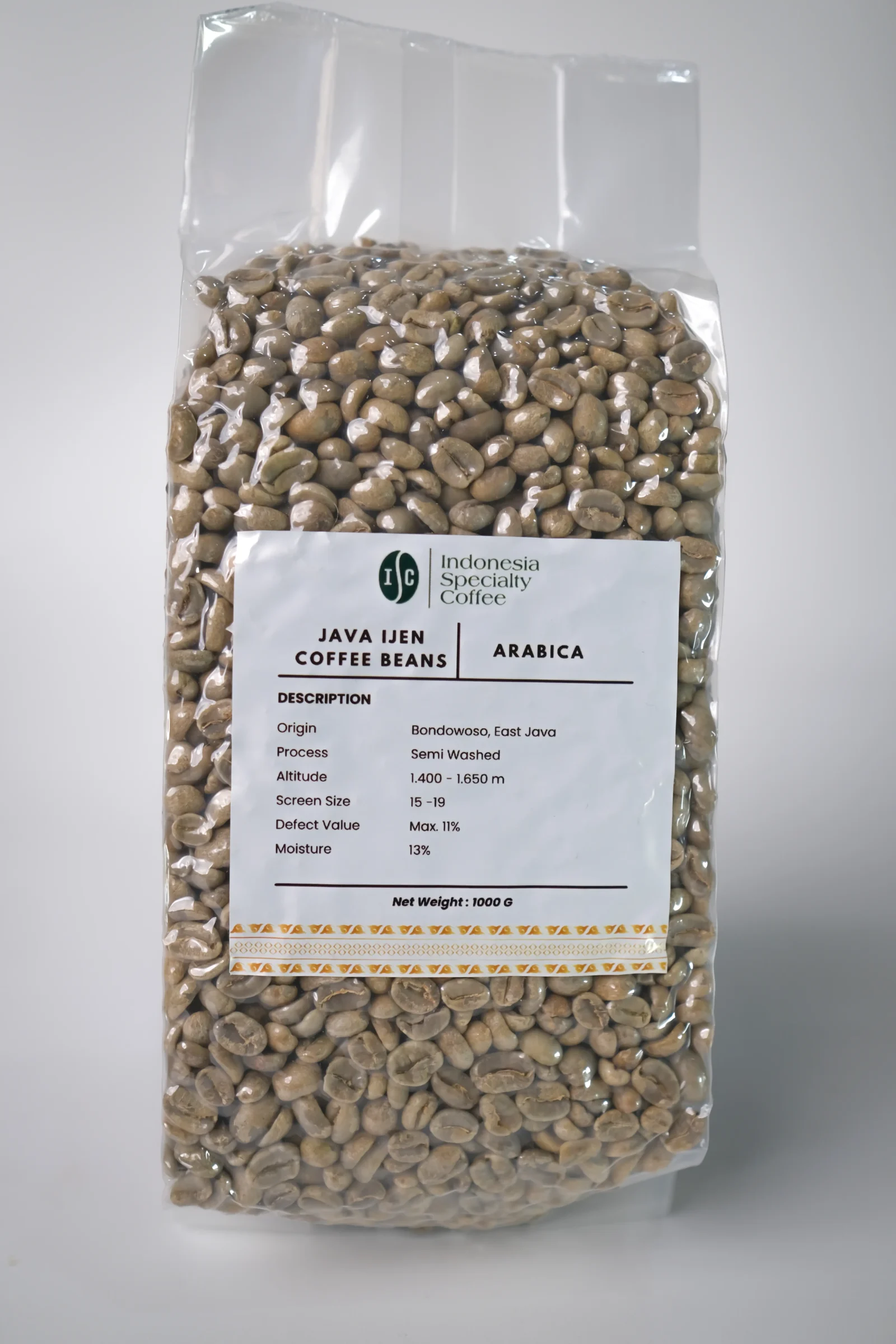
Qualifying lots from the Ijen Plateau are graded Grade 1 Specialty under SNI 01-2907-2008 and cup at 82+ SCA points. Indonesia Specialty Coffee sources Java Ijen directly from East Java and offers Grade 1 green beans to roasters and importers worldwide.
Growing Conditions: Ijen Plateau, Altitude, and Volcanic Soil
Java Ijen Arabica grows at 1,100 to 1,600 metres above sea level on the eastern slopes of the Ijen Plateau. The elevation generates consistent daily temperature swings that slow cherry maturation. Sugars accumulate gradually rather than quickly, which is why Ijen cups with more definition and clarity than lower-altitude Java lots.
The volcanic soil is basaltic and andesitic in composition, formed over centuries of eruption activity from the Ijen complex. Compare this to Sumatra’s Gayo Highlands, which sit on andisol soils that retain moisture and contribute to heavy body and earthiness. Ijen’s basaltic profile produces a cleaner, brighter cup with more pronounced top notes.
Harvest in East Java peaks in June and July, within a broader season from April through September. Cherries are hand-picked at full ripeness by smallholder and estate farm workers.
Java Ijen vs Java Preanger: How They Differ
Java Ijen and Java Preanger are both Arabica sub-origins from Java, but they come from opposite ends of the island and cup differently enough that choosing one over the other is a real roasting decision.
| Attribute | Java Ijen | Java Preanger |
|---|---|---|
| Region | Banyuwangi / Bondowoso, East Java | Garut / Bandung area, West Java |
| Altitude | 1,100–1,600 MASL | 1,200–2,000 MASL |
| Soil | Basaltic volcanic (Ijen complex) | Andisol / volcanic |
| Flavor | Dark chocolate, brown sugar, mild citrus, soft spice | Brighter acidity, stone fruit, floral |
| Body | Medium | Medium-light to medium |
| Processing | Full-washed, dry-hulled | Full-washed, dry-hulled |
For roast programs that call for a clean, chocolatey single-origin with a restrained acid profile, Ijen is typically the stronger match. Preanger suits roasters targeting brighter, more fruit-forward Java expressions.
Indonesia Specialty Coffee supplies both Java Ijen and Java Preanger as Grade 1 green beans. View current wholesale pricing on the ISC pricelist or contact our team to request samples of either origin.
Flavor Profile and Cupping Notes
Java Ijen Arabica cups differently from Sumatran origins, and that gap is wider than buyers sometimes expect. Without wet-hulling, there is no heavy earthiness, no dark loam, no funky complexity. What you get instead is a well-defined, repeatable profile that roasters working with clean single-origins find easy to position.
Typical cupping notes for Grade 1 Java Ijen:
- Dark chocolate and cocoa
- Brown sugar and mild caramel sweetness
- Mild citrus zest (orange or lemon peel)
- Light florals and soft herbal layers
- Soft woody spice on the finish
Body is medium, acidity is low to mild, and the finish is clean. Grade 1 lots cup at 82+ SCA points assessed against the SCA cupping protocol. Lots that exceed the SNI 01-2907-2008 Grade 1 defect value threshold are excluded from ISC’s export selection entirely.
Processing Methods: Full-Washed and Dry-Hulled
Java Ijen coffee is processed in two steps that together define its clean profile and separate it clearly from Indonesia’s wet-hulled origins.
Step 1 (Cherry Processing): Full-washed. Harvested cherries are pulped, fermented, and thoroughly washed to remove all mucilage before drying. This method removes the fermentation variables that natural or honey processing introduces, producing a consistent, clean base cup.
Step 2 (Hulling): Dry-hulled. After drying to approximately 12–13% moisture, the parchment is removed. Dry-hulling preserves bean density and produces the brightness and structure Java Ijen is known for.
This is the defining contrast with Sumatran origins such as Gayo and Mandheling, which use wet-hulled (Giling Basah) processing at 35–40% moisture. A roaster switching from a Sumatran wet-hulled lot to Java Ijen full-washed will notice the shift in the first few seconds of the cupping: less earthiness, lighter body, more citrus definition.
Frequently Asked Questions
What is Java Ijen coffee?
Java Ijen coffee is an Arabica specialty coffee grown on the volcanic Ijen Plateau in East Java, Indonesia, across the Banyuwangi and Bondowoso Regencies. It takes its name from the Kawah Ijen crater complex, known for its blue fire phenomenon and mineral-rich basaltic soil that contributes directly to the coffee’s clean, structured cup character.
What does Java Ijen coffee taste like?
Java Ijen is known for dark chocolate, brown sugar sweetness, mild citrus zest, and soft woody spice, with low acidity and a medium body. Full-washed and dry-hulled processing produces a clean, structured cup without the earthy heaviness of wet-hulled Sumatran origins. Grade 1 lots cup at 82+ SCA points under SCA protocol.
How is Java Ijen coffee different from Sumatra coffee?
The primary difference is processing. Java Ijen is full-washed and dry-hulled, producing a cleaner, brighter, more structured cup. Sumatran coffees such as Gayo and Mandheling are wet-hulled (Giling Basah), which creates heavier body and earthy, complex flavors. The two origins taste distinctly different even at the same roast development level.
Where can I buy Java Ijen green coffee beans wholesale?
Indonesia Specialty Coffee supplies Grade 1 Java Ijen Arabica green beans directly from East Java to international roasters and importers. Minimum order quantities start at 1 kg for cupping samples, 60 kg for microlots, and 350 kg for standard wholesale. Contact the ISC team at info@specialtycoffee.id or request a quote through the product page.
Order Java Ijen Coffee Beans from Indonesia Specialty Coffee
Indonesia Specialty Coffee is a direct exporter of Java Ijen Arabica green beans from East Java, shipping Grade 1, 82+ SCA lots FOB Belawan to roasters, importers, and distributors worldwide.
Current pricing: [confirm current Java Ijen FOB price with ISC pricelist before publishing]
MOQ tiers: 1 kg sample / 60 kg microlot / 350 kg wholesale / 9 MT+ container load.
View the Java Ijen product page and wholesale pricelist, or contact our team for a custom quote. Sample orders are welcome for new buyers.