
Java coffee beans are among the oldest commercially traded coffees in the world, and among the most frequently misread by wholesale buyers. Roasters sourcing Java coffee beans wholesale for the first time often assume Java processes like Sumatra: earthy, wet-hulled, heavy body. It does not.
Java Arabica is primarily full-washed and dry-hulled, producing a clean, bright cup that suits both single-origin espresso and filter programs. This guide covers Java’s two main growing zones (Ijen Plateau and Preanger), their flavor and cupping profiles, SNI grading requirements, current wholesale pricing, and how to order Grade 1 Specialty lots directly from Indonesia.
Last updated: May 2026
What Is Java Coffee? Origin and History
Java coffee cultivation began in 1699, when the Dutch VOC established the first commercial Arabica plantations in the Preanger highlands of West Java. Within decades, Java was Europe’s primary coffee supplier, and the island’s name passed into English as a synonym for coffee itself, a linguistic legacy that outlasted colonial trade by centuries.
In 1876, coffee leaf rust (Hemileia vastatrix) swept through Java’s Arabica Typica stock and destroyed the majority of cultivated trees. Robusta varieties, more disease-resistant and productive at lower altitudes, were introduced from 1900 onward to stabilise output. Today’s specialty Java Arabica comes from farms and estates above 1,100 metres, where altitude and volcanic soils provide the conditions that rust-resistant Robusta cannot replicate.
Java’s specialty output is smaller than Gayo or Mandheling, but its clean cup profile and estate-level traceability attract roasters building transparent single-origin programs.
Java Coffee Growing Regions: Ijen Plateau and Preanger

Specialty Indonesia Arabica coffee beans are concentrated in two geographically distinct zones on Java, each with different terroir, altitude, and flavor character.
East Java: Ijen Plateau
The Ijen Plateau sits in Bondowoso Regency, rising from 1,100 to 1,600 metres above sea level across volcanic soils fed by the active Ijen crater complex. Five historic estates dominate the plateau: Blawan, Jampit, Kayumas, Pancoer, and Tugosari, together covering more than 4,000 hectares. ISC sources Java Ijen lots from this zone. Cultivars include Typica, USDA, Kartika, and Line S, all well-adapted to Java’s high-altitude mineral soils.
West Java: Preanger
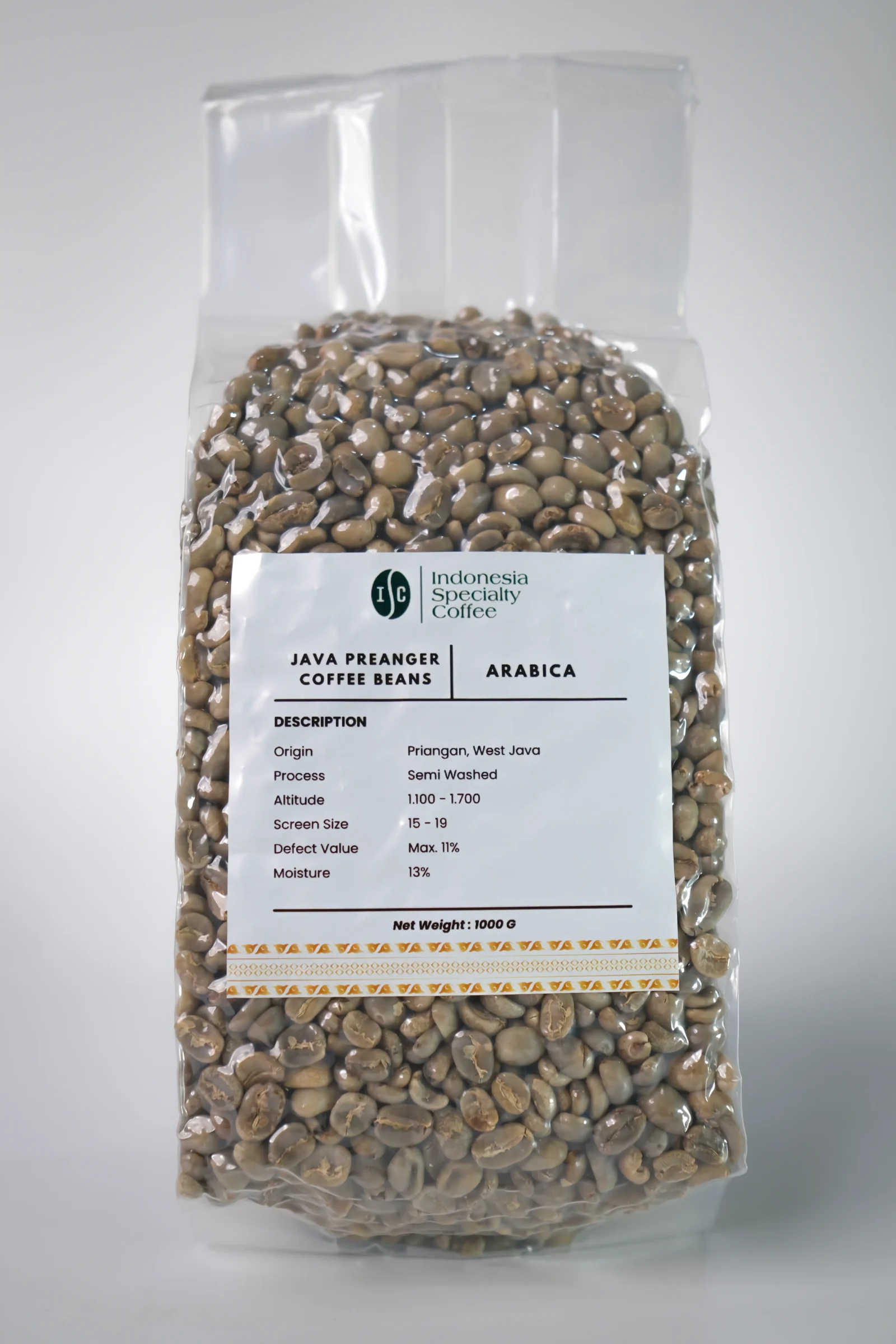
The Preanger highlands span Pangalengan, Ciwidey, and Malabar at 1,200–1,600 metres. Java Preanger Grade 1 holds Geographical Indication (GI) status: only coffee grown in the designated Preanger highland area qualifies for the name. ISC’s Java Preanger Grade 1 lots reflect that protected terroir.
| Feature | Java Ijen (East Java) | Java Preanger (West Java) |
|---|---|---|
| Altitude | 1,100–1,600m | 1,200–1,600m |
| Key zones | Blawan, Jampit, Kayumas, Pancoer | Pangalengan, Ciwidey, Malabar |
| Typical SCA score | 83–87 points | 85–87 points |
| GI protected | No | Yes |
| Primary process | Full-washed, dry-hulled | Full-washed / semi-washed, dry-hulled |
Java Coffee Flavor Profile and Cupping Notes
Java Ijen cups with brown spice, cocoa powder, and toasted nuts on the nose, a smooth tea-like body, soft citrus brightness, and a gentle herbal finish. Acidity is present and clean, not sharp. Roasters building single-origin espresso programs use it for its structural clarity and seasonal consistency. ISC’s Java Ijen Grade 1 lots cup at 83–87 SCA points, depending on sub-lot; Ijen Raung sub-lots reach 87+ SCA points in strong harvest years.
Java Preanger is fuller and more layered: dark chocolate, caramel, fresh florals, and a fine spice note, with a silky mouthfeel and medium-soft acidity. GI-protected terroir at Pangalengan and Malabar adds a complexity less common in estate-grown Ijen. ISC’s Preanger Grade 1 lots cup at 85–87 SCA points.
Both origins cup free of the fermented or musty character that can appear in wet-hulled Indonesian coffees. That cleanliness is a direct result of Java’s dry-hull processing.
Specialty roasters who want a recognisably Indonesian cup but with a brighter, cleaner structure than Gayo or Mandheling consistently reach for Java Ijen or Java Preanger as their sourcing anchor.
Java Coffee Processing: Full-Washed and Dry-Hulled
Understanding Java’s processing is the single most important thing a buyer can know before placing an order.
Step 1 — Cherry Processing: Java coffee is primarily full-washed (wet process): the cherry is pulped, fermented in water tanks for 24–36 hours to break down mucilage, then fully washed and dried on raised beds or patios. Some Java Preanger lots use semi-washed (Step 1 variation), retaining partial mucilage during drying to build body and sweetness. Both methods produce a clean, defect-low green bean at the parchment stage.
Step 2 — Hulling: After parchment coffee dries to approximately 12–13% moisture, the parchment layer is removed by dry-hulling, the same standard mechanical hulling used in Colombia, Ethiopia, and Central America.
Java is not Giling Basah (wet-hulled). Wet-hulling removes parchment at 35–40% moisture and defines Gayo, Mandheling, and most Sumatran origins. Buyers expecting Gayo’s earthy weight in a Java lot will be sourcing the wrong origin.
Ready to cup a Java sample? Contact ISC for Grade 1 Specialty Java Ijen or Java Preanger lots with full cupping documentation.
Java Coffee Grading: SNI Standards and What to Require
Indonesian green coffee exports are graded under SNI 01-2907-2008, Indonesia’s national grading standard. For Grade 1 Specialty Java, the specification requires:
- Defect value: ≤11 (primary defects: black beans, sour beans, foreign matter; secondary defects: broken beans, shells, husks)
- SCA cupping score: 82+ points assessed against the SCA cupping protocol (ISC ships only 82–88 SCA Grade 1 Specialty)
- Moisture content: ≤12.5%
- Screen size: 16–18
- Triage (waste): ≤5%
Grade 2 Commercial Java carries a defect value of ≤25 and SCA 79–81. ISC does not ship below Grade 1 Specialty.
Before committing to a pallet or container, always request the pre-shipment cupping sheet from your supplier: defect count, moisture reading, and screen size should all appear in writing. If they cannot provide this documentation, the lot is not specialty grade in practice, regardless of what the label says.
Java Coffee Beans Wholesale Price 2026
Java Arabica wholesale pricing reflects three variables: origin zone, processing method, and order volume. The table below shows ISC’s current Grade 1 Specialty price range, FOB Belawan.
| Origin | Step 1 Process | Step 2 Hulling | Grade | FOB Price (per MT) |
|---|---|---|---|---|
| Java Ijen | Full-washed | Dry-hulled | Grade 1 Specialty | $9,500 |
| Java Preanger | Full-washed / semi-washed | Dry-hulled | Grade 1 Specialty | $9,500 |
CIF to Rotterdam or Los Angeles adds approximately $0.65–$0.85/kg above FOB (freight and insurance). Confirm exact freight costs with ISC at the time of order.
ISC’s four-volume tiers:
- 1 kg — sample/cupping evaluation
- 60 kg — microlot rate
- 350 kg — standard wholesale rate
- 9 MT+ — container load, custom per-MT quote
The 350 kg tier delivers the best per-kg wholesale rate before container pricing applies. Java’s main harvest runs April–August; FOB-ready lots ship June–October. Buyers planning a new-season order should factor sourcing lead time of 4–8 weeks from contract to FOB-ready.
View the full ISC pricelist for current per-kg rates across all origins and processing methods.
Frequently Asked Questions
What is Java coffee?
Java coffee is Arabica coffee grown on the island of Java, Indonesia, primarily on the Ijen Plateau in East Java and in the Preanger highlands of West Java. It is one of the world’s oldest commercially traded coffees, with Dutch colonial cultivation dating to 1699. The island’s prominence in early European coffee supply made “java” a common English-language synonym for coffee.
Where does Java coffee come from?
Specialty Java Arabica comes from two main zones: the Ijen Plateau in Bondowoso, East Java (estates Blawan, Jampit, Kayumas, Pancoer, and Tugosari at 1,100–1,600m), and the Preanger highlands in West Java (Pangalengan, Ciwidey, Malabar at 1,200–1,600m). Java Preanger holds Geographical Indication (GI) status, meaning only coffee from the designated highland area may carry that origin name.
Is Java coffee washed or wet-hulled (Giling Basah)?
Java coffee is full-washed and dry-hulled, not wet-hulled. Giling Basah removes parchment at 35–40% moisture and defines Gayo, Mandheling, and most Sumatran origins. Java parchment dries to 12–13% moisture before hulling, producing a cleaner, brighter cup with less earthy character than Giling Basah coffees. This is the most common sourcing misunderstanding buyers bring to their first Java order.
What is the difference between Java and Sumatra coffee?
Java Arabica is full-washed and dry-hulled: clean cup, bright acidity, medium body, notes of cocoa, spice, and nuts. Sumatra (Gayo, Mandheling, Lintong) is typically semi-washed or full-washed and then wet-hulled (Giling Basah), producing heavier body, lower acidity, and earthy, cedar, dark chocolate character. Both are Grade 1 Specialty Indonesian origins but require different roast profiles and suit different brewing applications.
How much does Java coffee cost wholesale?
ISC’s Java Ijen Grade 1 Specialty is priced at $9,500/MT FOB Belawan for standard wholesale volumes (350 kg+). Java Preanger Grade 1 pricing is available on request. CIF adds approximately $0.65–$0.85/kg to Rotterdam or Los Angeles. Sample lots start at 1 kg; microlot pricing applies from 60 kg.
Order Java Coffee Beans from Indonesia Specialty Coffee
Indonesia Specialty Coffee is a direct exporter of Java Arabica green coffee beans, sourcing Grade 1 Specialty lots from the Ijen Plateau (East Java) and the Preanger highlands (West Java). Every lot we ship is Q-grader cupped before release and documented to 82–88 SCA under SNI 01-2907-2008.
We supply specialty roasters, importers, and distributors worldwide across four order tiers: 1 kg sample, 60 kg microlot, 350 kg wholesale, and 9 MT+ container loads. All Java lots are Halal certified. Organic certification is available on request. Free worldwide shipping applies to bulk orders.
View current pricing at the ISC pricelist or contact our team for a custom wholesale quote. Sample orders are open to new buyers evaluating Java Arabica for the first time.


