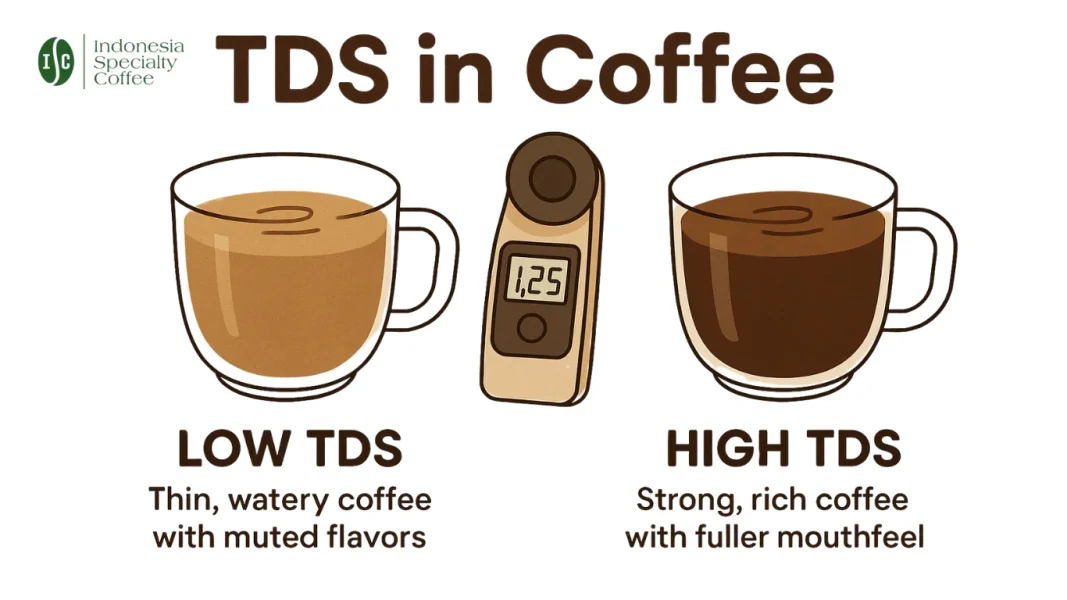
TDS in coffee, short for total dissolved solids, is the percentage of a brew’s mass made up of dissolved coffee compounds. TDS is how you put a number on strength: a filter coffee at 1.30% TDS holds 1.30 g of dissolved coffee per 100 g of liquid.
This guide gives you reference ranges by brew method, the extraction yield formula, a six-step measuring routine, and how we use TDS when cupping Indonesian green coffee samples.
Last updated: 10 September 2026
What Is TDS in Coffee?
TDS in coffee measures how concentrated dissolved coffee solids are in your cup: organic acids, chlorogenic acids, sugars, and caffeine that hot water pulls from the grounds. A coffee refractometer reports TDS as a percentage by mass: 1.15 to 1.55% for filter coffee across the SCA and ECBC standards, and 8 to 12% for espresso.
Coffee TDS and water TDS use different scales. Brewed coffee is expressed in percent and brewing water in ppm (mg/L), where 1% equals 10,000 ppm.
Strength is not extraction either. Roasted coffee is only about 30% soluble, and extraction yield tells you how much of that material you dissolved. A cup can be weak but over-extracted, or strong but under-extracted.
TDS vs Extraction Yield: The Formula and a Worked Example
Extraction yield converts a TDS reading into the share of your dry coffee dose that dissolved. You need three numbers: TDS, dose, and liquid mass.
- Percolation brews (pour-over, batch brew, espresso): EY % = beverage mass × TDS % ÷ dose
- Full-immersion brews (French press, cupping): EY % = water mass × TDS % ÷ dose
On a V60, you brew 15 g of coffee with 250 g of water, collect 213 g of beverage, and read 1.35% TDS. The cup holds 2.88 g of dissolved coffee, and 2.88 ÷ 15 = 19.2% extraction yield, inside the 18 to 22% range. The same brew at 1.10% TDS works out to 15.6%: under-extracted.
Under-extracted cups taste sour and vegetal; above 22%, cups turn bitter and drying. When the numbers drift, adjust grind and brew ratio before you blame the beans.
Ideal Coffee TDS Ranges by Brew Method
Ideal coffee TDS depends on each brew method’s coffee-to-water ratio. Filter coffee has two published standards; the rest are working ranges.
| Brew method | TDS range | Basis |
|---|---|---|
| Filter coffee | 1.15 to 1.35% | SCA Golden Cup Standard |
| Filter coffee | 1.30 to 1.55% | ECBC brewer certification |
| Cupping bowl | 1.2 to 1.4% | Working range |
| French press | 1.4 to 1.7% | Working range |
| Cold brew, ready to drink | 1.4 to 1.6% | Working range |
| Moka pot | 3 to 5% | Working range |
| Espresso | 8 to 12% | Working range |
Both filter standards share an 18 to 22% extraction window. The European Coffee Brewing Centre certification standard sits higher, reflecting European surveys that favor stronger filter coffee than US panels.
Neither range is pass-or-fail. The UC Davis Coffee Center’s 2023 Brewing Control Chart study found sweetness peaks at low strength and low extraction, while bitterness climbs when both run high. Brew to the profile your customers buy.
Building a filter program around Indonesian origins? Request a sample with Q-grader cupping notes and test it against these ranges first.
How to Measure Coffee TDS Accurately
Accurate coffee TDS readings depend more on sample handling than on the instrument. Use a coffee-calibrated refractometer, such as a VST, Atago PAL-COFFEE (BX/TDS), or DiFluid R2 Extract, with one fixed routine:
- Zero the refractometer with distilled water at your sample’s temperature.
- Stir the whole brew before sampling; stratified coffee reads unevenly.
- Filter espresso and immersion brews through a syringe filter.
- Cover the sample as it cools to room temperature; evaporation inflates readings.
- Read three times and record the average.
- Log dose, water, and beverage mass for extraction yield.
Why a Water TDS Pen Cannot Measure Coffee
A TDS pen reads electrical conductivity, which tracks dissolved minerals but misses sugars, lipids, and other nonionic coffee solids. A refractometer reads how light bends through the sample, which both ionic and nonionic solids change.
| Brewing water | Brewed coffee | |
|---|---|---|
| Dissolved material | Minerals such as calcium and magnesium | Coffee solubles |
| Unit | mg/L (ppm) | % by mass |
| Instrument | Conductivity TDS meter | Coffee refractometer |
| Target | 150 mg/L, acceptable 75 to 250 (SCA) | 1.15 to 1.35% for filter (SCA) |
Water at 150 ppm is just 0.015% on the coffee scale, so never compare the two readings.
Using TDS to Evaluate Indonesian Green Coffee Samples
When you evaluate green coffee samples side by side, TDS confirms every bowl matches in strength before you score origin or processing. In a full-immersion brew like cupping, UC Davis equilibrium extraction research shows strength follows the coffee-to-water ratio while extraction holds near 21%. At the SCA ratio of 8.25 g per 150 ml, a 0.5 g overdose lifts TDS about 6%.
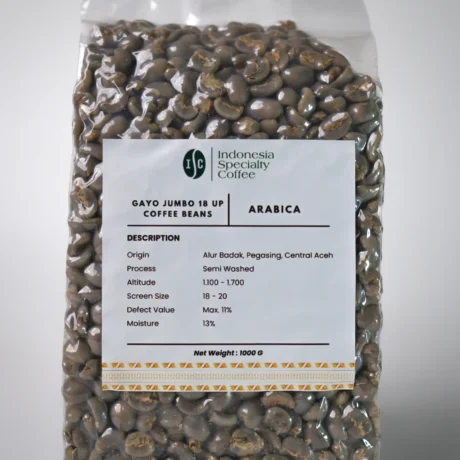
A 6% gap can distort the body difference between a semi-washed, wet-hulled (Giling Basah) Gayo Arabica lot from our Aceh Tengah and Bener Meriah partner farms and a full-washed, dry-hulled Bali Kintamani lot. Part of what you score as body would then come from the scoop, not the origin. In our B2B cupping sessions, we measure TDS with a refractometer so strength gaps never get scored as origin differences.
If an arrival sample tastes flatter than its pre-shipment sample, read TDS on both before you blame the shipment.
Frequently Asked Questions
What is a good TDS for coffee?
For filter coffee, the SCA Golden Cup range is 1.15 to 1.35% TDS, and the European Coffee Brewing Centre certifies brewers at 1.30 to 1.55%. Espresso runs far stronger at 8 to 12%. Use these ranges as starting targets, then dial in by cupping.
How do you calculate extraction yield from TDS?
Multiply beverage mass by TDS, then divide by the dry coffee dose. A 15 g pour-over yielding 213 g at 1.35% TDS extracts 19.2%. For full-immersion brews such as French press or cupping, use water mass instead of beverage mass in the same formula.
Can you use a TDS meter to measure coffee?
No. A standard TDS meter reads electrical conductivity, which detects dissolved minerals but misses sugars, lipids, and other nonionic coffee solids. Use a coffee-calibrated refractometer for brewed coffee, and keep the conductivity meter for checking your brewing water, the job it was built for.
What TDS should brewing water have for coffee?
The SCA water standard targets 150 mg/L TDS, within an acceptable range of 75 to 250 mg/L. Water below that range brews thin, hollow cups, while water above it mutes flavor and tends to scale equipment. Measure water TDS in ppm with a conductivity meter.
What TDS should espresso have?
Espresso typically reads 8 to 12% TDS. A 1:2 shot, such as 18 g of coffee yielding 36 g, lands near 9 to 11% when extraction falls between 18 and 22%. Run the sample through a syringe filter, because undissolved fines and oils skew the reading.
How do you increase TDS in coffee?
Use more coffee for the same amount of water, the most direct lever. In pour-over and espresso, a finer grind also raises TDS by increasing extraction, while in immersion brews the coffee-to-water ratio does most of the work. Recheck extraction yield after each change.
Order Indonesian Green Coffee Samples from Indonesia Specialty Coffee
Indonesia Specialty Coffee exports Grade 1 Specialty green coffee cupping at 82 to 88 SCA points, graded to SNI 01-2907-2008. New buyers can request a 350 g sample for a USD 100 deposit credited to their first contract; KYC-verified buyers sample free.
Cup the sample, check its TDS, then order a 60 kg microlot, 350 kg wholesale lot, or container from 9 MT, shipped FOB Belawan. See our wholesale pricelist or contact our team for a quote.