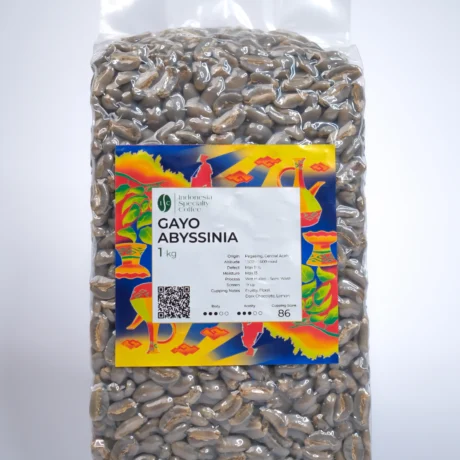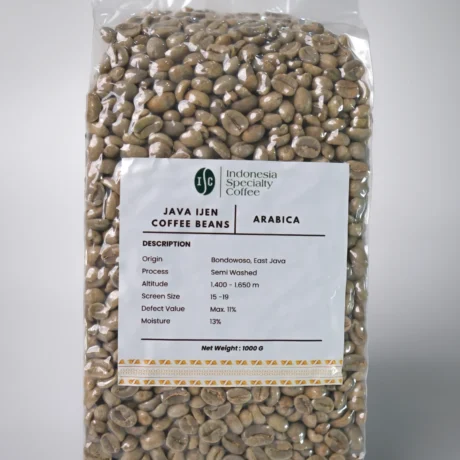

When a Japanese importer opens a bag of Indonesian green coffee, they are trusting a promise: that the beans inside are clean, safe, and legal to sell in one of the strictest food-safety markets in the world. The “ISOPROCARB certificate” is the piece of paper that turns that trust into evidence.
If you buy green coffee that is destined for Japan, this is the document you want to see before the container leaves origin. Here is what it actually tests, how long it takes, what the limits are, and a few myths worth clearing up.
What the “ISOPROCARB Test” Really Is
“ISOPROCARB test” is the name the trade has attached to it, but the certificate is really a pesticide-residue analysis run against Japan’s Positive List System for agricultural chemicals in food. Japan’s Ministry of Health, Labour and Welfare (MHLW) introduced this system on 29 May 2006, and it governs every food product entering the country.
For Indonesian green coffee, two residues sit at the center of attention, and a proper certificate reports both:
- Isoprocarb (MIPC) — a carbamate insecticide commonly used to control pests on coffee plants. This is the residue that has repeatedly caused Indonesian lots to be flagged at Japanese ports, which is why the whole test is now nicknamed after it.
- 2,4-Dichlorophenoxyacetic acid (2,4-D) — a herbicide used to control weeds. Its residues are monitored for the same reason: they can pose health risks above permitted levels.
So although people say “the ISOPROCARB test,” a compliant report actually screens for isoprocarb and 2,4-D together, because both are the residues Japan is most likely to reject Indonesian coffee over.
The Numbers That Matter: Tolerance Limits
Japan does not set a special, generous limit for coffee. Where no crop-specific limit exists, the uniform (default) limit of 0.01 ppm applies, and that is exactly what governs isoprocarb and 2,4-D in coffee beans. On a lab report, this is written as 0.010 mg/kg, which is the same thing as 0.01 ppm.
This is a deliberately strict threshold, far tighter than many other markets accept. In practical terms, it means the residue must be effectively absent.
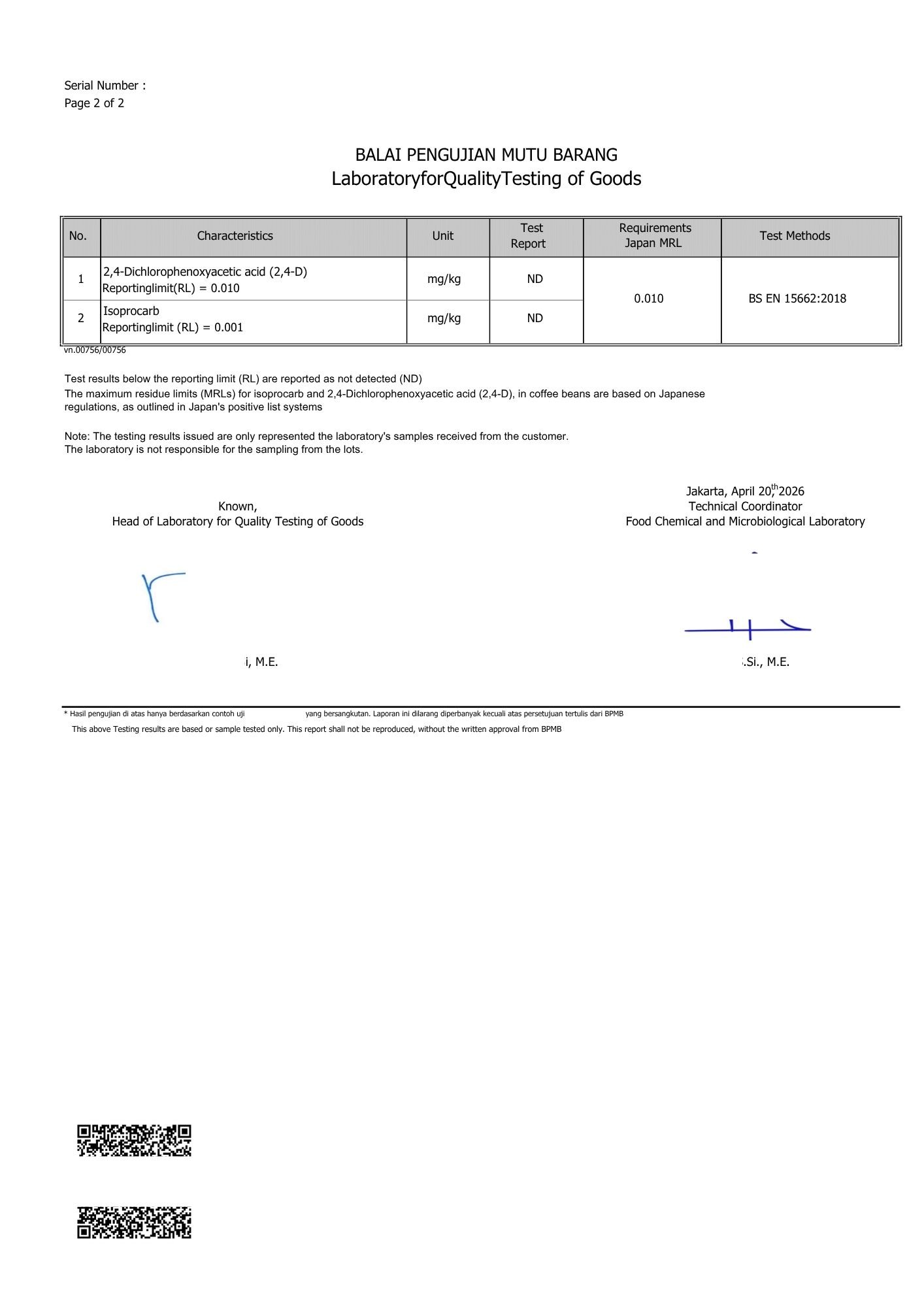
For example, on the certificate, the results read:
| Characteristic | Japan MRL | Reporting limit | Result |
|---|---|---|---|
| 2,4-D | 0.010 mg/kg | 0.010 mg/kg | ND (not detected) |
| Isoprocarb | 0.010 mg/kg | 0.001 mg/kg | ND (not detected) |
“ND” (not detected) is the outcome every buyer wants. It means the residue was below the laboratory’s reporting limit for isoprocarb, below 0.001 mg/kg, which is ten times more sensitive than the limit itself. In other words, the lab looked far harder than the rule requires and still found nothing.
The analytical method noted on the certificate is BS EN 15662:2018 — the internationally recognized QuEChERS extraction method, read on LC-MS/MS or GC-MS/MS instruments. It is the standard Japan-recognized laboratories use for this screen.
How Long the Test Takes
Two clocks matter here, and buyers should not confuse them.
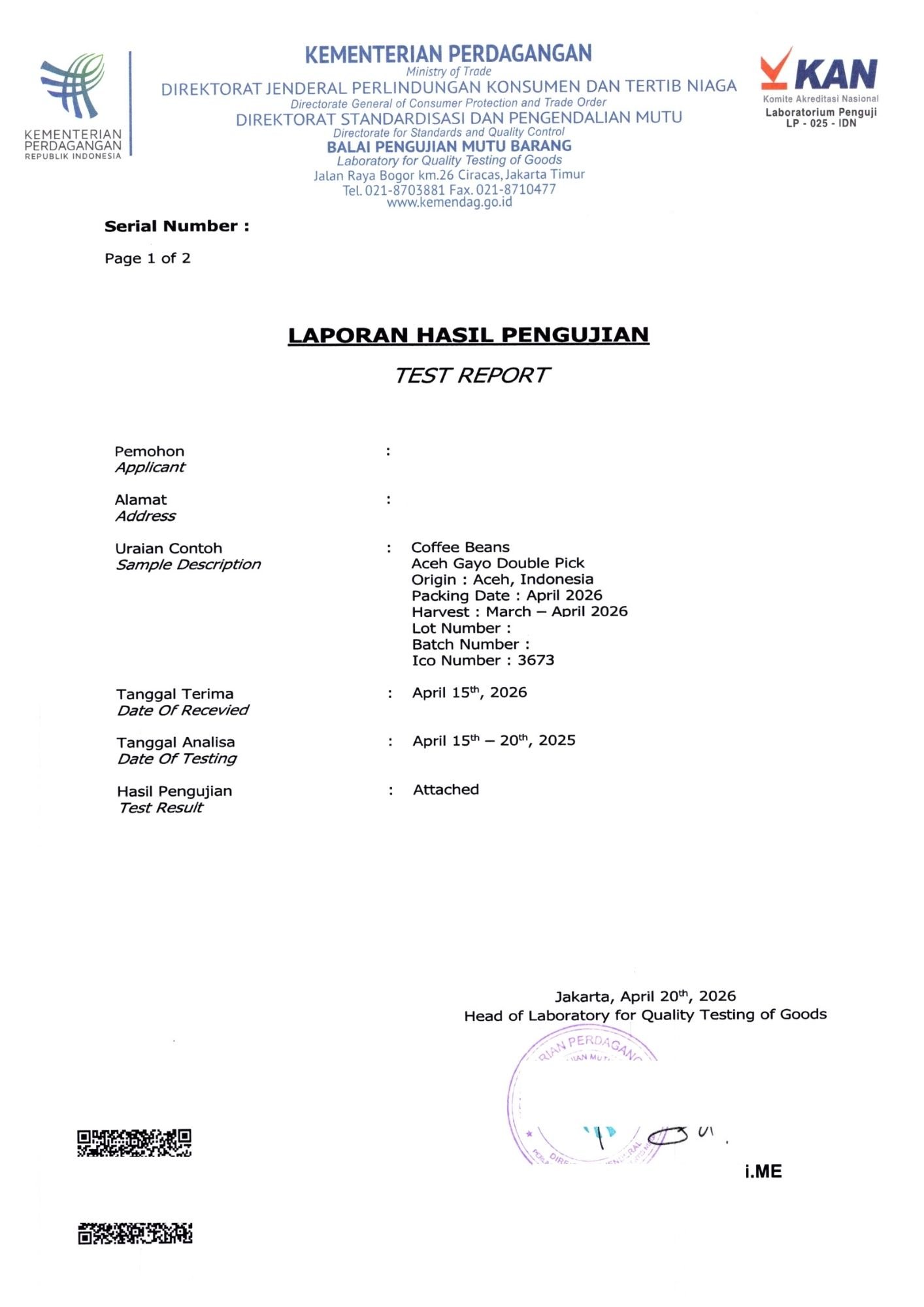
The laboratory turnaround is short. For our case as an example, the sample was received by Balai Pengujian Mutu Barang (Laboratory for Quality Testing of Goods) on 15 April, and testing ran 15–20 April, roughly five working days from sample-in to report. As a rule of thumb, plan for about 5 to 7 working days in the lab once the sample arrives, depending on the laboratory’s queue.
The total lead time is longer, because it includes drawing a representative sample from the lot, couriering it to the lab, the testing itself, and issuing the signed report. From “decision to test” to “certificate in hand,” a week to two weeks is realistic.
On cost: We got charged a price of around IDR 1.3 million per sample for the isoprocarb/2,4-D screen at an accredited Indonesian laboratory. Prices vary by lab and by how many analytes are bundled, so treat this as a working figure rather than a fixed rate.
Who Can Issue a Valid Certificate
Not every lab result will satisfy a Japanese buyer or Japanese customs. The test should be run by a laboratory recognized by Japan’s MHLW or an accredited testing body whose results Japan accepts. In Indonesia, these include government and KAN-accredited laboratories; the sample certificate here was issued by the Balai Pengujian Mutu Barang (Laboratory for Quality Testing of Goods) under the Ministry of Trade, accredited by the Komite Akreditasi Nasional (KAN, LP-025-IDN). Private MHLW-listed laboratories such as SIG (Saraswanti Indo Genentech, listed since March 2023) are also widely used.
The takeaway for a buyer: check that the issuing lab is accredited and, ideally, MHLW-recognized. A result from an unrecognized lab may not clear inspection.
“Even a 1 kg Sample Needs This Test” — Is That True?
Largely, yes. Any green coffee physically entering Japan, including small samples sent for cupping, grading, or buyer evaluation, is treated as an import under Japan’s Food Sanitation Act and is subject to the same Positive List rules. A sample is not automatically exempt just because it is only one kilogram.
In practice this means: if you ship a 1 kg pre-shipment sample to a Japanese roaster and it is found to carry isoprocarb above 0.01 ppm, that finding can taint the buyer’s confidence in the whole lot and, in some cases, trigger tighter inspection on the commercial shipment that follows. The safe habit is to have the lot tested before any sample or container leaves origin, so the sample and the bulk both carry the same clean story.
The Fumigation Question — Handle With Care
There is a common piece of advice circulating among exporters: “Don’t fumigate a lot that has passed the ISOPROCARB test.” It is worth being precise here, because the reasoning is partly right and partly a myth.
The myth: Standard coffee fumigants, phosphine (aluminium phosphide) and methyl bromide, are not isoprocarb. Fumigating with them does not add isoprocarb to the beans, so fumigation does not “directly contradict” or invalidate an isoprocarb result on its own.
The valid concern: Even so, the practical rule to avoid post-test treatment is sound, for two real reasons:
- Methyl bromide leaves its own residue. Methyl bromide fumigation deposits inorganic bromide in the beans, and bromide is a residue Japan also monitors under the Positive List. So fumigation can create a different compliance problem even when isoprocarb is clean.
- Any chemical treatment after testing breaks the chain of evidence. A certificate only speaks for the sample as it was on the test date. If you fumigate, re-spray, or otherwise treat a lot after it has been tested and certified, you have changed the product, and the clean certificate no longer reliably represents what is in the bag.
So the accurate version of the advice is: test the lot as close to shipment as possible, and do not apply any chemical treatment — fumigation included — after the certificate is issued. Not because phosphine becomes isoprocarb, but because post-test treatment can introduce new monitored residues and void the assurance the certificate was meant to provide. If a lot genuinely needs pest control, do it before sampling, then test — never the other way around.
What This Means for a Buyer
For an importer, the ISOPROCARB certificate is a short document that answers a big question: will this coffee clear Japanese inspection, or will it be stopped, destroyed, or shipped back at someone’s expense?
A certificate you can rely on shows four things at a glance: both isoprocarb and 2,4-D screened, both at or below the 0.01 ppm uniform limit, both reported ND, and an accredited, MHLW-recognized laboratory on the letterhead, with the report dated close to the shipment. When those four line up, the promise in the bag is backed by evidence.
Sources: Japan MHLW Positive List System for Agricultural Chemical Residues in Food; SIG Laboratory, “Ensuring the Quality of Indonesian Coffee for the Japanese Market”; and the attached Balai Pengujian Mutu Barang test reports (Serial No. 0846.A / 0847.A / 0848.A). The IDR 1.3 million cost and 5-working-day turnaround reflect exporter-reported figures and the attached certificate; confirm current pricing with your chosen laboratory.