
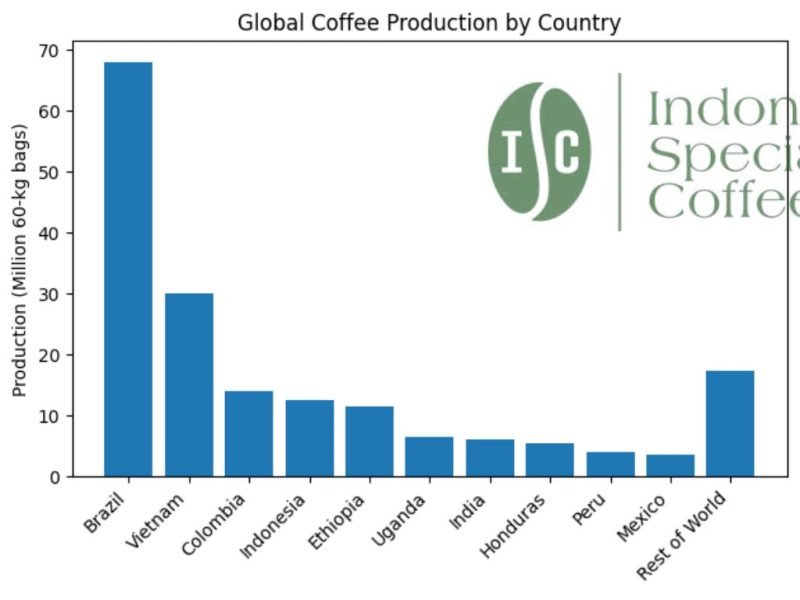
Global coffee production hit a forecast record of 178.8 million 60-kg bags in the 2025/26 crop year, according to the USDA Foreign Agricultural Service 2025/26 forecast. Ten countries supply the overwhelming majority of that volume. What those production numbers don’t tell you is which countries are worth sourcing from at specialty grade, which are primarily commercial-volume origins, and where Indonesia fits in the picture as one of the most diverse producing nations in the world. This article covers all ten: current volumes, processing traditions, cup profiles, and what each origin means for buyers making green coffee purchasing decisions in 2026.
Last updated: April 2026
The Top 10 Coffee Producing Countries (2026)
Production figures below are drawn from the USDA FAS 2025/26 crop year forecast and ICO trade data. Specialty relevance reflects current SCA-certified trade volume, not just production capacity.
| Rank | Country | Est. Production (60-kg bags) | Primary Type | Specialty Relevance |
|---|---|---|---|---|
| 1 | Brazil | ~63 million | Arabica + Robusta | High — Bourbon, Yellow Catuai, natural-process lots |
| 2 | Vietnam | ~30.8 million | Robusta | Growing — specialty Robusta development in Da Lat |
| 3 | Colombia | ~13.5 million | Arabica | Very High — washed single-origin, SCA-certified lots |
| 4 | Indonesia | ~10 million | Arabica + Robusta | Very High — Gayo, Sumatra, Bali, Java specialty grades |
| 5 | Ethiopia | ~9 million | Arabica | Very High — heirloom varieties, top SCA scores globally |
| 6 | Uganda | ~6.5 million | Robusta | Moderate — commercial Robusta dominant; Arabica rising |
| 7 | India | ~6 million | Arabica + Robusta | Moderate — Monsooned Malabar, Karnataka shade-grown |
| 8 | Honduras | ~5.5 million | Arabica | High — high-altitude Central American specialty Arabica |
| 9 | Peru | ~4 million | Arabica | High — organic certified, growing specialty market share |
| 10 | Mexico | ~3.5 million | Arabica | High — organic & fair trade certified |
1. Brazil
Brazil produces approximately 63 million 60-kg bags per year, around 35% of global coffee supply. It is the only country in the top 10 that produces significant commercial volumes of both Arabica and Robusta: Arabica accounts for roughly 60% of output, Robusta 40%. In 2025/26, Arabica output declined due to drought and high temperatures across Minas Gerais and São Paulo, while Robusta reached a record 25 million bags from Espírito Santo. For specialty buyers, the relevant lots come from Minas Gerais and Sul de Minas: Yellow Catuai and Bourbon varieties processed natural or pulped natural, with SCA scores reaching 85+ points on well-selected microlots. Brazil’s commercial-grade natural-process beans are also the primary base for Italian-style espresso blends globally.
Flavor profile:
- Chocolate, hazelnut, caramel, subtle dried fruit on natural lots
- Low to medium acidity, full body, clean finish on washed lots
2. Vietnam
Vietnam produces approximately 30.8 million 60-kg bags and is the world’s dominant Robusta supplier, accounting for roughly 40% of global Robusta output. Production is concentrated in the Central Highlands, Dak Lak, Gia Lai, and Lam Dong provinces, where yields are high and growing costs are low. This makes Vietnamese Robusta the price anchor for instant coffee and commercial espresso blends worldwide.
The specialty angle is narrow but real. The Da Lat plateau, at 1,500 metres above sea level, produces washed and honey-processed Arabica and high-quality Robusta lots with cup scores in the low to mid-80s. Volume is limited. For most specialty buyers, Vietnam is a blend-component origin rather than a single-origin program origin.
Flavor profile (Vietnamese Robusta):
- Dark chocolate, rubber, woody, slightly bitter
- Very high body, low acidity; strong performance in milk-based drinks
3. Colombia
Colombia produces approximately 13.5 million 60-kg bags, exclusively washed Arabica, grown at 1,200–2,000 metres above sea level across the Andes. The Colombian Coffee Growers Federation (FNC) enforces mandatory export quality standards, meaning the floor for Colombian green beans entering international trade is meaningfully higher than most origins. Nariño, Huila, and Antioquia regularly produce lots scoring 85-90 SCA points. Colombia operates two harvesting cycles per year in many regions, which gives buyers more order flexibility than single-harvest origins. It is the benchmark washed Arabica for roasters building year-round, traceable programs.
Flavor profile:
- Bright red fruit, citrus, stone fruit
- Balanced sweetness, medium body, clean transparent cup
4. Indonesia
Indonesia produces approximately 10 million 60-kg bags and holds a position in the global top five that no other Southeast Asian origin comes close to matching at specialty grade. Five regional Arabicas: Gayo Arabica green coffee beans (Aceh), Sumatra Mandheling (North Sumatra), Bali Kintamani, Java Arabica, and Flores Bajawa. Each produces lots graded to SNI 01-2907-2008 and cupped against SCA protocol, regularly achieving 85-88 points and above.
The dominant processing method is Giling Basah (wet-hulling), unique to Sumatra, which produces the low-acid, full-bodied, earthy character that distinguishes Indonesian Arabica from every other origin in this list. For a regional breakdown of all Indonesian growing areas, see ISC’s guide to Indonesia’s top coffee producing regions. See the buyer breakdown below for sourcing specifics.
Flavor profile (Gayo Arabica):
- Full body, low acidity, long clean finish
- Dark chocolate, cedar, herbs, dried tobacco
5. Ethiopia
Ethiopia produces approximately 9 million 60-kg bags and is the genetic origin of Arabica coffee as a species. Wild and semi-forest coffee still grows in the Kaffa region, where Coffea arabica was first identified, and the genetic diversity of Ethiopian heirloom varieties produces cup complexity that cultivated selections cannot replicate. Yirgacheffe, Sidama, and Guji are the three names specialty buyers know best. Natural-process Yirgacheffe regularly achieves 86-92 SCA points. If you are building an ultra-premium single-origin program and Ethiopia is not in the lineup, the program is incomplete.
Flavor profile:
- Jasmine, bergamot, blueberry, tropical fruit, peach
- Bright complex acidity, light to medium body, long floral finish
6. Uganda
Uganda produces approximately 6.5 million 60-kg bags, predominantly Robusta from regions around Lake Victoria, Masaka, and Kasese. Ugandan Robusta is a significant component in European commercial espresso blends. The specialty segment is concentrated on Mount Elgon’s western slopes, the Bugisu region, where washed Arabica grows at 1,500–2,200 metres above sea level and produces lots scoring in the mid-80s SCA range. The Uganda Coffee Development Authority (UCDA) reported meaningful investment in washing stations and post-harvest training in the 2024/25 cycle. Volume at specialty grade remains limited; Uganda is a niche but genuine specialty Arabica source for buyers who know where to look.
Flavor profile (Bugisu Arabica):
- Red fruit, cocoa, light spice, blackcurrant
- Moderate acidity, medium body
7. India
India produces approximately 6 million 60-kg bags across Karnataka (the largest growing state), Kerala, and Tamil Nadu. The split is roughly 35% Arabica and 65% Robusta, grown under shade canopy rather than full sun, a practice that slows bean development and moderates caffeine accumulation. Monsooned Malabar is India’s most distinctive processed product: green beans are exposed to monsoon humidity for several weeks, stripping acidity and creating a heavy, earthy, low-acid cup that divides specialty buyers but has a loyal customer base among espresso blenders. Karnataka shade-grown Arabica is the cleaner entry point for specialty programs.
Flavor profile (Karnataka Arabica):
- Spice, dark chocolate, earth, mild fruit
- Low acidity, heavy body, long finish
8. Honduras
Honduras produces approximately 5.5 million 60-kg bags of washed Arabica, making it the largest coffee producer in Central America. Growing regions: Copán, Marcala, Montecillos, Agalta, El Paraíso, and Comayagua sit at 1,000–1,800 metres above sea level. Honduras is a buyer’s market in the best sense: consistent altitude-grown Arabica at FOB prices that remain competitive relative to Colombia or Mexico, with SCA scores regularly reaching 84-87 points on well-selected lots. The Honduran Coffee Institute (IHCAFE) has prioritised traceability and certification in recent years. Roasters building value-tier specialty programs should be sourcing Honduras.
Flavor profile:
- Peach, citrus, caramel, light chocolate
- Bright acidity, medium body, clean finish
9. Peru
Peru produces approximately 4 million 60-kg bags of washed Arabica from the regions of Junín, Cajamarca, and San Martín. Peru’s main commercial value for specialty buyers is its certification credentials: a high proportion of Peruvian coffee carries both Organic certified and Fairtrade certified status, which makes it the default origin for roasters building certified-only supply chains. Cup scores typically fall in the 83-86 point range; standout microlots from Cajamarca’s high-altitude plots reach higher. Infrastructure and logistics are improving, and direct-trade relationships are more accessible here than in more commercially saturated origins.
Flavor profile:
- Floral brightness, citrus, light chocolate, honey
- Moderate acidity, light-medium body
10. Mexico
Mexico produces approximately 3.5–4 million 60-kg bags of washed Arabica annually, primarily from the southern states of Chiapas, Oaxaca, and Veracruz. Chiapas accounts for the largest share, with growing areas at 900–1,800 metres above sea level producing the most consistent specialty lots. Mexico is a significant source of Organic certified and Fairtrade certified coffee, with a large smallholder farming base that has attracted direct-trade investment from North American and European roasters. SCA scores on well-selected Chiapas and Oaxaca lots typically reach 83–86 points. Cup quality is reliable rather than exceptional. Mexico suits roasters who need a certified, traceable, mid-tier Arabica that works across multiple brew formats without dominating a blend.
Flavor profile:
- Milk chocolate, almond, light citrus, mild caramel
- Low to medium acidity, medium body, clean finish
Which Countries Produce Specialty-Grade Coffee?
Specialty grade requires an SCA cupping score of 80 points or above, with no primary defects and no more than five full defects per 350-gram sample. The SCA cupping protocol defines grading criteria, and under SNI 01-2907-2008 — Indonesia’s national grading standard — the equivalent threshold is Grade 1, with moisture content between 11–13% and screen size of 15 or above for Arabica.
Of the top 10 producing countries, six consistently supply traceable specialty-grade Arabica at commercial volume:
| Country | Primary Specialty Origins | Typical SCA Range |
|---|---|---|
| Ethiopia | Yirgacheffe, Sidama, Guji | 86–92 |
| Colombia | Nariño, Huila, Antioquia | 85–90 |
| Mexico | Chiapas and Oaxaca | 83–86 |
| Indonesia | Gayo (Aceh), Bali Kintamani, Java | 85–88 |
| Honduras | Copán, Marcala, Montecillos | 84–87 |
| Peru | Cajamarca, Junín | 83–86 |
Brazil and Vietnam produce specialty lots but are primarily high-volume commercial origins. Uganda and India have growing specialty segments that have not yet reached a consistent scale at the export level.
Indonesia is the only origin in this table where you can source directly from an Indonesian green coffee beans supplier with farm-level traceability, at FOB prices that reflect production costs in the growing country rather than re-export margins from an intermediary.
Indonesia in the Top 5: What Buyers Need to Know
Indonesia’s specialty coffee is built on Arabica grown at altitude across multiple islands, processed using methods that produce a cup profile found at no other origin.
Gayo Arabica, from the Gayo Highlands of Aceh at 1,200–1,700 metres above sea level, is Indonesia’s most internationally traded specialty grade. Lots graded to SNI 01-2907-2008 Grade 1 and cupped against SCA protocol consistently achieve 85–87 points. The Giling Basah (wet-hulling) process strips parchment while the bean still carries high moisture content (36-40% moisture level), then dries to a final moisture level of 12–13%.
The result is a characteristic full body, low acidity, and earthy-herbal complexity that separates Indonesian Arabica from any washed African or South American equivalent. This is not a processing shortcut; it is a deliberate method tied to the humid climate of Sumatra’s highlands, and it creates a genuinely distinct and marketable cup.
Bali Kintamani green coffee beans offer a contrasting character: grown under the Subak Abian cooperative system near Lake Batur, they have a cleaner cup with citrus brightness and lighter body, closer to a washed Central American than a Sumatra. Sumatra Mandheling, sourced from smallholder farms around Lake Toba in North Tapanuli, uses the same wet-hulling process as Gayo and produces the deepest, most earthy expression of the Indonesian profile.
One thing buyers learning Indonesian sourcing often get wrong: they order outside the harvest window and receive beans that are under-rested. The main Gayo harvest runs April to June, with a smaller second crop in October to November. Beans purchased from the main harvest, processed and shipped by July, typically arrive at destination roasteries at 60–90 days post-processing, the optimal resting window before drum entry. Ordering in December or January means you are working with either the old-crop main harvest or the early-crop second harvest. Know which you are buying.
View ISC’s current wholesale pricing for Indonesian specialty green beans, or buy Aceh Gayo coffee beans and request a sample of the current lot before committing to volume.
Frequently Asked Questions
What is the largest coffee-producing country in the world? Brazil is the largest coffee-producing country in the world, producing approximately 63 million 60-kg bags in the 2025/26 crop year, roughly 35% of global supply. Brazil produces both Arabica and Robusta at commercial scale. Its Minas Gerais and Sul de Minas regions are the primary sources of specialty-grade natural-process Arabica, with SCA scores reaching 85–88 on selected lots.
Which country produces the best specialty coffee? Ethiopia consistently produces the highest-scoring specialty coffee globally, with SCA cupping scores reaching 88–92 points from Yirgacheffe, Sidama, and Guji. Colombia, Mexico, and Indonesia also produce traceable specialty Arabica with lots regularly scoring 85–88 points. The right answer depends on the cup profile a roaster is building: floral and complex points to Ethiopia; clean and balanced points to Colombia; earthy and full-bodied points to Indonesia.
Which country produces the most Arabica coffee? Brazil is the largest Arabica producer by volume, contributing approximately 38 million 60-kg bags annually. Colombia produces exclusively Arabica and is the world’s leading source of washed, traceable Arabica at specialty grade. Ethiopia produces the widest genetic diversity of Arabica varieties anywhere in the world, as it is the species’ centre of origin.
Where does most of the world’s Robusta coffee come from? Vietnam produces approximately 30.8 million 60-kg bags and supplies around 40% of global Robusta. Uganda is among the largest Robusta exporters in Africa. Indonesia produces significant Robusta volumes from Lampung in South Sumatra and parts of Java, though its international specialty reputation is built on Arabica from Aceh, Bali, and Flores.
How do I buy green coffee beans directly from a producing country? The most direct route is working with a licensed exporter in the producing country. For Indonesian specialty green coffee, Indonesia Specialty Coffee (ISC) exports Gayo Arabica, Sumatra Mandheling, Bali Kintamani, Java Arabica, and other origins directly to roasters and importers worldwide. Minimum orders start from 60 kg, with sample availability for new buyers. Contact: [email protected] or WhatsApp +62 811 6380 606.
Source Indonesian Specialty Coffee from ISC
Indonesia Specialty Coffee (ISC) is a direct exporter of Indonesian green coffee beans, sourcing Gayo Arabica, Sumatra Mandheling, Bali Kintamani, Java Arabica, and Flores Bajawa from smallholder farms and cooperatives across the archipelago. Every lot we supply is graded to SNI 01-2907-2008 and cupped against SCA protocol, with a minimum threshold of 82+ SCA points for all specialty-grade shipments.
Our Kopi Luwak wild civet coffee is 100% wild-certified, sourced from wild Asian palm civets (Paradoxurus hermaphroditus), certified by the local government authority. All ISC products are Halal certified. We supply roasters and importers worldwide, with minimum orders from 60 kg for most origins and metric-ton pricing available for larger programs.
View our wholesale pricelist for current USD/kg pricing by origin and grade, or contact our team for a custom wholesale quote. Sample orders are available for new buyers: [email protected] or WhatsApp +62 811 6380 606.