
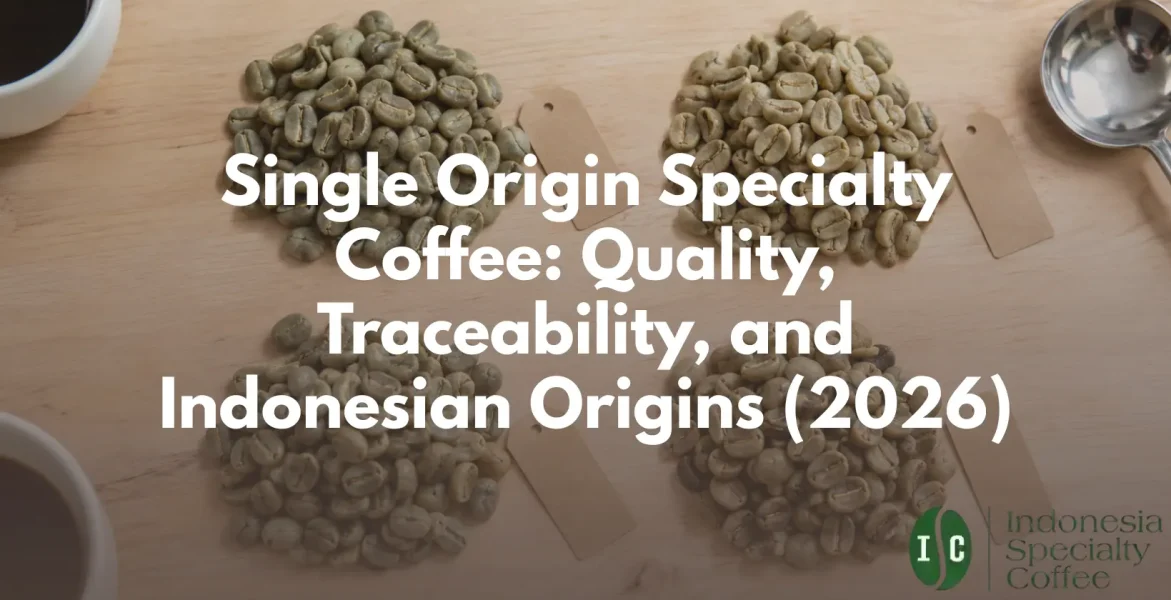
Single origin specialty coffee is coffee traced to one defined source, a single farm, cooperative, or growing region, that also meets specialty grade: a cupping score of 80 points or more on the SCA scale with zero primary defects in the green sample. Both conditions matter. A bag can say “single origin Sumatra” and still be commercial grade, and a specialty-grade coffee can be a blend. The category this article covers is the overlap.
This guide is written for roasters, cafés, and importers building a single origin menu. We supply Indonesian green coffee from Medan, North Sumatra, so the examples come from the origins we cup every week. It covers how specialty grade is measured, what “single origin” can mean at different levels of traceability, how Indonesian origins and processing change the cup, and what to check before you buy.
Last updated: 02 October 2026
What Is Single Origin Specialty Coffee?
Single origin specialty coffee has to pass two separate tests. The origin test asks whether every bean in the bag can be traced to one named place. The quality test asks whether the green coffee and the cup meet specialty grade under Specialty Coffee Association (SCA) protocol.
| Test | Requirement | Who checks it |
|---|---|---|
| Single origin | One country, region, cooperative, farm, or lot, named on the label | Supplier documentation, lot records |
| Specialty green grade | Zero primary (category 1) defects and no more than 5 full defects per 350 g sample | Green grader, SCA protocol |
| Specialty cup | 80 points or more on the SCA cupping form | Licensed cupper |
| Indonesian export grade | Grade 1 under SNI 01-2907-2008, defect value 11 or lower | Exporter, SNI grading |
The SCA scale is the one buyers trade on; our guide to the SCA cupping form shows how the score is built. We set our own line higher than the SCA minimum: every lot we ship as specialty cups at 82 to 88 SCA points. Our broader introduction to single origin coffee covers the consumer side of the term; this article stays on the specialty, buyer side.
The Five Levels of Traceability
“Single origin” is not one standard. It describes how narrowly the source is defined, and the narrower it gets, the more the coffee tells you about one place, and the less of it there is.
- Country. “Indonesia” or “Sumatra” on a label. This is the loosest use of the term and often not specialty.
- Region. Gayo, Lintong, Toraja, Kintamani. Most Indonesian single origin specialty coffee is sold at this level, because Indonesian coffee is grown by smallholders on plots usually under two hectares.
- Cooperative or washing station. One collection point serving a defined group of farmers, with shared processing.
- Single farm or estate. One producer, one set of plots. Common in Latin America, rarer in Indonesia outside estate regions such as Ijen.
- Microlot. One farm, one varietal, one process, one harvest window, often under a few hundred kilograms. Our guide to micro-lot coffee explains why they cost more.
For buyers selling into the EU, the EU Deforestation Regulation also requires them to provide plot-level geolocation, regardless of how they market the coffee.
Single Origin Specialty Coffee vs Blends
Blends exist to deliver the same cup every week; single origins exist to show a difference. Neither is better. They do different jobs on a menu, and most cafés need both.
| Single origin specialty coffee | Blend | |
|---|---|---|
| Goal | Show one place’s character | Consistent flavour all year |
| Flavour | Distinct, changes with harvest | Balanced, stable |
| Supply | Seasonal, finite per lot | Swappable components |
| Best use | Filter, tasting flights, seasonal releases | House espresso, milk drinks |
| Price | Higher per kg | Lower, more flexible |
Our single origin vs blend comparison goes deeper into recipe design. A practical note from our side of the trade: many roasters build their house espresso from one Indonesian single origin, often Mandheling or Gayo, then add a brighter coffee only when the base lacks acidity.
Planning a single origin lineup for next season? See our wholesale pricelist or contact our team for 1 kg cupping samples from several Indonesian origins.
Indonesian Origins for Single Origin Specialty Coffee
Indonesia is the world’s fourth-largest coffee producer by volume, and its islands give it more distinct single origins than almost any other producing country. Altitude, volcanic soil, and processing tradition change from one island to the next.
| Origin | Island | Altitude | Typical process | Cup |
|---|---|---|---|---|
| Gayo | Sumatra (Aceh) | 1,400 to 1,800 m | Semi-washed, wet-hulled; full-washed, dry-hulled | Dark chocolate, cedar, brown sugar, herbal top note |
| Mandheling | Sumatra (North) | 1,100 to 1,500 m | Semi-washed, wet-hulled | Heavy body, earthy, low acidity |
| Lintong | Sumatra (Lake Toba) | 1,200 to 1,700 m | Semi-washed, wet-hulled | Cocoa, cedar, spice |
| Java Preanger and Ijen | Java | 1,200 to 1,700 m | Washed and semi-washed | Chocolate, gentle spice, cleaner cup |
| Bali Kintamani | Bali | 1,200 to 1,600 m | Full-washed, dry-hulled | Citrus, clean, sweet |
| Toraja | Sulawesi | 1,400 to 1,900 m | Semi-washed, wet-hulled | Balanced body, herbal, dark fruit |
| Flores | Flores | 1,200 to 1,700 m | Full-washed and semi-washed | Cocoa, sweet spice, floral |
Each of these is a full single origin in its own right. Our origin guides cover them in detail: Gayo Arabica, Sumatra Mandheling, Bali coffee, and Indonesia’s top coffee-producing regions.
How Processing Shapes the Cup
The same farm can produce three different single origin specialty coffees depending on how the cherry is processed. In Indonesia that is a two-step decision: the cherry method first, then the hulling method.
Step 1, cherry processing:
- Full-washed: pulp removed, fermented, washed clean. Brighter acidity, cleaner cup.
- Semi-washed: pulped and briefly fermented, with less washing. Fuller body.
- Honey: pulp removed, some mucilage left on during drying. Sweetness, rounder acidity.
- Natural: dried as whole cherry. Fruit-forward, heavier body.
Step 2, hulling:
- Wet-hulled (Giling Basah): parchment removed at 35 to 40 percent moisture. Heavy body, low acidity, earthy and woody notes. This is the classic Sumatran profile.
- Dry-hulled: parchment removed at around 12 to 13 percent moisture. Cleaner, brighter, closer to washed coffees from other origins.
So a Gayo can be semi-washed, wet-hulled for a traditional earthy cup, or full-washed, dry-hulled for something cleaner. Always ask for both steps on the spec sheet. Our wet-hulled coffee process guide and guide to coffee processing methods cover each method.
How to Source Single Origin Specialty Coffee
Buying single origin specialty coffee well is mostly about asking for evidence before you pay. Six checks we recommend to every new buyer:
- Origin on paper. Region, district, producer group or farm, and lot ID, matching the level of traceability you are paying for.
- Grade and defects. SCA green grade or SNI Grade 1, with defect count, screen size, and moisture for the specific lot.
- Cupping score. A score on the SCA form for this lot and this crop year, not an average for the origin.
- Both processing steps. Cherry method and hulling method.
- Harvest window. Indonesian main crops arrive at different times; for Gayo the main harvest runs June to August. Order fresh-crop coffee early because producers allocate the best lots first.
- A sample first. Cup a 1 kg sample against what you currently buy. It costs little and settles most questions.
One supplier observation: buyers often reject wet-hulled Sumatra on the first cupping because they roast it like a washed Central American coffee. Wet-hulled beans are less dense and take heat fast. Give the sample a slower, gentler roast before judging it. Our specialty coffee grading guide explains what each grade figure means.
Frequently Asked Questions
What is single origin specialty coffee?
Single origin specialty coffee is coffee traced to one defined source, such as a farm, cooperative, or region, that also meets specialty grade: 80 or more points on the SCA cupping scale and zero primary defects in the green sample. Origin alone does not make a coffee specialty, and specialty grade alone does not make it single origin.
Is single origin coffee always specialty grade?
No. Single origin only describes where the coffee comes from. A coffee from one region can still be commercial grade with a cupping score below 80 and visible defects. To be single origin specialty coffee, the lot must also pass SCA green grading and cup at 80 points or more.
Is single origin specialty coffee better than a blend?
It is different rather than better. Single origin specialty coffee shows one place’s character and changes with each harvest, which suits filter brewing and seasonal menus. Blends combine origins for a consistent cup all year, which suits house espresso and milk drinks. Most specialty cafés use both.
Which Indonesian origins are best for single origin specialty coffee?
Gayo, Lintong, and Mandheling from Sumatra, Bali Kintamani, Toraja from Sulawesi, Java Preanger and Ijen, and Flores all produce specialty-grade single origins. Sumatran coffees usually use wet-hulling, which creates a heavy body and low acidity, while Bali and Java producers often wash their lots to create cleaner, brighter cups.
Why is single origin specialty coffee more expensive?
Traceable lots are smaller, require separate processing and storage, and must be graded and cupped individually. Specialty-grade sorting also removes more defective beans, lowering yield per kilogram of cherry. The narrower the traceability, from region down to a single microlot, the higher the price per kilogram.
How do I buy single origin specialty coffee wholesale?
Ask the supplier for lot-level origin documents, a defect count, moisture, screen size, the SCA cupping score for the current crop, and both processing steps. Cup a 1 kg sample before ordering. Indonesia Specialty Coffee supplies Indonesian single origins from 1 kg samples up to container loads, FOB Belawan.
Source Indonesian Single Origins from Indonesia Specialty Coffee
Indonesia Specialty Coffee sources single origin specialty coffee directly from smallholder farms across Sumatra, Java, Bali, Sulawesi, and Flores, and exports it from Medan, North Sumatra, FOB Belawan with CIF quoted on request. Every lot is graded against SNI 01-2907-2008, cupped against SCA protocol at 82 to 88 points, and Halal certified, with Organic and Rainforest Alliance available on request. Bulk orders ship free worldwide.
Order tiers run 1 kg for a cupping sample, 60 kg for a microlot rate, 350 kg for standard wholesale, and container loads from 9 MT quoted per metric tonne.
Start with samples from two or three origins and cup them side by side. See our current wholesale pricelist or contact our team for this season’s lots.