Drive up from Medan toward Berastagi, and the coffee starts about where the vegetable fields stop. A lot of it is younger than you would guess, planted after Mount Sinabung buried the old farms in ash. Tanah Karo coffee is arabica grown in Karo Regency, in the North Sumatra highlands between the Sinabung and Sibayak volcanoes, at roughly 1,100 to 1,400 meters. Farmers wet-hull it in the Sumatran way, which gives a heavy body, low acidity, and a dark-chocolate, earthy cup. Most of it reaches roasters under a different name. Here is what it actually is.
Last updated: August 2026
What is Tanah Karo coffee?
Tanah Karo coffee is single-origin Arabica from Karo Regency in North Sumatra, grown on volcanic soil around Berastagi and Kabanjahe. Farmers process it in two steps: semi-washed at the farm, then wet-hulled. The cup is low in acidity and full in body, with dark chocolate and an earthy, herbal edge, usually sorted to Grade 1.
The Karo plateau sits inside the Bukit Barisan range, the volcanic spine that runs down Sumatra. Coffee here is a smallholder crop, grown in plots of a hectare or two and processed by hand before it ever reaches a mill. Most of it is arabica, which is what buyers mean when they say “Karo,” though robusta grows on the lower slopes too.
One thing to settle early, because it causes real confusion at the buying desk: Karo coffee and Mandheling coffee are not different beans so much as different labels. More on that below. For now, treat Tanah Karo as a specific North Sumatra highland origin with its own terroir, often sold under the broader Mandheling trade name.
Where it grows: a plateau between two volcanoes
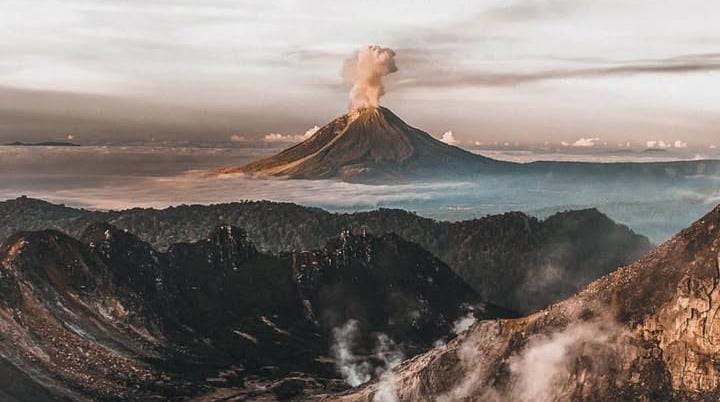
Tanah Karo coffee grows in Karo Regency on a highland plateau flanked by two active volcanoes, Sinabung and Sibayak. The main coffee districts are Merek, Tiga Panah, Simpang Empat, Payung, and Munthe, at elevations of roughly 1,100 to 1,400 meters. The soil is young volcanic andisol, mineral-rich and free-draining, which is the single biggest reason the coffee cups the way it does.
The volcano is not just scenery here. Coffee expanded across Karo largely as a recovery crop. When Sinabung woke up around 2010 and kept erupting on and off for a decade, the ash smothered the cabbage, carrot, and chili farms that Karo families had lived on for generations. Coffee was one of the few crops that could take the higher, ash-dusted ground and pay a living. So people replanted, uphill, into the same soil the eruptions had just wrecked.
That is the quiet irony of the place. The ash that ruined the vegetable economy is the same fresh mineral load that feeds the coffee. Field studies on the Sinabung slopes have measured arabica yields running well above nearby non-eruption zones, credited to that soil enrichment. Volcanic destruction and volcanic fertility are the same event on a different timescale.
The varieties, and why they were chosen to survive
The main arabica varieties in Tanah Karo are Sigararutang (often written Sigarar Utang), Tim-Tim (a Timor hybrid), and Ateng, with older Typica and Bourbon still scattered through the region. These are the workhorses of North Sumatran replanting, and they were picked for durability more than for the cupping table.
Here is the honest version, because it matters for what ends up in your cup. Sigararutang and the Timor-hybrid types are grown widely because they tolerate coffee leaf rust and produce early, not because a Q-grader ranked them highest. After the eruptions, a farmer rebuilding a plot needs a tree that survives disease and yields fast. A rust-wiped field earns nothing while you wait for a purist Bourbon lot to mature.
By contrast, the older Typica and Bourbon material can cup more delicately when it is grown and picked well, but it is more fragile and lower-yielding. So the Karo varietal map is really a map of risk tolerance. That is not a knock on the coffee. It is why the region recovered at all, and it explains why Karo tastes dependable and heavy rather than wild and floral.
How Tanah Karo coffee is processed
Tanah Karo coffee is processed in two steps, the way nearly all Sumatran coffee is. Step one is the cherry method: semi-washed, where the farmer depulps the cherry and ferments off the fruit overnight. Step two is the hulling method: wet-hulling, or Giling Basah, where the parchment skin is stripped off while the bean is still soft and wet, at around 30 to 50 percent moisture, then sun-dried the rest of the way down to 11 to 13 percent.
That second step is the whole signature. In most of the coffee world you dry the bean fully inside its parchment, slowly, to protect it. In Sumatra you cannot. The climate does not give you long dry windows, and smallholders need cash fast, so the parchment comes off early and the naked bean finishes drying on tarps and patios. It is a shortcut born of weather and economics, and it is exactly where the heavy body and low acidity come from.
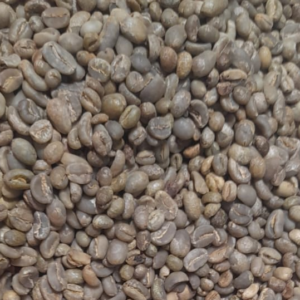
You can see it before you taste it. A wet-hulled Karo bean lands at the Medan mill with a distinctive bluish, open-faced look and a damp, earthy smell that a washed coffee never has. It also arrives uneven. Farm-level hand-cranked hulling and roadside drying mean moisture and color vary lot to lot, so the mill re-dries, re-sorts, and hand-picks the coffee before export. Grade 1 TP, the label you will see on Karo offerings, means Triple Picked: sorted by hand three times. Some of the defects that matter, the partial blacks and insect damage, only reveal themselves after the beans rest and even out in color, which is why one sorting is never enough.
What Tanah Karo coffee tastes like
Tanah Karo coffee tastes heavy and low-acid, with dark chocolate, a gentle herbal earthiness, and a clean, lingering finish. Better lots lift into cedar, dried fruit, and a quiet citrus note at the top. It is unmistakably a Sumatra profile: syrupy body, muted brightness, savory depth. If you have had Mandheling, you know the neighborhood.
Where it sits among its neighbors is a fair question, since North Sumatra packs several origins into a small area. This table lines up the ones buyers most often compare.
| Origin | Body | Acidity | Signature notes |
|---|---|---|---|
| Tanah Karo | Heavy | Low | Dark chocolate, herbal earth, faint citrus lift |
| Lintong | Full | Low-medium | Cedar, tobacco, spice |
| Sidikalang | Heavy | Low | Dark chocolate, milder |
| Mandheling | Heavy, syrupy | Very low | Deep earth, dark chocolate, licorice, spice |
| Gayo (Aceh) | Full | Low-medium | Brown sugar, cedar, herbal, brighter at altitude |
Read across it and Karo lands in the classic heavy-and-earthy camp, a touch cleaner than Mandheling, less spice-forward than Lintong. It is a blender’s and dark-roaster’s coffee first, a single-origin curiosity second.
The honest part: it sells as “Mandheling”
Here is what most origin guides will not tell you. Tanah Karo rarely reaches your roastery under its own name. It ships as “Sumatra Mandheling Grade, Karo Highlands,” and plenty of it disappears entirely into generic Mandheling lots with no regional callout at all. Mandheling is a trade name, not a bounded geographic origin, and it has long absorbed coffee from Karo, Sidikalang, and beyond.
We would argue that convention undersells one of North Sumatra’s most consistent origins. Karo has a real terroir: a defined plateau, distinct volcanic soil, its own altitude band. Folding it into “Mandheling” is convenient for the supply chain and lazy about traceability. If you want Karo specifically, you often have to ask for it by the sub-region, because the default label will not volunteer it.
Now the trade-off, stated plainly. On a clean-cup scale, a wet-hulled Karo will lose to a washed Guatemala or a bright Kenyan every time. That is not what you buy it for. You buy it for a body and an earthy weight that no washed coffee can fake. And because so much Karo is blended anonymously, traceability is thin unless your supplier can name the collector or the district. If a seller offers you “single-farm, fully traceable” Karo at a commodity price, ask more questions. Real lot-level Karo exists, but it is not the cheap default.
What this means for roasters and buyers
If you are buying Tanah Karo green coffee, treat it as a dependable Sumatra workhorse rather than a delicate single origin. It shines in espresso blends and medium-to-dark roasts, where its body and low acidity carry milk and add weight to a base. It is not the coffee for a light, acidity-forward filter program, and pretending otherwise sets up disappointed customers.
Before you commit to a bag, let alone a pallet, ask any supplier three things: the crop year, the full two-step process description (cherry method plus hulling method), and a recent cupping score on the actual lot. For Karo specifically, ask whether it is a named sub-region lot or generic Mandheling, and get a sample. A good Karo sample should show clean sorting, even moisture, and that heavy chocolate-and-earth profile without a musty or fermented off-note. If it smells like a wet basement rather than damp forest floor, the drying went wrong somewhere.
Frequently asked questions
What is Tanah Karo coffee?
Tanah Karo coffee is arabica grown in Karo Regency, North Sumatra, on volcanic soil between the Sinabung and Sibayak volcanoes at 1,100 to 1,400 meters. Farmers semi-wash then wet-hull it, producing a heavy-bodied, low-acid cup with dark chocolate and earthy notes, usually graded Grade 1.
Where is Tanah Karo coffee grown?
It grows in Karo Regency in the North Sumatra highlands, around Berastagi and Kabanjahe, across the districts of Merek, Tiga Panah, Simpang Empat, Payung, and Munthe. The region sits on young volcanic soil, which gives the coffee much of its body and depth.
What does Tanah Karo coffee taste like?
Expect a heavy body, low acidity, dark chocolate, and a gentle herbal earthiness with a clean finish. Higher, well-processed lots add cedar, dried fruit, and a faint citrus lift. It is a classic Sumatra profile, close to Mandheling but often a touch cleaner.
Is Karo coffee the same as Mandheling?
Not exactly. Mandheling is a trade name that covers coffee from several North Sumatra areas, including Karo. Tanah Karo is a specific regional origin often sold under the Mandheling label, most commonly as “Sumatra Mandheling Grade 1 TP, Karo Highlands.”
How is Tanah Karo coffee processed?
In two steps. First the cherry is semi-washed: depulped and fermented overnight. Then it is wet-hulled (Giling Basah), meaning the parchment is stripped while the bean is still wet at 30 to 50 percent moisture, before sun-drying down to 11 to 13 percent. This method creates the heavy body and low acidity.
What grade is Tanah Karo coffee?
Most exported Tanah Karo is Grade 1 under the Indonesian grading standard, often marked TP for Triple Picked, meaning it has been hand-sorted three times to remove defects. Grade is a defect count, not a cupping score, so always ask for both.
Sourcing Tanah Karo green coffee: where to start
Whatever supplier you use, ask for the current crop year, the full two-step process, a recent cupping score, and whether the lot is named Karo or generic Mandheling. A 200-gram sample will tell you more than any spec sheet. If you want to start with North Sumatra arabica, Indonesia Specialty Coffee exports Grade 1 Sumatra lots from our Medan mill and can send cupping samples: request a sample or browse the green coffee range.