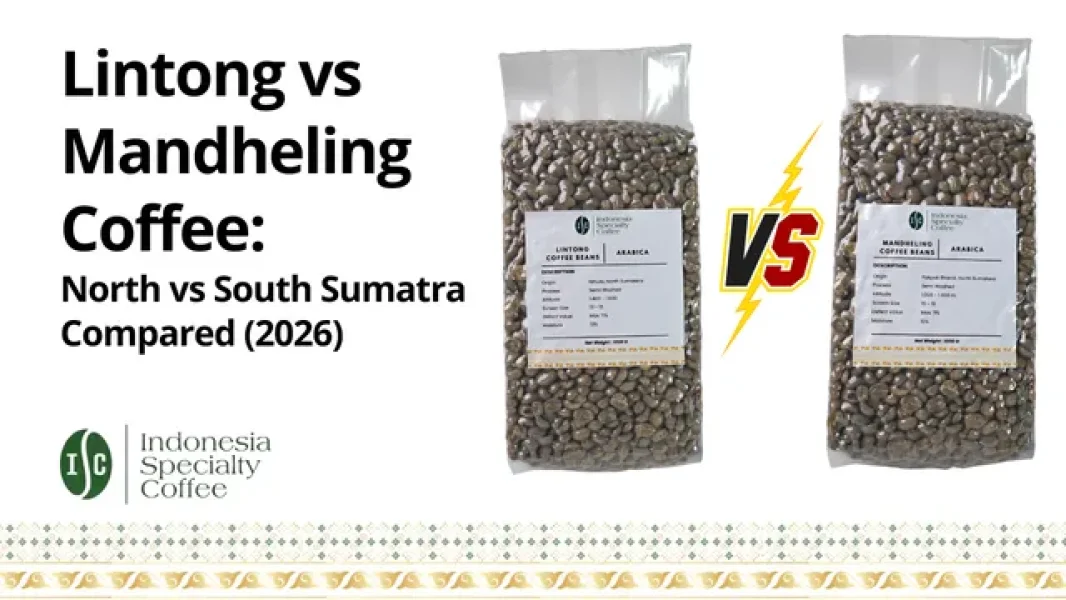
The Lintong vs. Mandheling coffee question comes up regularly among roasters sourcing Sumatran green beans, and for good reason: both origins share the same island, similar processing traditions, and a recognizable earthy depth, yet they deliver meaningfully different cups. Lintong grows in the volcanic highlands southwest of Lake Toba in Humbang Hasundutan Regency.
Mandheling is a broader trade name tied to the Mandailing ethnic group, historically sourced from Mandailing Natal and South Tapanuli further south. This guide covers geography, flavor, processing, grading, wholesale price, and how to decide which origin fits your roastery program, whether you source from Sumatra coffee origins regularly or are evaluating either for the first time.
Last updated: May 2026
Lintong vs Mandheling: Quick Comparison
The table below covers the key differences between Lintong and Mandheling coffee across the factors that matter most to buyers evaluating either origin.
| Factor | Lintong | Mandheling |
|---|---|---|
| Geographic origin | Lintong Nihuta, Humbang Hasundutan, North Sumatra | Mandailing Natal / South Tapanuli, North Sumatra |
| Altitude | 1,200–1,500m ASL | 750–1,500m ASL |
| Key flavor notes | Cedar, dark chocolate, baking spice, clean earth | Deep earth, dark chocolate, licorice, herbal |
| Body | Medium-full | Full |
| Acidity | Low-medium | Low |
| Cherry process (Step 1) | Semi-washed or full-washed | Semi-washed |
| Hulling method (Step 2) | Wet-hulled (Giling Basah) | Wet-hulled (Giling Basah) |
| SCA grade (Grade 1) | 82–88 SCA points | 82–88 SCA points |
| Best for | Single-origin filter, medium espresso | Single-origin filter, medium espresso, blends for milk-based drinks |
| FOB price | USD 9,500/MT | USD 9,500/MT |
Lintong Coffee: Lake Toba Terroir and Flavor Profile
Lintong coffee beans take their name from the Lintong Nihuta sub-district in Humbang Hasundutan Regency, southwest of Lake Toba in North Sumatra. The growing area sits at 1,200 to 1,500 metres above sea level, on land shaped by the ancient Toba supervolcano. Smallholder farmers here cultivate predominantly Typica and Catimor varietals in mineral-rich volcanic soil. Because of the higher altitude and consistently cooler air, Lintong lots tend toward a cleaner cup than most other Sumatran origins.
What Lintong Coffee Tastes Like
Lintong delivers cedar, dark chocolate, and baking spice as its dominant notes, with an earthy base that reads as clean forest floor rather than mud. Unlike the heaviest Mandheling expressions, Lintong carries a low-to-medium acidity that gives the cup identifiable structure. Body is medium-full. ISC’s Grade 1 Lintong lots cup at 82–88 SCA points, graded to SNI 01-2907-2008 with a defect value of ≤11 and moisture below 12.5%. Roasters who work with Lintong frequently note that it holds its character across a wider roast range than other North Sumatra origins. See current wholesale rates on the Lintong coffee price page.
Mandheling Coffee: Southern Tapanuli Origins and Profile
Mandheling coffee beans do not carry a geographically bounded designation in the same way Lintong does. The name traces to the Mandailing people, an ethnic group historically from Mandailing Natal and South Tapanuli, further south along Sumatra’s highland spine. As a trade name, Mandheling may cover beans from several growing areas, including Sidikalang and Padang Sidimpuan. Growing altitudes range from 750 to 1,500 metres ASL — a wider and often lower range than Lintong’s.
That lower altitude ceiling matters. Lots grown at 750 to 1,000 metres produce a heavier, more intense cup than Lintong’s typical profile.
What Mandheling Coffee Tastes Like
Mandheling delivers full body, deep earth, dark chocolate, and licorice notes, with a herbal aroma that roasters building dark-roast programs specifically seek out. Acidity sits lower than Lintong, and the mouthfeel is heavier and more syrupy at the same roast level. ISC’s Grade 1 Mandheling lots cup at 82–88 SCA points, graded to SNI 01-2907-2008. For buyers interested in the highest-grade Mandheling expression, ISC also sources Golden Mandheling — a premium-grade selection within the Mandheling trade name. However, buyers sourcing any Mandheling lot should ask for the specific growing district and altitude, since the trade name’s broad use creates wider lot-to-lot variation than you see with Lintong.
ISC sources both Lintong and Mandheling Grade 1 Specialty lots directly from North Sumatra smallholder farms. View current wholesale pricing on the ISC pricelist or contact our team for a volume quote.
Processing Methods: How Both Coffees Are Made
Both Lintong and Mandheling use the same two-step processing tradition that defines North Sumatran specialty coffee.
Step 1 (cherry processing): Cherries undergo semi-washed or full-washed processing. Lintong producers more commonly apply full-washed cherry processing, which contributes directly to the origin’s cleaner acidity. Mandheling producers typically use semi-washed, leaving more mucilage on the bean during drying.
Step 2 (hulling): Both origins apply wet-hulling (Giling Basah), removing parchment at 35–40% moisture before the beans finish drying. This high-moisture hulling step produces the heavy body and low acidity both origins deliver. It also produces the characteristic bluish-green appearance roasters learn to identify on arrival. One practical note for your roastery: wet-hulled beans retain higher residual moisture than dry-hulled lots, so account for that in your drying and development phase.
Which Should You Choose? A Buyer’s Guide
The right origin depends on how you roast and what you need from the cup.
Choose Lintong if you want a clean, structured Sumatran single-origin. Lintong works well as a filter coffee or a medium-roast espresso blend component where spice and chocolate notes read clearly. Roasters introducing customers to Indonesian coffee often find Lintong more accessible as a starting point.
Choose Mandheling if you roast dark and need a bean with the body to hold up. Mandheling suits full-city-to-dark profiles and blends built for milk-based drinks. Buyers who anchor their house espresso blend with a heavy-bodied base frequently choose Mandheling for that role.
That said, many roasters carry both. They serve different purposes in the same lineup, and ISC supplies both origins under the same Grade 1 Specialty standard, so the minimum order structure is identical.
Frequently Asked Questions
What is the difference between Lintong and Mandheling coffee?
Lintong coffee comes from a specific growing district southwest of Lake Toba in Humbang Hasundutan, North Sumatra, at 1,200 to 1,500 metres ASL. Mandheling is a broader trade name tied to the Mandailing ethnic group, covering beans from South Tapanuli and Mandailing Natal at 750 to 1,500 metres. Lintong tends toward a cleaner, more structured cup; Mandheling runs heavier with deeper earth and licorice.
Is Lintong or Mandheling better for espresso?
Both work for espresso, but each suits a different roast style. Lintong performs best at medium roast for specialty espresso where chocolate and spice notes are identifiable. Mandheling suits dark-roast espresso programs and milk-based drinks, where its full body and low acidity hold up through steaming. For milk drinks specifically, Mandheling is the stronger choice.
Are Lintong and Mandheling both specialty grade?
Yes. ISC ships only Grade 1 Specialty lots for both origins, cupping at 82–88 SCA points and graded to SNI 01-2907-2008 with a defect value of ≤11 and moisture below 12.5%. Commercial-grade Lintong and Mandheling exist on the market, but ISC does not supply sub-specialty lots.
Where does Mandheling coffee come from geographically?
Mandheling is not a single growing region. The name derives from the Mandailing people of North Sumatra and covers coffee from South Tapanuli, Mandailing Natal, and surrounding highland areas south of Lintong Nihuta. Buyers should confirm the exact growing district and altitude with their supplier, since lot consistency varies considerably across the Mandheling trade name.
Order Lintong and Mandheling Coffee from Indonesia Specialty Coffee
Indonesia Specialty Coffee sources Grade 1 Lintong and Mandheling green coffee beans directly from North Sumatra smallholder farms, shipping FOB Belawan. Both origins carry Halal certification and cup at 82–88 SCA points assessed on SCA cupping protocol. ISC supplies 1 kg samples, 60 kg microlots, 350 kg standard wholesale orders, and 9 MT+ container loads.
View current pricing on the ISC wholesale pricelist or contact our team for a custom quote. Sample orders are available for new buyers.