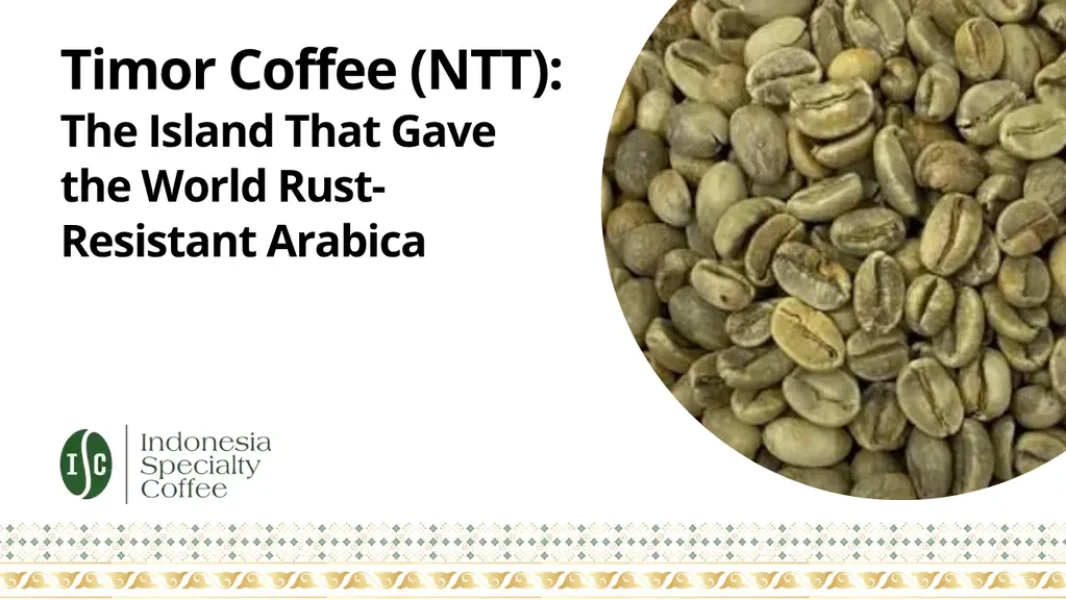
Some origins matter for how they taste. Timor matters for what it did to every other coffee. Timor coffee is arabica grown on Timor island, split between Indonesian West Timor in the province of Nusa Tenggara Timur (NTT) and independent Timor-Leste to the east. The Indonesian side grows organic, smallholder highland arabica around Mount Mutis, nutty and chocolatey with a gentle acidity. But the island’s real fame is genetic: this is the birthplace of the Hibrido de Timor, a freak natural cross between arabica and robusta that rescued arabica from leaf rust and became the ancestor of rust-resistant coffee worldwide. Here is the origin whose family tree you have almost certainly tasted.
Last updated: August 2026
What is Timor coffee?
Timor coffee is arabica grown on the island of Timor, which is divided between Indonesian West Timor, in Nusa Tenggara Timur province, and the country of Timor-Leste in the east. The Indonesian NTT side produces organic, smallholder highland arabica, typically wet-processed, with a medium to full body, gentle acidity, and nutty, chocolatey, herbal, and spicy notes. Much of it carries Timor Hybrid genetics.
Two things make Timor unusual. First, it is one origin split across an international border, so “Timor coffee” on the market can mean Indonesian West Timor or Timor-Leste, and the two are often blurred. Second, and far more important, Timor is where the Hibrido de Timor was born, the single most historically consequential coffee plant Indonesia has a claim to.
So this origin has two stories running at once: a modest, honest highland arabica in the cup, and a genetic legacy that reshaped the entire coffee world. Both are worth telling straight.
West Timor and NTT: where Indonesia’s Timor coffee grows
:strip_icc():format(webp)/kly-media-production/medias/4712216/original/054314100_1704902727-WhatsApp_Image_2024-01-10_at_22.14.47.jpeg)
Indonesian Timor coffee grows in the highlands of West Timor, in Nusa Tenggara Timur, mostly in the central mountains around Mount Mutis and the regency of South Central Timor near the town of Soe. Mount Mutis, at about 2,417 meters, is the highest point in NTT, and its surrounding highlands give arabica the altitude and cool climate it needs, roughly 1,000 to 1,500 meters and up on the growing slopes.
This is remote, low-input farming. Farms are small, worked by families, and because synthetic fertilizer and pesticide are expensive and hard to get out here, most West Timor coffee is effectively organic whether or not it is certified. A good deal of it grows in agroforestry, under shade among other crops and trees, rather than in dedicated monoculture plantations.
For a buyer, the NTT context matters. West Timor sits in the same province as the far more famous Flores origins like Bajawa, and it is easy to overlook. Timor’s specialty scene is younger, smaller, and less organized than Flores or the big Sumatran names, which is both its limitation and, for an early buyer, its opportunity.
The Hibrido de Timor: the accident that changed coffee
The Hibrido de Timor, or Timor Hybrid (HdT), is a naturally occurring cross between arabica and robusta, discovered on Timor in 1927 among a plot of Typica arabica that had been planted around 1917. Arabica and robusta almost never cross successfully, so this was a genuine fluke, likely from a single robusta parent. The result inherited robusta’s disease resistance while keeping a cup quality close to arabica.
That combination was a turning point, because of one disease: coffee leaf rust. The fungus Hemileia vastatrix had been destroying arabica since the 1870s, the same epidemic that wiped out Java’s original plantations. In the Hibrido de Timor, breeders finally had an arabica-quality plant with built-in rust resistance from its robusta side. From the 1950s and 60s, the Coffee Rust Research Center in Portugal and its partners used HdT to breed the rust-resistant varieties that now grow across the world.
Two of those descendants matter most. Catimor, a cross of Hibrido de Timor with the compact Caturra, and Sarchimor, a cross with Villa Sarchi, are the backbone of rust-resistant arabica planted from Latin America to Asia. Nearly every modern rust-resistant variety has Timor Hybrid somewhere in its family tree. The Slow Food movement has even added the original Hibrido de Timor to its Ark of Taste as a heritage plant worth protecting.
Tim Tim: how Timor’s hybrid reshaped Indonesian arabica
The Hibrido de Timor did not just travel to distant research stations, it spread across Indonesia, where it is known as Tim Tim, short for Timor Timur, the Indonesian name for East Timor. From the mid-twentieth century, Tim Tim and its selections moved out from Timor to the arabica highlands of the rest of the archipelago, prized for the same reason everywhere: it survived the rust that killed older Typica.
That is why Timor’s fingerprints are all over Indonesian arabica today. In Gayo, in Flores, in Sumatra, the variety lists routinely include Tim Tim alongside local selections and Catimor-type plants that descend from it. When you drink a rust-tolerant Indonesian arabica, you are very often drinking Timor genetics grown somewhere else.
This is the quiet irony of the origin. Timor is one of Indonesia’s smaller, less commercially developed coffee islands, yet through Tim Tim it shaped the genetics of the country’s biggest and most famous arabica regions. The island exported its DNA more successfully than its coffee.
What Timor coffee tastes like
West Timor arabica tastes medium to full-bodied and low in acidity, with chocolate, nuts, brown sugar, and herbal, spicy, sometimes woody notes, over a smooth, velvety texture. Wet processing gives it a balanced, rounded cup rather than a bright, fruit-forward one. It sits closer to the earthy, grounded end of Indonesian arabica than to the clean, citric styles of Solok or Kerinci.
This table sets Timor against familiar Indonesian arabica reference points.
| Coffee | Region | Elevation | Body | Signature notes |
|---|---|---|---|---|
| Timor (NTT) | West Timor | 1,000-1,500 m+ | Medium-full | Chocolate, nutty, brown sugar, herbal, spice |
| Flores Bajawa | Flores, NTT | 1,000-1,600 m | Full | Chocolate, floral, spice, sweet |
| Gayo | Aceh | 1,200-1,800 m | Full | Brown sugar, cedar, herbal, low-medium acidity |
| Mandheling | North Sumatra | 1,000-1,500 m | Heavy, syrupy | Deep earth, dark chocolate, licorice |
Read across it and Timor lands in the comfortable, chocolatey, low-acid Indonesian middle. It is a dependable, easygoing cup rather than a showstopper, which is honest to say and important for setting expectations.
The honest part: heritage is not the same as the cup
Here is the tension nobody selling Timor wants to spell out. The origin’s genetic legacy is world-changing, but that does not automatically make the coffee in your cup world-class. The Hibrido de Timor was bred for survival, not flavor, and its most famous descendant, Catimor, is notorious for cupping a step below pure heirloom arabica, sometimes with a green or harsh edge when grown low or picked carelessly. The very trait that made Timor important, robusta-derived toughness, is also what can flatten the cup.
We would argue that is not a reason to dismiss Timor, but a reason to buy it clear-eyed. Well-grown, high-grown, carefully processed West Timor arabica is a pleasant, chocolatey, honest coffee. It is just not going to out-cup a top washed Central American, and anyone selling it on romance alone is overpromising. Judge it as a solid daily arabica, not a competition lot.
Then there is the border problem. Because Timor is split between Indonesia and Timor-Leste, and because Timor-Leste has the bigger specialty reputation, much coffee sold simply as “Timor” is actually Timor-Leste, not Indonesian West Timor. If NTT origin matters to you, that distinction is on you to confirm, because the label rarely makes it clear. Traceability on the Indonesian side is still thin.
What this means for roasters and buyers
For roasters, West Timor is a blend and daily-drinker origin more than a single-origin showpiece. Its chocolate, nuts, and low acidity make it a friendly, approachable cup and a decent body-and-sweetness component in a blend. If you want a story, the Hibrido de Timor heritage is one of the best in coffee, but tell it honestly, as genetics, not as a promise about the flavor in the bag.
Before you commit past a sample, ask any supplier four things: whether it is Indonesian West Timor or Timor-Leste, the specific area and elevation, the variety, and the process. Then cup it. A good West Timor lot should show clean chocolate and nutty sweetness with no green, woody, or harsh Catimor edge. If it tastes rough and vegetal, it was probably grown too low or processed carelessly, and the famous hybrid heritage will not save it.
Frequently asked questions
What is Timor coffee?
Timor coffee is arabica grown on Timor island, split between Indonesian West Timor in Nusa Tenggara Timur (NTT) and the country of Timor-Leste. The Indonesian side produces organic, smallholder highland arabica with a medium to full body, gentle acidity, and nutty, chocolatey, herbal notes, often carrying Timor Hybrid genetics.
What is the Hibrido de Timor?
The Hibrido de Timor, or Timor Hybrid, is a natural cross between arabica and robusta discovered on Timor in 1927. It inherited robusta’s leaf-rust resistance with a cup quality close to arabica, and became the parent of rust-resistant varieties like Catimor and Sarchimor grown around the world.
Where is Indonesian Timor coffee grown?
It grows in the highlands of West Timor, in Nusa Tenggara Timur, mainly in the central mountains around Mount Mutis and the South Central Timor regency near Soe. Farms sit at roughly 1,000 to 1,500 meters and up, and most are small, shade-grown, and effectively organic.
What does Timor coffee taste like?
West Timor arabica is medium to full-bodied and low in acidity, with chocolate, nuts, brown sugar, and herbal, spicy notes over a smooth, velvety texture. It is a rounded, easygoing cup rather than a bright or fruity one, sitting in the earthy, chocolatey middle of Indonesian arabica.
Is Tim Tim the same as Hibrido de Timor?
Yes. Tim Tim is the Indonesian name for the Hibrido de Timor, short for Timor Timur (East Timor). From the mid-twentieth century it spread from Timor to arabica regions across Indonesia, including Gayo, Flores, and Sumatra, because it resisted the leaf rust that killed older Typica.
Is Timor coffee organic?
Usually in practice, yes. West Timor’s farms are small and remote, so synthetic fertilizers and pesticides are rarely used, and much of the coffee grows in shaded agroforestry. It is often organic in substance even where it lacks formal certification.
Sourcing Timor coffee: where to start
Because Timor is split across a border, first confirm whether a lot is Indonesian West Timor or Timor-Leste, then ask for the area, elevation, variety, and process, and cup a sample before buying, since quality varies widely with altitude and handling. If you want NTT arabica, the neighboring Flores origins are the more established starting point; talk to sourcing or browse the green coffee range.