
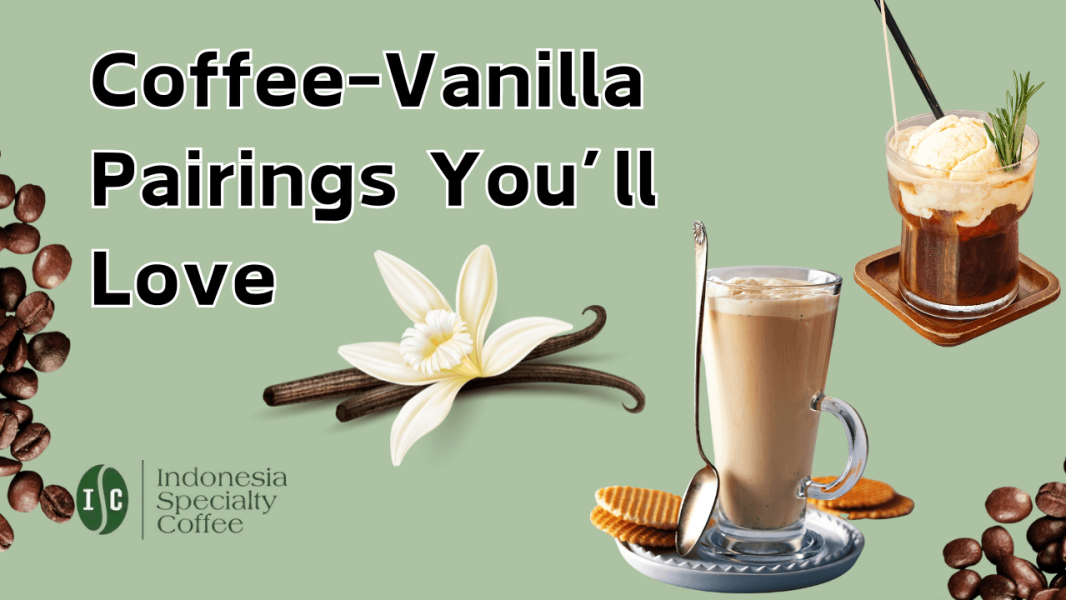
Two different things get called vanilla coffee. One is a cupping note that turns up in unflavored coffee with nothing added to it. The other is a manufactured flavoring applied to roasted beans. This guide separates them, because the green coffee you buy for each is not the same.
Indonesia Specialty Coffee grades and exports green beans, so this is written from the sourcing side: where vanilla notes come from, which Indonesian origins carry them, and what roasters specify when building a flavored line.
Last updated: 23 September 2026
What Is Vanilla Coffee Flavor?
Vanilla coffee flavor describes a soft, creamy sweetness associated with vanillin, and the term covers two separate sources.
Roast-derived vanillin occurs on its own. Vanillin, chemically 4-hydroxy-3-methoxybenzaldehyde, is released when lignin in the bean’s cell walls degrades under roasting heat. Every roasted coffee carries some, usually in trace amounts.
Added vanilla flavoring is deliberate. Vanilla extract, natural vanillin, or synthetic ethylvanillin is applied to roasted beans or dosed into the finished drink.
On the SCA Coffee Taster’s Flavor Wheel, vanilla sits in the Sweet category alongside caramel, brown sugar, and honey. That placement matters when you grade. Vanilla does not register as a separate, nameable note the way a citrus or berry descriptor does. Vanilla integrates with the acidity and bitterness already in the cup, softening perceived sharpness without competing for attention.
Where Vanilla Notes Come From in Unflavored Coffee
Natural vanilla character in coffee is a roasting product, not a farming one. Lignin sits in the cell wall structure of every green bean. Apply heat and part of it breaks down into vanillin, which is why the note appears in the roast and not in the green.
Roast degree decides how much of it you can actually taste:
| Roast level | Vanillin concentration | What you perceive |
|---|---|---|
| Light roast | Low | Subordinate to fruit and floral aromatics, rarely called out |
| Medium roast | Highest | Round sweetness, most perceptible as a vanilla descriptor |
| Dark roast | Present but masked | Smoke-derived phenolics and carbonization cover it |
The practical takeaway for a roaster is narrow but useful. If vanilla sweetness is what you want on the cupping form, medium is where it lives. Push to a dark roast and you spend the same green coffee to bury the note you were chasing. Our guide to aromatics in coffee covers how vanillin sits among the other phenolic compounds formed in the drum.
Indonesian Origins That Cup with Natural Vanilla Notes
Three Indonesian coffees we grade carry vanilla in their published cupping notes, and all three are Arabica from Sumatra and Aceh.
| Origin | Published cupping notes | Screen size | Moisture | Defect value |
|---|---|---|---|---|
| Blue Batak | Fresh nutty aroma, vanilla, delicate almond; herbal, refreshing, spicy flavor; soft to medium acidity | 15 to 18 | Max 13% | 6 to 8 |
| Kopi Luwak | Fresh nutty, vanilla, chocolate, gentle almond; soft to medium acidity, soft to mild body | 15 to 18 | Max 13% | 6 to 8 |
| Gayo Arabica | Complex profile with hints of vanilla, good acidity, medium to high full body | 15 to 18 | Max 12.5% | Max 11 (Grade 1) |
All three are semi-washed at the cherry stage and wet-hulled (Giling Basah) at 35 to 40 percent moisture. That combination is also why the vanilla reads the way it does in these lots. Wet-hulling produces the low acidity and heavy body Sumatran coffee is known for, and a soft, rounded sweetness has more room to show in a cup that is not carrying bright citric acidity.
Building a dessert-profile or flavored SKU and want to cup these side by side? See our current wholesale pricelist or contact our team for 1 kg samples.
How Roasters Make Vanilla Flavored Coffee
Flavored coffee is made after roasting, not during it, and the method is more mechanical than most buyers expect.
- Step 1: Roast and cool. Flavoring oil is applied to roasted beans that have already come down to handling temperature. Applying it hot drives off the aromatics you just paid for.
- Step 2: Dose the oil. Vanilla flavoring is a concentrated oil containing vanillin or ethylvanillin dissolved in a carrier solvent, most commonly propylene glycol. Typical dosing runs 1 to 3 percent of batch weight.
- Step 3: Tumble. A rotary or centrifugal mixer distributes the oil evenly across the batch.
- Step 4: Hold. Beans absorb the oil over a holding period. Residual carbon dioxide still degassing out of the bean helps carry it into the porous structure.
Two things follow from this for anyone buying green coffee to feed a flavored line. Medium roast is the standard base, because dark roast masks vanilla and light roast fights it. And flavoring oils oxidize, so flavored beans lose aromatic intensity faster than unflavored ones. Plan inventory in weeks, not months.
One more point worth being straight about. Flavoring overwrites origin character. If you are applying vanilla oil at 3 percent, you do not need an 82 to 88 SCA point Grade 1 lot underneath it. Buy the cup quality your product actually uses.
Vanilla and Indonesian Coffee: Two Crops, Same Islands
Indonesia is the world’s second-largest vanilla producer, behind Madagascar. Between 2018 and 2023, Madagascar contributed 42 percent of global vanilla production and Indonesia 24 percent, together with Mexico, Papua New Guinea, and China making up more than 85 percent of world supply.
Indonesian vanilla grows in Java, Bali, Sulawesi, Papua, and Sumatra. Those are the same islands the coffee comes from.
For a roaster or cafe building a single-origin vanilla SKU, that opens a sourcing story most flavored products cannot tell: both components from one archipelago, each traceable to a region rather than to a flavor house. Indonesia Specialty Coffee supplies the coffee side of that equation, not the vanilla.
Vanilla Coffee Drinks Worth Putting on a Cafe Menu
Vanilla is the highest-volume flavored coffee category in commercial cafes, and the base coffee you choose changes the result more than the syrup does.
| Drink | What it is | Base coffee that works |
|---|---|---|
| Vanilla latte | Espresso, steamed milk, vanilla syrup | Medium roast with chocolate or nut character; milk reinforces the creamy note |
| Affogato | Hot espresso poured over vanilla ice cream | Heavy-bodied, low-acid Sumatran espresso stands up to melting dairy |
| Vanilla cold brew | Cold brew infused with vanilla bean or extract | Wet-hulled Sumatra; cold brew amplifies body and softens brightness |
| Vanilla mocha | Espresso, cocoa, milk, vanilla | Origins already showing chocolate, so vanilla moderates cocoa bitterness |
Barrel-aged lots are the other route to this profile without any syrup at all. Our guide to aged barrel coffee covers how bourbon and whiskey barrels push a cup toward vanilla and toasted oak.
Frequently Asked Questions
Does coffee naturally contain vanilla?
Roasted coffee contains vanillin naturally, released when lignin in the bean degrades under roasting heat. Concentrations are usually trace-level. Some origins carry enough for graders to record vanilla as a cupping note, but the intensity is far below any flavored coffee product.
What is the difference between vanilla coffee and vanilla flavored coffee beans?
Vanilla coffee usually means a drink with vanilla syrup added after brewing. Vanilla flavored coffee beans have flavoring oil applied directly to the roasted bean during post-roast processing, so every batch brewed from them carries the same vanilla character without further dosing.
How is vanilla flavored coffee made?
Flavoring oil containing vanillin or ethylvanillin, dissolved in a carrier such as propylene glycol, is applied to roasted beans after cooling, typically at 1 to 3 percent of batch weight. A rotary mixer distributes it, then the beans absorb it during a holding period.
Which roast level works best for vanilla coffee?
Medium roast. Vanillin concentration peaks there, so the sweetness is most perceptible. Dark roast masks vanilla behind smoke-derived phenolics and carbonization. Light roast leaves vanilla subordinate to brighter fruit and floral aromatics. Most commercial flavored coffee uses a medium roast base.
Where can I buy green coffee beans with vanilla notes wholesale?
Indonesia Specialty Coffee supplies Sumatran and Acehnese Arabica with vanilla in the cupping notes, shipping FOB Belawan from Medan. Order tiers start at 1 kg for samples, then 60 kg microlot, 350 kg wholesale, and container loads from 9 MT.
Buy Indonesian Green Coffee with Vanilla Notes from Indonesia Specialty Coffee
Indonesia Specialty Coffee exports Blue Batak, Gayo Arabica, and wild-certified Kopi Luwak green beans from Medan, North Sumatra. We ship Grade 1 Specialty only, graded against SNI 01-2907-2008 at 82 to 88 SCA points, FOB Belawan. All lots are Halal certified, with Organic and Rainforest Alliance available on request. Current pricing sits at [confirm current price with ISC pricelist].
Order tiers run 1 kg for a cupping sample, 60 kg microlot, 350 kg standard wholesale, and container loads from 9 MT quoted per metric tonne.
Deciding between a naturally sweet origin and a flavored base? Cup them against each other before you commit. See our green coffee beans or contact our team for a wholesale quote.


