Bali Kintamani coffee beans are specialty-grade Arabica green coffee beans grown on the volcanic slopes of Mount Batur in Kintamani District, Bangli Regency, Bali. They break the typical Indonesian mold: fully washed and dry-hulled, these beans deliver bright citrus acidity, a clean medium body, and elegant aromatics shaped by the centuries-old Subak Abian organic farming system. Specialty roasters comparing cup profiles often place Kintamani alongside washed Central American origins rather than next to Sumatra Mandheling or Gayo Arabica green coffee beans.
This guide gives roasters, importers, and distributors everything needed before placing a wholesale order: growing geography, the Subak system, Specialty Coffee Association-graded flavor notes, processing options, 2026 wholesale pricing (FOB Tanjung Perak per ton), and how to source directly through Indonesia Specialty Coffee.
Last updated: April 2026
What Are Bali Kintamani Coffee Beans?
Bali Kintamani coffee beans are specialty-grade Arabica green coffee beans cultivated in the Kintamani District of Bangli Regency, Bali Province, Indonesia. Most production comes from smallholder families around Ulian Village, where each farm covers 0.5 to 2 hectares and yields run 800 to 1,500 kg per hectare, a range that signals a region prioritizing cup quality over volume.
Unlike the semi-washed, wet-hulled (Giling Basah) origins that define Sumatra, Kintamani lots are fully washed and dry-hulled. That single processing difference explains why buyers compare this cup to a washed Central American origin rather than to Sumatra Mandheling or Gayo Arabica. Where Sumatran coffees deliver earthiness and body, Kintamani delivers brightness and clarity.
Indonesia Specialty Coffee sources Bali Kintamani directly from Subak Abian partner farms in Ulian Village, grading every lot to SNI 01-2907-2008 before export from Tanjung Perak.
Mount Batur and the Kintamani Highlands: Altitude, Climate, and Soil
The Kintamani region sits on the slopes of Mount Batur, an active volcano whose 1,717-metre summit and surrounding caldera define the entire growing environment. Volcanic terroir is the single largest driver of why Kintamani lots cup the way they do.
Altitude and Volcanic Terroir
Kintamani farms sit between 1,200 and 1,700 metres above sea level. At those elevations, cherry maturation takes nine months from flower to ripe fruit. Slower development concentrates sugars and acid precursors inside the seed, producing the bean density required to meet specialty thresholds under SNI 01-2907-2008. Lots harvested from farms at the upper end of that altitude band consistently show higher sugar content at the cupping table.
Climate
Daytime temperatures range from 13 to 28°C, with annual rainfall between 1,000 and 3,000 mm. Cool nights near Lake Batur drive sugar accumulation; warm days sustain photosynthesis through the full growing cycle. The result is a predictable harvest window, April through August, for most Subak Abian farms.
Volcanic Soil
Mount Batur’s eruptions have deposited young andisol soils across the Kintamani slopes. These soils are rich in micronutrients, drain freely, and maintain a slightly acidic pH that suits Arabica root systems. The natural fertility means most Kintamani farms operate without synthetic fertilizers, which is why Organic certified lots are available through ISC on request.
The Subak Abian Organic Farming System
The Subak Abian is a Balinese cooperative farming structure rooted in Tri Hita Karana, a Hindu philosophy of harmony between people, nature, and the spiritual world. Every coffee-growing family in Kintamani belongs to a Subak group that governs shared water access, planting calendars, and farming practice across mountain villages.
For wholesale buyers, this matters in three specific ways. First, Subak rules formally prohibit synthetic pesticides on all member plots, making most Kintamani lots organic by practice rather than by coincidence. Second, coffee grows alongside mandarin and tangerine trees under Subak intercropping arrangements, a relationship that contributes directly to Kintamani’s signature citrus character in the cup. Third, every Subak group maintains detailed production records, which simplifies chain-of-custody verification for importers requiring traceability documentation.
ISC sources directly from Subak partners in Ulian Village. That direct relationship gives buyers consistent access to the same farms crop year to crop year, with Halal certified status on all lots and Rainforest Alliance certification available on listed lots.
Want to evaluate before committing? Contact ISC to arrange a 1 kg cupping sample.
Flavor Profile and SCA Cupping Notes
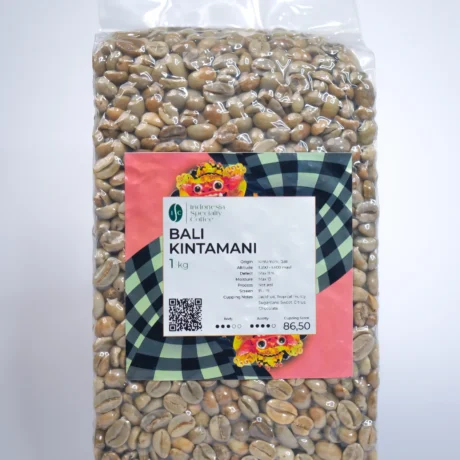
Bali Kintamani coffee beans produce a cup profile unlike any other Indonesian Arabica. Sumatran origins lean earthy and full-bodied; Kintamani offers brightness, clarity, and a citrus-forward character that suits light to medium roast profiles.
ISC’s Grade 1 lots cup in the 82–87 SCA range. The premium 85+ lot achieves a verified SCA cupping score of 85+, assessed against SCA cupping protocol at our Medan grading facility.
Typical cupping notes for ISC Grade 1 Bali Kintamani lots:
- Fragrance/Aroma: Orange, lemon, citrus blossom
- Flavor: Molasses, toast, mandarin, gentle chocolate undertones
- Acidity: Bright, vibrant, and clean without sharpness
- Body: Medium, smooth mouthfeel
- Finish: Clean, lingering citrus sweetness
One observation buyers rarely hear until they have roasted a few Kintamani batches: the citrus character holds better at a lighter first-crack pull than at full city. Roasters who develop this origin past medium roast often report the mandarin brightness fading and a toasted grain note moving forward. A light to medium-light profile preserves what makes this origin worth sourcing.
Processing Methods for Bali Kintamani Coffee Beans
Indonesian coffee processing operates as a two-step system. The cherry processing method (Step 1) shapes primary flavor; the hulling method (Step 2) determines bean structure and moisture behavior in the roaster. Bali differs fundamentally from Sumatran origins by using dry-hulling across all major lots, the opposite of the wet-hulled (Giling Basah) approach that defines Gayo, Mandheling, and Lintong.
The three available Kintamani processing combinations ISC offers:
| Step 1: Cherry Process | Step 2: Hulling | ISC Lot | Flavor Result |
|---|---|---|---|
| Fully washed | Dry-hulled | Bali Kintamani Grade 1 | Clean citrus, bright, balanced |
| Natural process | Dry-hulled | Bali Natural | Sweet tropical fruit, orange, guava |
| Wine process | Dry-hulled | Bali Wine | Deep fermented fruit, syrupy, complex |
Fully washed lots dominate Bali’s specialty trade because the volcanic soil and citrus intercropping already provide flavor complexity. Washing cleans the cup without suppressing the inherent Kintamani character.
Quality Specifications and Grading
Every Grade 1 lot ISC ships from Bali meets the following specifications, verified at our Medan facility before export under SNI 01-2907-2008:
| Specification | Grade 1 Requirement |
|---|---|
| Screen size | 15–19 |
| Moisture content | Maximum 13% |
| Triage | 8–10% |
| Defect value | Maximum 11 per 300 g sample |
| Caffeine content | 0.8–1.4% |
| Bean form | Flat with clear midline |
Lots that exceed the maximum defect value or fall outside the moisture range are downgraded to commercial tiers and do not ship as ISC specialty stock. Buyers receive consistent Grade 1 quality across crop years.
2026 Bali Kintamani Coffee Beans Wholesale Pricing
ISC publishes 2026 wholesale rates in two formats: per kilogram for sample and microlot orders, and per metric ton for container loads shipped FOB Tanjung Perak. View the full ISC wholesale pricelist for all current rates.
Per Metric Ton (FOB Tanjung Perak)
| Product | Price per MT |
|---|---|
| Bali Kintamani Grade 1 (Green) | $10,200 |
| Bali Kintamani 85+ (Green) | $12,500 |
| Bali Wine (Green) | $15,500 |
| Bali Kintamani Robusta ELB 350BC (Green) | $5,600 |
ISC’s MOQ tiers: 1 kg for samples, 60 kg for microlot pricing, 350 kg for standard wholesale, and 9 MT+ for container loads with custom per-MT quotes. Free worldwide shipping applies to all bulk orders.
Frequently Asked Questions
Where are Bali Kintamani coffee beans grown?
Bali Kintamani coffee beans grow on the volcanic slopes of Mount Batur in Kintamani District, Bangli Regency, Bali Province, Indonesia. Farms sit between 1,200 and 1,700 metres above sea level, primarily around Ulian Village. All production is smallholder-based, organized through traditional Subak Abian cooperative groups.
What does Bali Kintamani coffee taste like?
Bali Kintamani delivers a bright, clean cup with citrus aroma (orange and lemon), molasses and toasted flavor notes, vibrant acidity, and medium body. ISC’s Grade 1 lots cup at 82–87 SCA points, with the premium 85+ tier exceeding 85 SCA points. Citrus intercropping in Subak farms contributes the natural mandarin sweetness.
Are Bali Kintamani coffee beans organic?
Most Kintamani lots are organic by traditional practice. Subak Abian rules formally prohibit synthetic pesticides and herbicides across all member plots. Formal Organic certified documentation is available on request through ISC’s certified supply chains. Halal certified status covers all Bali lots automatically, and Rainforest Alliance certification is available on listed lots.
How much do Bali Kintamani coffee beans cost wholesale in 2026?
ISC’s 2026 wholesale pricing starts at $10,200/MT (FOB Tanjung Perak) for Grade 1 green beans for container loads. Premium 85+ lots run $12,500/MT, and Bali Wine reaches $15,500/MT. Minimum order starts at 1 kg for samples and 60 kg for microlot pricing.
What is the difference between Bali Kintamani and Sumatra coffee?
Bali Kintamani uses fully washed cherry processing and dry-hulling, producing a clean, bright, citrus-forward cup. Sumatran origins like Mandheling and Gayo use semi-washed or full-washed cherry processing and wet-hulling (Giling Basah), producing heavy body, low acidity, and earthy complexity. The two represent opposite ends of the Indonesian Arabica flavor spectrum.
Order Bali Kintamani Coffee Beans from Indonesia Specialty Coffee
Indonesia Specialty Coffee is a direct exporter of Bali Kintamani coffee beans, sourcing Grade 1 Arabica from Subak Abian partner farms in Ulian Village, Bali. Every lot is cupped and graded at our Medan facility, with Grade 1 lots scoring 82–87 SCA points and the premium tier reaching 85+ SCA points, verified before export.
We supply roasters and importers worldwide. Minimum orders start at 1 kg for samples, 60 kg for microlot pricing, and 350 kg for standard wholesale. Container loads from 9 MT are available with custom per-MT pricing and free worldwide shipping on bulk orders.
View current pricing on the ISC wholesale pricelist or contact our team for a custom wholesale quote.