
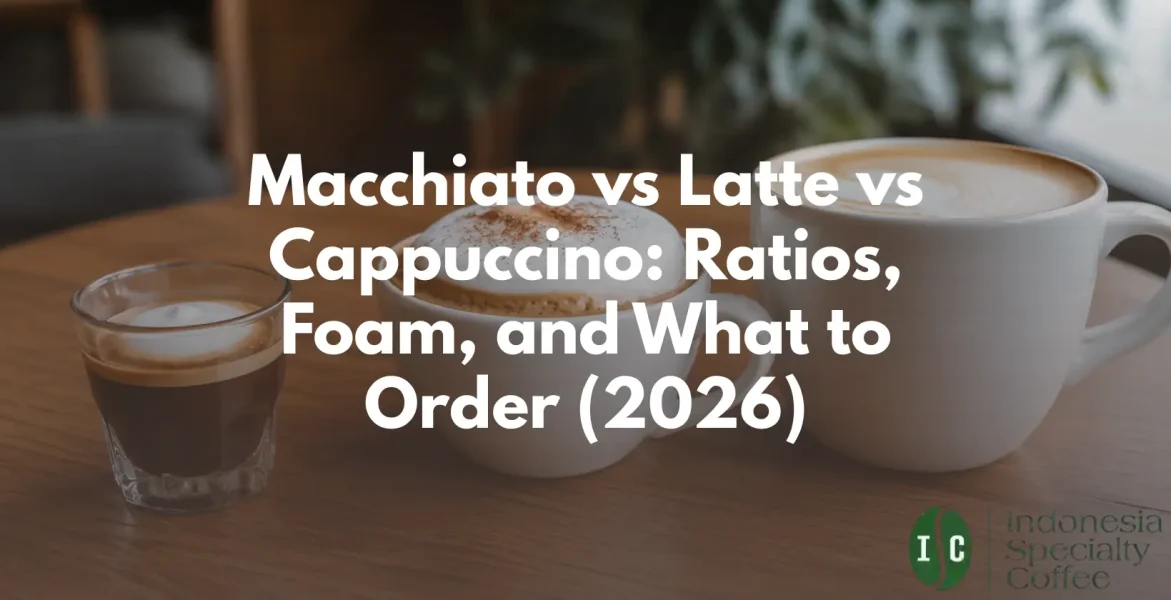
Macchiato vs latte vs cappuccino comes down to one variable: how much milk meets the espresso. A macchiato is espresso marked with a spoonful of foam. A cappuccino is espresso with roughly four times its volume in steamed milk and a thick foam cap. A latte is more milk again, with only a thin foam layer. Everything else you notice follows from that ratio.
Last updated: 26 August 2026
Macchiato vs Latte vs Cappuccino at a Glance
All three start with the same espresso. What changes is milk volume, foam thickness, and the cup it lands in, so this is the table to scan before you order.
| Macchiato | Cappuccino | Latte | |
|---|---|---|---|
| Espresso | 1 shot (2 in the US) | 1 to 2 shots | 1 to 2 shots |
| Milk | A spoonful of foam | About 100 ml steamed | 200 to 300 ml steamed |
| Foam | A visible mark on top | Thick cap, 1 cm or more | Thin layer |
| Total volume | 2 to 3 oz (60 to 90 ml) | 5 to 6 oz (150 to 180 ml) | 8 to 12 oz (240 to 350 ml) |
| Served in | Small espresso cup | Small handled cup | Tall cup or glass |
| Coffee intensity | Strongest | Balanced | Mildest |
| Usually sweetened? | No, unless flavoured | Rarely | Often |
| Name means | Stained, marked | After Capuchin friars’ robes | Milk |
Read the milk row and everything else makes sense. The macchiato is an espresso drink. The latte is a milk drink. The cappuccino sits between them, which is precisely why it is the hardest of the three for your barista to make well.
What Is a Macchiato?
Macchiato is Italian for stained or marked, and that is a literal description of the drink: a shot of espresso marked with a small dollop of steamed milk foam. Two ingredients, nothing else, and that is what you should get if you order one.
The foam is not optional. A macchiato without the mark is simply an espresso, which is worth saying because plenty of guides will tell you it has “little or no foam.” The mark is the entire point of the name.
In Italy the drink is traditionally a single shot, and coffee educator Andreas Willhoff, co-author of Craft Coffee: A Manual, notes that Italians tend to shift from cappuccino in the morning to espresso and macchiato in the afternoon. American cafés commonly pull two shots for a bolder cup.
One point of confusion worth clearing now. Caffè macchiato is espresso marked with milk. Latte macchiato is the inverse: a glass of steamed milk marked with espresso, using around 200 ml of milk. Same word, opposite drink, and the second one is where the café menu in front of you gets muddled.
What Is a Cappuccino?
The cappuccino is the one you will see ratios quoted about, usually the 1:1:1 rule of equal espresso, steamed milk, and foam. That rule is a useful shorthand rather than an official standard.
The closest thing to an official standard comes from the Istituto Espresso Italiano, whose Certified Italian Cappuccino is defined precisely.
| Standard | Espresso | Milk | Total |
|---|---|---|---|
| Certified Italian (IEI) | 25 ml | 100 ml steam-foamed | About 125 ml |
| Specialty café | 1 to 2 shots | To fit the cup | 150 to 180 ml (5 to 6 oz) |
| US chain | 1 to 2 shots | Considerably more | Often 360 ml (12 oz) or larger |
Note the Italian ratio is closer to 1:4 than 1:1:1. The Institute also specifies fresh cow’s milk with minimum protein and fat levels, since protein is what builds stable foam. SCA barista competition rules historically called for at least 1 cm of foam depth measured vertically.
Willhoff puts the foam volume at roughly four to five ounces in a traditional cappuccino, which is why a well-made one feels noticeably light in your hand compared to a latte of similar size.
What Is a Latte?
A caffè latte is espresso with a much larger volume of steamed milk, finished with only a thin layer of microfoam. Latte means milk in Italian, and the name is honest about the proportions.
Traditional servings run 200 to 300 ml in a glass, while café menus commonly stretch to 12 oz and beyond. Because milk dominates, the latte is the mildest and creamiest of the three, the easiest to drink, and the one you will most often see finished with syrup.
It is also the drink where the espresso underneath matters most, because a thin or acidic shot simply disappears under that much milk.
Why the Caramel Macchiato Confuses Everyone
If you have ever ordered a caramel macchiato and wondered why it arrived as a tall milky drink rather than a two-ounce espresso, this is why.
The café version is built like a latte macchiato, not a caffè macchiato: vanilla syrup and steamed milk go into the glass first, then espresso is poured through the top, then caramel drizzle. Milk marked with espresso, not espresso marked with milk.
So the name is technically defensible and practically misleading. If you want the Italian drink, order an espresso macchiato or a caffè macchiato, and say traditional if the menu carries flavoured versions. Matcha macchiatos, strawberry macchiatos, and most other modern variants follow the same milk-first construction.
Which Coffee Beans Work Best in Each Drink
Here is the part café guides skip, and it is where we can actually help you. The bean and roast under these drinks matter differently in each one, because milk hides some qualities and exposes others.
For lattes and cappuccinos, buy for body and low acidity. Milk dilutes everything and mutes bright acidity into something flat and thin. Wet-hulled Indonesian lots are built for exactly this problem: Sumatra Mandheling and Arabica Gayo carry heavy syrupy body and cocoa depth that survive 200 ml of milk with the coffee still recognisable. Wet-hulling is the reason they cup that way.
For macchiatos, the origin shows. With only a spoonful of foam, nothing in your cup is hiding, so a lot with real aromatic character earns its place. Bali Kintamani brings citrus and molasses that read clearly at that ratio.
For crema and blend weight, a proportion of good Fine Robusta thickens the crema and holds structure under milk, which is why so many Italian espresso blends include it.
Building an espresso programme and want lots that hold up under milk? See our pricelist or contact our team for samples.
Frequently Asked Questions
What is the difference between a macchiato, latte, and cappuccino?
The difference is milk volume. A macchiato is espresso marked with a spoonful of foam, around 2 to 3 oz total. A cappuccino adds about 100 ml of steamed milk with a thick foam cap. A latte uses 200 to 300 ml of milk with only thin foam.
Is a macchiato stronger than a latte or cappuccino?
Yes. A macchiato has the highest espresso-to-milk ratio of the three, so the coffee flavour is most concentrated. A cappuccino sits in the middle, and a latte is mildest because milk dominates. Flavoured versions with syrup soften the intensity considerably.
What is a caramel macchiato really?
Café caramel macchiatos are built like a latte macchiato rather than a traditional macchiato. Syrup and steamed milk go in first, espresso is poured through the top, and caramel is drizzled over. That makes it milk marked with espresso, not espresso marked with milk.
What is the official cappuccino ratio?
The Istituto Espresso Italiano defines a Certified Italian Cappuccino as 25 ml of espresso with 100 ml of steam-foamed milk, roughly 125 ml in total. The popular equal-parts rule of espresso, milk, and foam is a shorthand rather than an official specification.
Which has more calories, a macchiato, latte, or cappuccino?
The latte, because calories in these drinks come almost entirely from the milk. A macchiato has the fewest, using only a spoonful of foam. Cappuccinos sit in between. Syrups, whole milk, and the larger café sizes common outside Italy change the picture substantially.
What coffee should I use for a latte or cappuccino?
Choose beans with heavy body and low acidity, since milk mutes brightness and thins out delicate lots. Wet-hulled Indonesian coffee such as Mandheling or Gayo works well here, carrying cocoa depth and syrupy weight that stay recognisable under a full cup of steamed milk.
Buy Indonesian Green Coffee from Indonesia Specialty Coffee
Indonesia Specialty Coffee supplies the green coffee that sits under drinks like these. We ship Grade 1 Specialty lots at 82 to 88 SCA points, graded against SNI 01-2907-2008 with a defect value of 11 or lower and moisture at or below 12.5%, FOB Belawan from Medan, Halal certified.
Our wet-hulled Sumatran lots are the ones roasters reach for when a blend has to survive milk, and our guide to Indonesian coffee regions sets out how each origin behaves. Order tiers run 1 kg cupping samples, 60 kg microlot, 350 kg wholesale, and container loads from 9 MT. Cup a sample as espresso and again under milk before you commit, because plenty of lots that shine black fall apart in a cappuccino. Browse our green coffee beans.


