
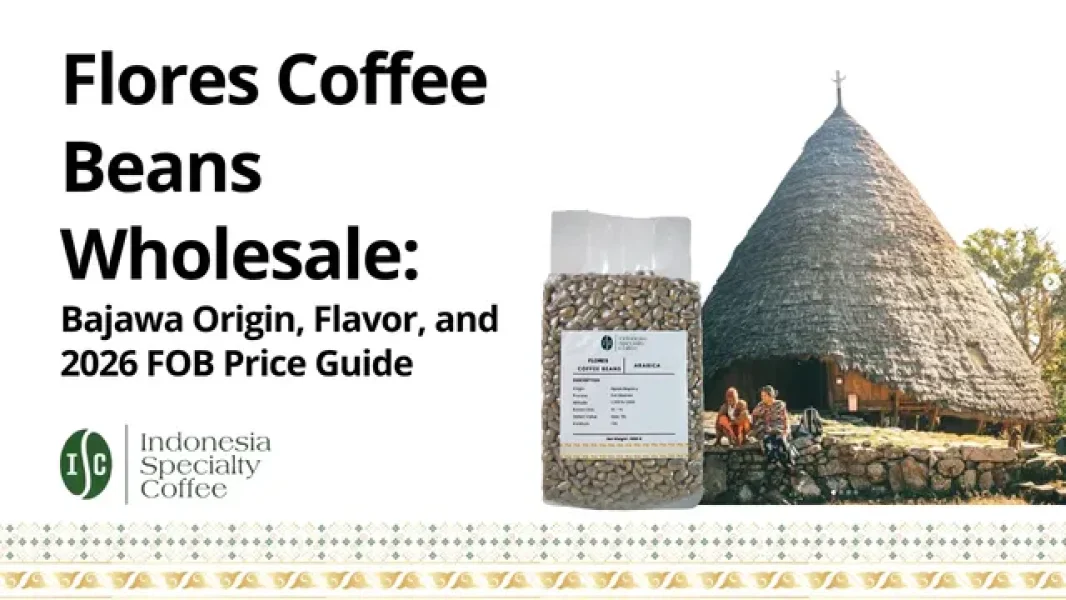
Flores coffee beans from the Bajawa highlands of Ngada Regency deliver a sweet, balanced Arabica that has held Geographical Indication (GI) status since 2012, one of the few Indonesian origins with this formal recognition. This guide from Indonesia Specialty Coffee (ISC) covers everything buyers need to evaluate the 2026 crop: Flores Island geography, Bajawa’s volcanic terroir, SCA cupping scores, processing methods, grading specifications, and current FOB Belawan pricing. Every figure reflects the April 2026 ISC catalog and the Q Grader cupping panel conducted on 14 January 2026.
Last updated: April 2026
What Are Flores Coffee Beans?

Flores coffee beans are Arabica green coffee grown on Flores Island, part of East Nusa Tenggara province in eastern Indonesia. Production spreads across five districts: Manggarai, Manggarai Timur, Ngada (home to Bajawa), Ende, and Lembata. Active volcanoes feed mineral-rich andisol soils across the island, and those soils suit specialty-grade Arabica better than most terrain in eastern Indonesia. Smallholder farmers manage most production, hand-picking ripe cherries between May and September.
Flores Island Geography and Growing Regions
Flores sits roughly 500 kilometres east of Bali, positioned in the Lesser Sunda Islands between the Java Sea and the Indian Ocean. Altitude across the Arabica belt ranges from 1,000 to 1,800 metres above sea level, with the highest farms concentrated in Bajawa and Manggarai. The island’s active volcanoes contribute ongoing mineral deposits to the soil, which is why Flores Arabica expresses a consistently sweet, layered cup rather than the flat profile typical of lower-altitude Indonesian origins. ISC supplies Grade 1 specialty green coffee beans wholesale with a screen size of 15 to 19 and a defect value of 11 or fewer per 300-gram sample.
The Bajawa Highlands of Ngada Regency
ISC positions Bajawa as the benchmark origin for specialty buyers in 2026, supported by its Geographical Indication (GI) certificate awarded in 2012, one of only a handful of Indonesian coffee origins with this formal recognition. Located in Ngada Regency, central Flores, Bajawa sits between two active volcanoes: Mount Inerie at 2,245 metres and Mount Ebulobo at 2,124 metres. Geographic isolation has preserved traditional shade-growing methods, and most Bajawa coffee is organically managed by small-scale farming families without formal pesticide programs.
Altitude, Volcanic Soil, and Growing Conditions
Bajawa coffee farms sit at 1,200 to 1,800 metres above sea level. Volcanic ash from Mount Inerie and Mount Ebulobo deposits and isolated soils packed with phosphorus, potassium, and trace minerals that are difficult to replicate in lower-altitude Indonesian soils. Annual rainfall averages 1,500 to 3,000 mm, and steady daytime temperatures of 18 to 24°C slow cherry maturation, allowing sugars to concentrate before harvest.
Most farms are family-owned smallholdings averaging 0.5 to 2 hectares. Cooperatives in Ngada handle centralised processing at the village level, keeping fermentation control consistent across thousands of individual growers. Common Arabica cultivars in Bajawa include Typica, Catimor, S795, Ateng, Tim Tim, and Kartika.
For a deeper look at the Bajawa and Manggarai growing districts, see ISC’s Flores Bajawa & Manggarai origin guide. For a full breakdown of Indonesian coffee wholesale logistics, visit the Indonesia coffee wholesale guide.
Ready to request a 2026 Flores sample? Contact ISC for pricing, sample availability, and shipping timelines.
Flores Bajawa Flavor Profile and SCA Cupping Score
Flores Bajawa Arabica delivers a medium-to-full body with low to medium acidity. The flavour profile leads with sweetness: caramel and chocolate are the most consistent notes across the ISC cupping panel, followed by nutty and woody undertones. A subtle hint of tobacco appears in the finish, the detail that separates Bajawa from the brighter, fruitier Arabicas of Bali Kintamani or Java.
According to ISC’s January 2026 cupping panel led by Q Grader Heri Setiawan, the Classic Washed Flores lot scored 85.50 SCA points, placing it in the upper Premium Specialty band. Roasters use this profile for single-origin pour-over menus or as a smooth base for medium-roast espresso blends where lower acidity is the priority.
Processing Methods Used in Flores
Flores Bajawa coffee reaches buyers under two primary processing routes. Both steps (cherry processing and hulling) determine the cup character, and buyers need to confirm both when placing orders.
Step 1 (Cherry Processing): Traditional Bajawa lots are semi-washed: cherries are pulped, partially washed, and dried with some mucilage intact. ISC’s Classic Washed Flores uses full-washed cherry processing: cherries are pulped, fully fermented, and washed before drying, producing a cleaner, brighter result. Honey process, natural process, and wine process lots are available made-to-order.
Step 2 (Hulling): Traditional Bajawa lots are wet-hulled (Giling Basah): parchment is removed at roughly 35 to 40 percent moisture before final drying. This is the step that produces Bajawa’s characteristic thick body, low acidity, and earthy depth. ISC’s Classic Washed Flores uses dry-hulling at 12 to 13 percent moisture, producing a cleaner cup that separates it from the traditional Giling Basah character.
One thing roasters sometimes overlook: wet-hulled beans arrive with higher residual moisture than dry-hulled lots. Heat transfer in the roaster runs slower through the early drying phase, which shifts first crack timing. Confirm the hulling method with ISC before building your roast profile.
Flores Coffee Grading and Quality Specifications
ISC grades every Flores lot against SNI 01-2907-2008, the Indonesian national coffee grading standard. Grade 1 Specialty requires a defect value of 11 or fewer per 300-gram sample, moisture below 13 percent, and triage of 8 to 10 percent. Lots exceeding a defect value of 11 are regraded as commercial-grade or rejected from the ISC specialty program. Screen size below 15 indicates underdeveloped beans and is excluded from Grade 1 shipments.
The table below summarises the full 2026 crop specifications for ISC’s Flores Grade 1.
| Parameter | Flores Grade 1 Specification |
|---|---|
| Screen Size | 15 to 19 |
| Moisture Content | Maximum 13% |
| Triage | 8 to 10% |
| Defect Value | Maximum 11 (per 300 g) |
| Cupping Score (SCA) | 85.50 points |
| Caffeine Content | 0.8 to 1.4% |
| Bean Form | Flat with clear midline |
Flores Coffee Beans Wholesale Price 2026
The current FOB Belawan price for flores coffee beans wholesale Grade 1 Arabica is USD $9,500 per metric tonne ($9.50 per kg), based on the May 2026 ISC pricelist. The retail listing on the ISC website shows USD $20 per kg; B2B buyers receive significantly lower pricing once volume thresholds are met.
| MOQ Tier | Price (FOB Belawan) | Best For |
|---|---|---|
| 1 kg sample | Sample fee on request | Cupping evaluation |
| 60 kg microlot | Microlot rate, contact ISC | Single-origin limited release |
| 350 kg standard wholesale | USD $9,500/MT ($9.50/kg) | Roasters and importers |
| 9 MT+ container | Custom per-MT quote | Distributors |
Insurance and freight (CIF) typically add USD $650 to $850 per MT depending on the destination port. CIF Rotterdam from Belawan, for example, adds roughly $850 per MT (equivalent to $0.85/kg).
Why Specialty Roasters Source Flores Arabica
Three concrete reasons drive specialty buyer decisions on Flores Arabica.
GI-protected origin. Flores Bajawa Arabica has carried Geographical Indication status since 2012. That gives buyers a verifiable single-origin claim backed by Indonesian government certification, not a marketing label.
Volcanic terroir. Andisol soils on the slopes of Mount Inerie and Mount Ebulobo concentrate trace minerals that translate into consistent caramel sweetness and woody complexity in the cup. It is not a character you engineer through processing. It comes from the soil.
Smallholder traceability. Most Bajawa farms are organically managed, shade-grown, and family-run. Cooperatives in Ngada consolidate processing at the village level, which allows ISC to offer lot-level traceability that single-estate roasters value for premium sourcing programs.
Frequently Asked Questions
What is Flores coffee known for?
Flores Bajawa Arabica is known for low to medium acidity, medium-to-full body, and sweetness reminiscent of caramel and chocolate, with nutty and woody undertones and a hint of tobacco in the finish. ISC’s January 2026 cupping panel scored Flores Classic Washed at 85.50 SCA points. Bajawa has carried Geographical Indication status since 2012.
Where is Bajawa coffee grown?
Bajawa coffee is grown in Ngada Regency, central Flores Island, East Nusa Tenggara, Indonesia. Plantations sit at 1,200 to 1,800 metres on the slopes of Mount Inerie and Mount Ebulobo. The volcanic andisol soil and 18 to 24°C climate produce balanced specialty Arabica with a GI certificate dating to 2012.
What is the wholesale price of Flores coffee in 2026?
ISC lists Flores Grade 1 Arabica at USD $9,500 per metric tonne FOB Belawan for the April 2026 crop. Container orders of 9 MT or more qualify for custom per-MT pricing. CIF freight adds roughly USD $650 to $850 per MT depending on destination port.
How is Flores coffee processed?
Flores Bajawa is traditionally semi-washed at the cherry stage (Step 1) and wet-hulled (Giling Basah) at 35 to 40 percent moisture (Step 2). ISC’s Classic Washed Flores uses full-washed cherry processing with dry-hulling at 12 to 13 percent moisture. Honey, natural, semi-washed, and wine processes are available made-to-order.
Can I order flores coffee beans wholesale as a small roaster?
Yes. ISC’s flores coffee beans wholesale program starts at 1 kg cupping samples, scales to 60 kg microlots for limited-release programs, and reaches 350 kg standard wholesale orders. Distributors can request a custom per-MT quote on container loads of 9 MT or more.
Order Flores Coffee Beans Wholesale from Indonesia Specialty Coffee
Indonesia Specialty Coffee is a direct exporter of Flores Grade 1 Arabica from the Bajawa highlands of Ngada Regency, an origin recognised under Geographical Indication since 2012. ISC ships flores coffee beans wholesale FOB Belawan at USD $9,500/MT, with cupping scores verified at 85.50 SCA points by Q Grader Heri Setiawan. Halal certification covers every lot; Organic and Rainforest Alliance certifications are available on request.
Order via the ISC Flores product page or message the ISC team on WhatsApp at +62 811 6380 606. Start with a 1 kg cupping sample, scale to a 60 kg microlot, or place a 350 kg standard wholesale order. Contact ISC for a custom per-MT price on container loads of 9 MT or more.


