The Liberica vs Excelsa question trips up more green coffee buyers than any other species comparison, because the two are not separate species at all. Excelsa is a variety of Liberica. They still cup nothing alike, carry different bean sizes, and trade at different prices. This guide covers the taxonomy, the physical and sensory differences, current wholesale pricing per kg, and how to verify which one you are actually being sold.
Last updated: 02 September 2026
Liberica vs Excelsa: Quick Comparison
Both belong to the Liberoid group, and Indonesia Specialty Coffee sources both from Jambi Province, Sumatra.
| Attribute | Liberica | Excelsa |
|---|---|---|
| Botanical name | Coffea liberica var. liberica | Coffea liberica var. dewevrei |
| Origin of species | Liberia, West Africa | Central Africa |
| Share of world production | ~1.5% | <1% |
| Growing altitude | Lowland | 0 to 750 m |
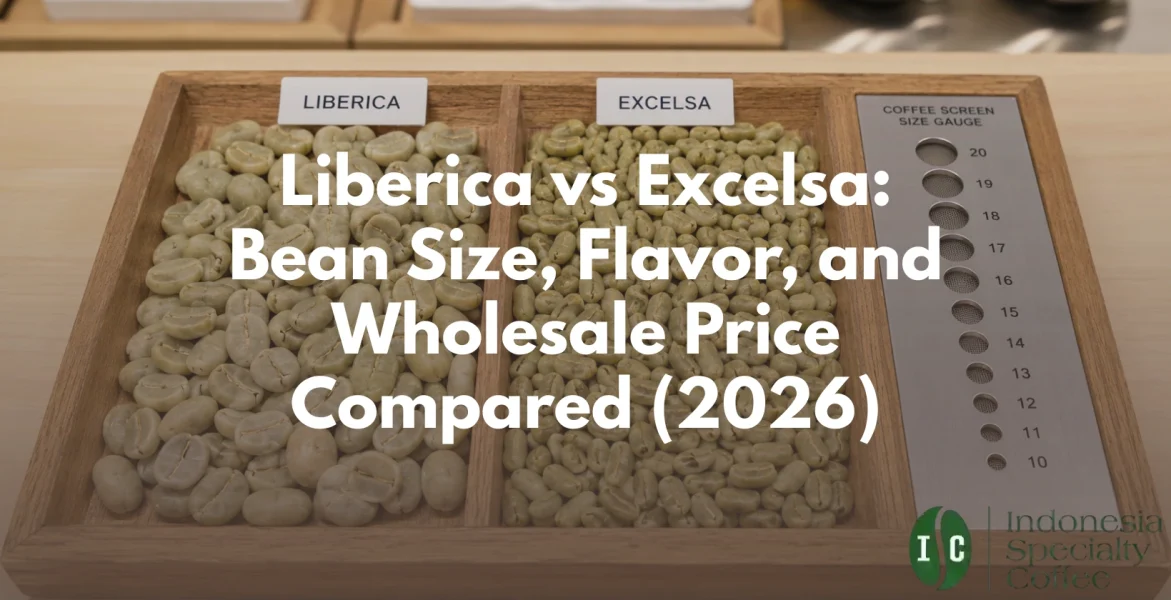
| Bean size | Largest in coffee, up to 24 mm long | Smaller than Liberica, larger than Arabica |
| Bean shape | Asymmetrical, elongated, irregular | Rounder, irregular |
| Aroma | Ripe jackfruit, strong and distinct | Berry, tropical fruit, bright |
| Flavour | Woody, smoky, floral, herbal | Tart, fruity, sweet, lightly spiced |
| Body | Full and heavy, ~12% fat content | Medium, cleaner finish |
| Caffeine | ~1.23 g per 100 g, the lowest of any commercial coffee | Low, below Arabica and Robusta |
| ISC price, FOB Belawan | $10 to $18/kg (Grade 1 specialty) | $9 to $14/kg |
Pricing reflects 2026 ISC figures [confirm current pricing against the ISC pricelist].
Are Liberica and Excelsa the Same Species?
No, but they are closer than most articles admit. Excelsa was described as its own species, Coffea excelsa, after its identification in Central Africa in 1903. In 2006 it was reclassified as a variety of Liberica: Coffea liberica var. dewevrei. Liberica proper is Coffea liberica var. liberica.
The classification is not settled. Genomic research published in 2025 argues for restoring Excelsa to full species status as Coffea dewevrei. Buyers should expect the naming to keep shifting, and should specify the varietal name on contracts rather than relying on the trade term.
That taxonomic closeness has a practical consequence in the market. Liberica lots are routinely sold under the label “Excelsa,” which distorts published production statistics for both and lets lower-grade Liberica reach buyers at Excelsa prices. Excelsa is also confused with Colombian “Excelso,” which is a screen-size grading term and has no relationship to either variety.
Here is a detail that only shows up when a supplier handles both: ISC sources Liberica from Tanjung Jabung Regency and Excelsa from Tanjung Jabung Barat, adjacent areas in the same Jambi province. Same soils, same climate, same processing infrastructure. The flavour gap between the two lots is therefore genetic, not terroir.
Liberica: Jackfruit Aroma and the Largest Bean in Coffee
Liberica produces the largest bean of any cultivated coffee, reaching 24 mm in length and 12 mm in width, with an asymmetrical, elongated shape that is unmistakable on a grading tray. The trees grow to roughly 20 feet, against 10 to 15 feet for Arabica and Robusta.
The cup is heavy. Fat content sits around 12%, which is what produces the thick, almost creamy mouthfeel Liberica is bought for. ISC’s Jambi lots carry a pronounced ripe jackfruit aroma, with woody, smoky, floral, and herbal notes in the cup.
The most commercially useful fact about Liberica is one almost no guide mentions: it is the lowest-caffeine commercial coffee on the market, at roughly 1.23 g per 100 g of green beans. That sits below Arabica, not just below Robusta. For roasters building a low-caffeine single-origin offer without decaffeination processing, Liberica is the only species that gets there naturally.
ISC ships Liberica green beans and Excelsa green beans as Grade 1 specialty. See the current pricelist for both.
Excelsa: Tart Fruit and Blending Utility
Excelsa cups in the opposite direction to Liberica. Where Liberica reads woody and smoky, Excelsa reads tart and fruity, with lively acidity, natural sweetness, and a light spice note. The body is medium rather than heavy, and the finish is cleaner.
Excelsa grows between 0 and 750 metres, and performs well in the acidic peat soils of Jambi where Arabica cannot establish at all. Trees reach first harvest in about 3.5 years and yield roughly 1.2 tonnes per hectare, faster than Liberica.
Roasters use Excelsa differently. Its acidity and fruit lift a blend without dominating it, which makes it useful as a 10 to 20% component in blends that need brightness. Liberica, by contrast, is difficult to blend into anything because its woody, high-fat character takes over. Excelsa works as a supporting bean. Liberica works as a standalone.
Price, Grading, and How to Avoid Mislabelled Lots
Green bean pricing separates into four bands, all quoted FOB origin port.
| Lot type | Price per kg, FOB |
|---|---|
| Commercial Liberica, Vietnam | $6 to $8 |
| Excelsa, Grade 1 specialty | $9 to $14 |
| Liberica, Grade 1 specialty | $10 to $18 |
| Liberica, GI-protected micro-lot | $20 to $22 |
CIF freight and insurance adds roughly $0.65 to $0.85 per kg on top.
Indonesia Specialty Coffee grades both under SNI 01-2907-2008. Grade 1 specifications are a defect value of ≤11 and moisture ≤12.5%.
Given how often Liberica is sold as Excelsa, run three checks before accepting a lot:
- Measure the beans. Liberica reaches 24 mm and is visibly elongated. Excelsa is noticeably smaller and rounder. This is the fastest physical test available.
- Ask for the botanical name on documentation, not the trade name. Var. liberica and var. dewevrei are distinct entries.
- Cup a sample first. Woody and smoky is Liberica. Tart and fruity is Excelsa. The profiles do not overlap.
Frequently Asked Questions
Are Liberica and Excelsa the same coffee?
No. Excelsa is a variety of Liberica, classified as Coffea liberica var. dewevrei since 2006, while Liberica proper is Coffea liberica var. liberica. They share a species but differ in bean size, flavour, and price. Genomic research from 2025 argues for separating them again.
Which is bigger, Liberica or Excelsa beans?
Liberica is larger. Liberica beans reach 24 mm in length and 12 mm in width, the largest of any cultivated coffee. Excelsa beans are smaller and rounder than Liberica, though still larger and more irregular than Arabica or Robusta beans. Bean size is the fastest way to tell them apart.
Does Liberica or Excelsa have more caffeine?
Both are low. Liberica contains roughly 1.23 g of caffeine per 100 g of green beans, the lowest of any commercially grown coffee, below Arabica as well as Robusta. Excelsa also sits below Arabica and Robusta, making both useful for naturally low-caffeine offerings.
How much do Liberica and Excelsa green beans cost per kg?
Grade 1 specialty Liberica trades at $10 to $18 per kg FOB, and Excelsa at $9 to $14 per kg FOB. Commercial Liberica from Vietnam clears at $6 to $8 per kg, while GI-protected Indonesian micro-lots reach $20 to $22 per kg.
Where can you buy Liberica and Excelsa green coffee beans wholesale?
Indonesia Specialty Coffee supplies both from Jambi Province, Sumatra, graded under SNI 01-2907-2008. Orders start at 1 kg samples for cupping, with 60 kg microlots, 350 kg wholesale lots, and container loads from 9 MT. Email [email protected] for a quote.
Order Liberica and Excelsa Green Beans from Indonesia Specialty Coffee
Indonesia Specialty Coffee is a direct exporter of both Liberoid varieties from Jambi Province, Sumatra, shipped as Grade 1 specialty with a defect value of ≤11 and moisture ≤12.5%. All lots are Halal certified and quoted FOB Belawan.
Because Liberica and Excelsa are the two most frequently mislabelled coffees in the trade, cup before you commit. Order at 1 kg for sample evaluation, then scale to 60 kg microlots, 350 kg wholesale, or container loads from 9 MT with per-MT pricing.
For a fuller price breakdown, see ISC’s guides to Liberica price per kg and Indonesian Excelsa origins. To request samples of both, email [email protected] or contact the ISC team on WhatsApp at +62 811-6380-606.