
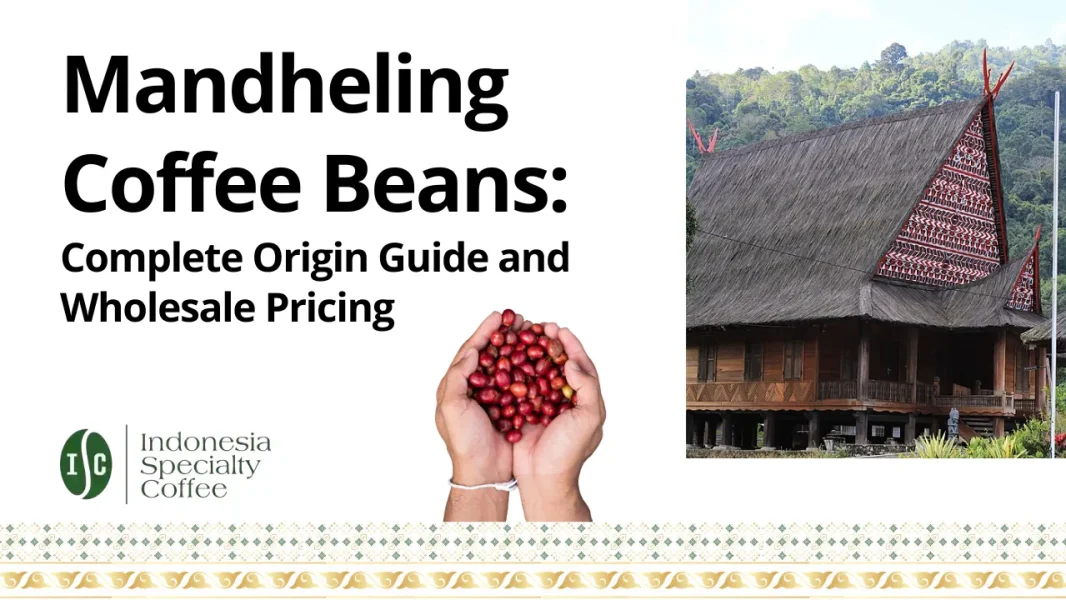
Mandheling coffee beans are Arabica green coffee beans grown across the Tapanuli highlands and surrounding Batak districts of North Sumatra, Indonesia. They carry one of the most recognizable profiles in specialty coffee: low acidity, heavy syrupy body, earthy complexity, and a long dark chocolate finish.
This guide covers everything a buyer needs before placing a wholesale order: where Mandheling actually comes from, how the two-step processing method shapes the cup, how SNI grading applies, wholesale pricing (FOB Belawan), and how to source directly from Indonesia Specialty Coffee.
Last updated: April 2026
Where Do Mandheling Coffee Beans Come From?

Mandheling is a regional commercial name, not a variety and not a single village. The name traces to the Mandailing ethnic group of North Sumatra, but production today spans the broader Tapanuli region: Padang Sidempuan, Dolok Sanggul, Dolok Saribu, Sipirok, Berastagi, Sidikalang, Lintong, Borong-borong, Tobasa, and the Batak highlands west of Lake Toba.
Indonesia Specialty Coffee sources Mandheling coffee beans from farms sitting between 1,100 and 1,500 metres above sea level. That altitude band is lower than the Gayo Highlands of Aceh (1,400–1,800+ m), which partly explains why Mandheling tends to cup heavier and earthier than its northern counterparts.
Farming in this region is predominantly smallholder. Farmers harvest cherry by hand and deliver it as fresh cherry or wet parchment to local collectors. The coffee then moves through wet-hulling stations before reaching dry-mills in Medan, the commercial export hub for North Sumatra coffee.
Growing Conditions: Altitude, Climate, and Soil
The cup starts here, long before the hulling machine or the roaster enters the picture. The growing environment of North Sumatra is genuinely unusual, and understanding it explains why this coffee tastes the way it does.
Altitude
ISC sources Mandheling coffee beans from farms at 1,100–1,500 metres above sea level across Berastagi, Sidikalang, Dolok Sanggul, Dolok Saribu, Lintong, Borong-borong, Tobasa, Sipirok, and Mandailing. Higher elevation slows cherry maturation. The longer a cherry takes to ripen, the more sugars, acids, and aromatic compounds build up inside the bean, producing a denser, more flavor-complex seed compared to low-altitude commercial lots.
The SCA specialty threshold for Indonesian Arabica is rarely achievable below 1,000 metres. Starting at 1,100 metres, Mandheling production zones consistently supply lots that meet Grade 1 specialty standards under SNI 01-2907-2008.
Climate
The Tapanuli highlands receive 1,000–3,000 mm of annual rainfall, distributed across wet and dry seasons that support consistent cherry development without waterlogging roots. Temperatures in the growing zones range from 13 to 28°C, cool enough at night to drive sugar concentration and warm enough during the day to sustain active growth.
Main crop harvest falls between October and March, with selective hand-picking on smallholder plots. Because farms are family-scale operations, selective picking of only ripe red cherries is practical across most of the production area.
Soil
The soil profile across Mandheling production zones is black volcanic andisol: young volcanic material that is exceptionally fertile, well-drained, and rich in micro-nutrients. Volcanic andisol holds moisture without waterlogging, maintains a slightly acidic pH ideal for Arabica growth, and continuously releases nutrients as the volcanic minerals break down.
This natural fertility largely removes the need for heavy synthetic fertilizer on traditional smallholder farms. It is why Organic Mandheling Grade 1 and FTO Grade 1 lots are commercially viable and widely available from this region.
Processing Methods: The Two-Step Sumatran Framework
Mandheling coffee beans cannot be assessed without understanding the two-step processing system that defines their character. Both steps matter: the cherry processing method (Step 1) shapes the primary flavor drivers, and the hulling method (Step 2) determines the bean’s structural character in the roaster.
Step 1 — Cherry Processing: Most Mandheling lots go through semi-washed cherry processing. Farmers pulp ripe cherries and ferment them briefly overnight, then partially wash off the mucilage before drying. ISC also sources natural process and wine process Mandheling in smaller volumes for buyers seeking distinct fermentation-driven profiles.
Step 2 — Hulling Method: All North Sumatra Arabica, including Mandheling, uses wet-hulling (Giling Basah). Parchment is stripped from the bean while it is still at 35–40% moisture, swollen and soft, before the bean finishes drying on patios or raised beds to below 12.5% export moisture.
Stripping parchment at high moisture expands the cellular structure and locks in earthy, herbal, and cedar compounds that washed coffees do not produce. This is the mechanism behind Mandheling’s characteristic thick body and low brightness. Wet-hulled beans carry a distinctive blue-green color in green state, a normal marker of properly processed Sumatran coffee, not a defect.
The full sequence for a standard ISC Mandheling lot:
- Ripe red cherries hand-picked on smallholder farms
- Cherry pulped and briefly fermented (semi-washed, Step 1)
- Wet parchment partially dried to 35–40% moisture
- Parchment removed by wet-hulling machine (Giling Basah, Step 2)
- Exposed beans finish-dried to below 12.5% export moisture
- Dry-milled, graded, and cupped at ISC’s Medan facility
One thing roasters miss: wet-hulled beans behave differently in the drum than dry-hulled coffees of the same moisture reading. Residual cellular moisture is distributed unevenly after Giling Basah, which means first crack can arrive faster and more abruptly than expected. Account for this when setting your roast curves for Sumatran lots.
Flavor Profile: What to Expect in the Cup
Mandheling coffee beans from ISC’s Grade 1 lots deliver a cup built for the dark and complex end of the single-origin spectrum. Roasters who work with this origin regularly describe the profile in consistent terms, and that consistency is part of what makes Mandheling a reliable menu anchor.
Typical cupping notes:
- Body: Full, heavy, syrupy
- Acidity: Low to very low
- Aroma: Cedar, earth, tobacco, dark chocolate
- Flavor: Dark chocolate, herbal, spice, molasses, brown sugar
- Finish: Long, lingering, complex
ISC’s Sumatra Mandheling Grade 1 cups at 85.75 SCA points, firmly in specialty territory. The weight and depth make it an outstanding espresso blend component as well as a viable single-origin offering. Golden Mandheling, ISC’s premium-tier selection, scores higher and offers additional clarity in the cup. It is available at US$38.57/kg retail, a natural choice for specialty cafes looking for a showcase of Sumatran origin.
Looking to evaluate before committing to a wholesale volume? Contact ISC to arrange a cupping evaluation or 1 kg sample order.
Mandheling Coffee Grades and Quality Standards
Indonesia grades green coffee under SNI 01-2907-2008, based on defect counts per 300-gram sample. The grade you choose directly affects cup consistency, price, and end-use suitability.
The table below shows ISC’s current Mandheling grade offerings with 2026 FOB Belawan pricing.
| Grade | Defect Value | SCA Score | Best Use | FOB Price (per ton) |
|---|---|---|---|---|
| Mandheling FTO Grade 1 | ≤11 | 82–88 pts | Certified specialty single-origin | $8,550 |
| Mandheling High Grade | ≤11 | 82–88 pts | Specialty blend / single-origin | $8,300 |
| Organic Mandheling Grade 1 | ≤11 | 82–88 pts | Certified organic specialty | $8,300 |
| Mandheling Grade 1 | ≤11 | 82–88 pts | Specialty use | $8,100 |
| Mandheling Grade 2 | ≤25 | 79–81 pts | Commercial espresso blend | $7,800 |
| Mandheling Grade 3 | ≤44 | Below 80 | Commercial bulk | $7,400 |
For most specialty roasters and importers, Grade 1 or Organic Grade 1 is the standard entry point. Grade 2 offers strong value for commercial espresso blends. Grades 3 and below serve commodity-scale bulk buyers where cup consistency matters less than cost per kilogram.
The SCA cupping protocol benchmarks specialty lots against: zero Category 1 defects (full black, sour bean, fungus-damaged), no more than 5 Category 2 defects per 350-gram sample, SCA cupping score of 80+, and moisture content below 12.5%. ISC cups all Mandheling lots at the Medan facility before shipment. Buyers can request cupping reports or arrange third-party cupping through ISC’s B2B cupping service. This is not a formality; it is the verification layer that protects you from receiving a lot that does not match what you ordered.
Mandheling vs. Lintong and Gayo: A Sourcing Comparison
Buyers comparing North Sumatra origins often ask how Mandheling, Lintong, and Gayo differ. All three are wet-hulled Arabica from the same island, but the growing regions, altitude bands, and varietal composition produce meaningfully different cup profiles.
| Origin | Altitude | Body | Acidity | Key Flavor Notes | Cherry Process (Step 1) | Hulling (Step 2) |
|---|---|---|---|---|---|---|
| Mandheling | 1,100–1,500m | Heavy | Very low | Dark chocolate, earth, cedar, tobacco | Semi-washed (primary) | Wet-hulled (Giling Basah) |
| Lintong | 1,100–1,500m | Medium-heavy | Low-medium | Chocolate, herbal, mild citrus | Semi-washed (primary) | Wet-hulled (Giling Basah) |
| Gayo (Aceh) | 1,400–1,800m+ | Heavy | Low | Earthy, dark chocolate, cedar, brown sugar | Semi-washed or full-washed | Wet-hulled (Giling Basah) |
Mandheling leads on depth of earth and chocolate character. Lintong is slightly cleaner with a brighter citrus edge. Gayo reaches higher altitude and generally cups higher on the SCA scale, with a different aromatic identity. Buyers building a dark, complex, heavy Sumatran house blend return to Mandheling consistently.
2026 Mandheling Coffee Wholesale Pricing
The following pricing reflects ISC’s current publicly listed rates for Mandheling coffee beans. All ton prices are FOB Belawan.
Per Kilogram (Retail / Small Wholesale)
| Product | Price per kg |
|---|---|
| Sumatra Mandheling Green Coffee Beans | $19.71 – $20.55 |
| Golden Mandheling Green Coffee Beans | $38.57 |
| Mandheling Wine Green Coffee Beans | $32.00 |
Per Ton (FOB Belawan)
| Grade | Price per Ton |
|---|---|
| Mandheling FTO Grade 1 | $8,550 |
| Mandheling High Grade | $8,300 |
| Organic Mandheling Grade 1 | $8,300 |
| Mandheling Grade 1 | $8,100 |
| Mandheling Grade 2 | $7,800 |
| Mandheling Grade 3 | $7,400 |
ISC’s MOQ tiers: 1 kg sample, 60 kg microlot, 350 kg standard wholesale, 9 MT+ container load with a custom per-MT quote. For container-load pricing, contact ISC directly for a custom quote.
Frequently Asked Questions
What are Mandheling coffee beans?
Mandheling coffee beans are Arabica green coffee beans grown in the Tapanuli and broader North Sumatra highlands of Indonesia, processed using semi-washed cherry methods and wet-hulled (Giling Basah). The name traces to the Mandailing people of the region. ISC’s Grade 1 Mandheling lots cup at 82–88 SCA points under SNI 01-2907-2008.
Are Mandheling beans Arabica or Robusta?
Mandheling coffee is Arabica. North Sumatra does produce Robusta (notably Sidikalang Robusta), but those lots are marketed separately under different labels. Mandheling specifically refers to Arabica from the Tapanuli and Batak highland districts, grown at 1,100–1,500 metres above sea level and cupping at 82+ SCA points for Grade 1 lots.
What processing method does Mandheling coffee use?
Mandheling uses a two-step system. Step 1 is semi-washed cherry processing: cherry is pulped, briefly fermented overnight, then partially washed before drying. Step 2 is wet-hulling (Giling Basah): parchment is stripped at 35–40% moisture. This combination produces Mandheling’s characteristic heavy body and low acidity.
What is the minimum order quantity from ISC?
ISC offers four MOQ tiers: 1 kg for sample or cupping evaluation, 60 kg for microlot pricing, 350 kg for standard wholesale pricing, and 9 MT+ for container load with a custom per-MT quote. Contact ISC at specialtycoffee.id/contact-us to get a quote for your volume.
Can I get organic-certified Mandheling from ISC?
Yes. ISC offers Organic Mandheling Grade 1 ($8,300/ton FOB) and Mandheling FTO Grade 1 (Fair Trade Organic, $8,550/ton FOB). Both carry the same SNI 01-2907-2008 Grade 1 defect standard as conventional Grade 1 and include full certification documentation.
Does ISC provide cupping reports or samples?
Yes. ISC operates a B2B cupping service and provides cupping reports for wholesale lots. Grade 1 Mandheling cups at a minimum of 82 SCA points (ISC’s published Grade 1 standard); current crop cupping scores are available on request. Sample orders start at 1 kg and are submitted through the ISC contact page.
Order Mandheling Coffee Beans from Indonesia Specialty Coffee
Indonesia Specialty Coffee is a direct exporter of Sumatra Mandheling green coffee beans from North Sumatra, with Grade 1 lots cupping at a minimum of 82 SCA points and shipping FOB Belawan to roasters, importers, and blend builders worldwide.
We supply across all MOQ tiers: 1 kg samples, 60 kg microlots, 350 kg standard wholesale, and container loads from 9 MT. All Mandheling lots are Halal certified. Organic and FTO certifications are available on listed grades. Free worldwide shipping applies to bulk orders.
View current pricing at the ISC wholesale pricelist or contact our team for a custom wholesale or container-load quote. We’re available Monday through Saturday and respond to wholesale inquiries promptly.