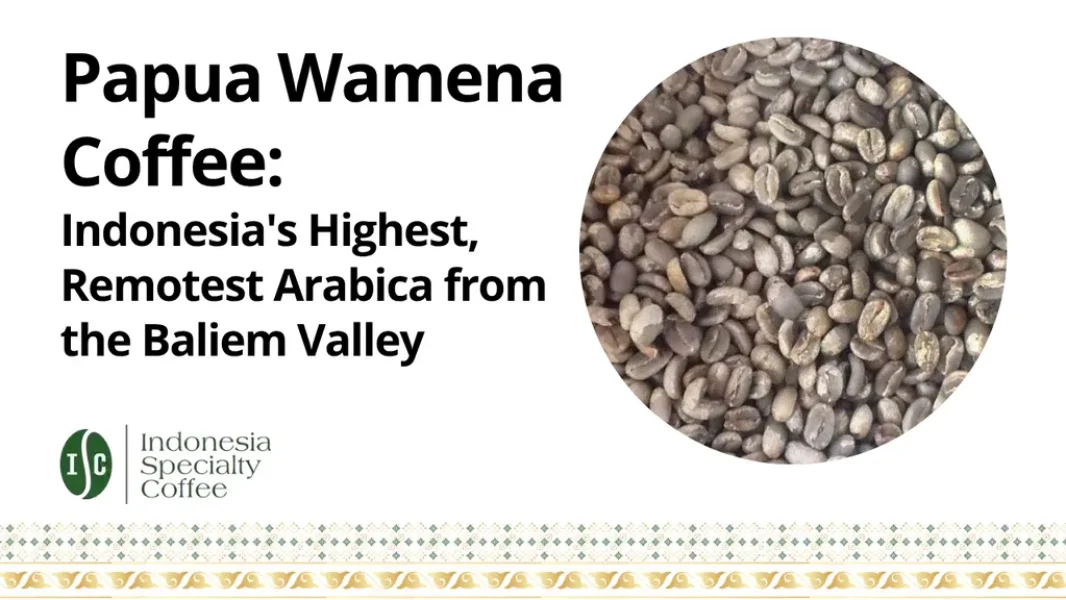
Most Indonesian coffee grows on a volcano. This one does not. Papua Wamena coffee is arabica grown in the Baliem Valley, high in the Jayawijaya mountains of Papua, on some of the most remote farmland in the country, reachable historically only by air or on foot. It is grown between about 1,400 and 2,000 meters, among the highest arabica in Indonesia, from old heirloom Typica trees, washed clean and farmed organically almost by default. The cup is floral, sweet, and elegant, closer to a fine Central American than to earthy Sumatra. Here is what makes Wamena coffee unlike anything else Indonesia grows.
Last updated: August 2026
What is Papua Wamena coffee?
Papua Wamena coffee is specialty arabica grown around Wamena in the Baliem Valley, in the central highlands of Papua, Indonesia, at roughly 1,400 to 2,000 meters. It is grown from old Typica trees, washed processed, and farmed organically without chemical inputs. The cup is floral and clean, with chocolate, caramel, nutty and citrus notes, a smooth medium body, and gentle acidity.
Two things set it apart from the rest of Indonesian coffee before you even taste it. First, altitude and isolation: this is among the highest and by far the most remote arabica in the country. Second, geology. Unlike Sumatra, Java, Bali, or Sulawesi, the Papuan highlands are not volcanic. The fertility here comes from highland forest and valley soils, not volcanic ash, which makes Wamena a genuine outlier in an archipelago of volcano coffees.
If your mental model of Indonesian coffee is heavy, earthy, and wet-hulled, Wamena breaks it completely. It is clean, sweet, and delicate.
Where it grows: the Baliem Valley, the roadless highland
Papua Wamena coffee grows in and around the Baliem Valley, a broad highland valley in the Jayawijaya mountain range of central Papua, centered on the town of Wamena. Farms sit between about 1,400 and 2,000 meters, and the valley is so isolated that for most of its modern history it has been reachable only by light aircraft or on foot, with no road link to the coast.
That remoteness is the defining fact of this coffee, and it cuts both ways. On one side it has kept the valley’s farming traditional and low-input, which is why the coffee is effectively organic. On the other, it makes everything harder. Green coffee has to be flown out of Wamena before it can even begin the haul to a port, so you are paying air freight into the cost of the bean long before it reaches a ship.
The growing conditions themselves are excellent. High altitude means cool nights and slow-ripening cherries, which build sweetness and complexity, and the Baliem Valley’s forest soils are naturally fertile. What the region lacks is not quality, it is access and scale.
Heirloom Typica: the variety time forgot
The main variety in Wamena is Typica, one of the oldest and most storied arabica types, largely descended from seed the Dutch introduced to Papua from neighboring Papua New Guinea in the 1960s, part of the historic Typica line that also produced Jamaica Blue Mountain. Across most of Indonesia this old Typica was torn out decades ago and replaced with higher-yielding, disease-resistant Catimor and Timor hybrids. In the Baliem Valley, it largely stayed.
It stayed for an unglamorous reason: isolation. The replanting programs and hybrid seed that swept through Sumatra and Java never fully reached a valley you can only fly into. What looks like heritage preservation was mostly an accident of geography. The result is the same, though. Wamena is one of the few places in Indonesia where you can still buy a cup built on old-lineage Typica.
That variety is a big part of why the coffee tastes the way it does. Typica is low-yielding and fussy, which is why the rest of the country abandoned it, but grown high and picked ripe it gives a clarity and a sweet, clean elegance that the hardy hybrids rarely match. You are tasting an older style of arabica that has mostly disappeared from the archipelago.
Organic and washed, almost by accident
Wamena coffee is processed with the washed, or wet, method rather than the wet-hulling used across most of Sumatra, and it is farmed organically by default. Indonesian processing has two steps: the cherry method, then the hulling method. Here the cherry is fully washed, fermented, and cleaned, then the bean is dried down slowly and dry-hulled at around 12 to 13 percent moisture, closer to how Central American coffee is handled than to the Sumatran wet-hull.
The organic side is not a marketing program, it is a circumstance. Chemical fertilizer and pesticide are expensive and hard to fly into a roadless valley, so most Baliem farmers never used them, relying on forest fertility and natural compost instead. Much of the coffee is organic in practice even where it is not certified on paper. That is worth knowing as a buyer: the substance is real, the certificate often is not.
Washed processing is what keeps the cup clean. By stripping the fruit off early and drying the bean in parchment, Wamena avoids the heavy, earthy body that wet-hulling builds into Sumatran coffee, and lets the floral and sweet notes come through. The one catch is drying: a highland valley with afternoon rain is a hard place to dry coffee evenly, and village-level processing means quality swings from lot to lot.
What Papua Wamena coffee tastes like
Papua Wamena coffee tastes clean, sweet, and floral, with chocolate and caramel, a nutty and citrus lift, and gentle spice, over a smooth medium body and soft acidity. High-grown, well-processed lots add palm sugar, red fruit, and chestnut, with an elegant, refined character that has made Wamena one of Indonesia’s most quietly respected single origins.
This table sets Wamena against familiar Indonesian arabica reference points.
| Coffee | Region | Elevation | Body | Signature notes |
|---|---|---|---|---|
| Papua Wamena | Baliem Valley, Papua | 1,400-2,000 m | Medium | Floral, chocolate, caramel, nutty, citrus, palm sugar |
| Gayo | Aceh | 1,200-1,800 m | Full | Brown sugar, cedar, herbal, low-medium acidity |
| Mandheling | North Sumatra | 1,000-1,500 m | Heavy, syrupy | Deep earth, dark chocolate, licorice |
| PNG highlands | Papua New Guinea | 1,300-1,900 m | Medium-full | Fruit, chocolate, bright, complex |
Read across it and Wamena sits with its cross-border cousin in Papua New Guinea at the clean, sweet, complex end, a long way from the earthy northern Sumatran origins. Its closest relative is not another Indonesian coffee at all, it is the highland coffee on the other side of the island.
The honest part: tiny, remote, and easy to fake
Here is what a Wamena seller may not volunteer. The supply is very small and the logistics are brutal. Annual production is measured in the low hundreds of tons at most, and every kilo has to be flown out of the valley before it can be exported. That makes real Baliem Valley coffee scarce, expensive, and slow to move, and it means you cannot buy it by the container on demand the way you can a Sumatran robusta.
Scarcity plus a famous name is a recipe for fakes, and Wamena has them. Plenty of coffee sold as “Papua Wamena” is blended with cheaper mainland Indonesian arabica, or is simply Papuan coffee from easier-to-reach areas wearing the Baliem name. Once it is roasted and ground, almost nobody can tell. If you want the real thing, buy it green and traceable to a specific valley cooperative, and be suspicious of anyone offering large, steady volumes at a comfortable price.
Now the trade-off, stated plainly. Wamena is genuinely special, an heirloom-Typica, high-grown, clean-washed coffee with a story few origins can match. But it is a boutique buy, not a program you can scale, and its village-level processing means consistency is not guaranteed crop to crop. You are buying rarity and character, and accepting small volume and some variability as the price of it.
What this means for roasters and buyers
For roasters, Wamena is a premium single-origin feature, not a workhorse. Its floral clarity and sweetness make it a standout on a filter or pour-over menu, and the story, the highest and remotest arabica in Indonesia, grown from old Typica, sells itself to a curious customer. It would be a waste to bury it in a blend.
Before you commit past a sample, ask any supplier four things: the crop year, the specific valley or cooperative and elevation, the process, and whether it is genuine Baliem Valley coffee or a wider Papua blend. Then cup it. A real high-grown Wamena should show clean florals and sweetness with a soft acidity and no musty or over-fermented note. If it tastes flat, muddy, or heavy, you are probably holding a mainland blend, not Baliem Typica, whatever the bag says.
Frequently asked questions
What is Papua Wamena coffee?
Papua Wamena coffee is specialty arabica grown in the Baliem Valley around Wamena, in the central highlands of Papua, Indonesia, at roughly 1,400 to 2,000 meters. It is grown from heirloom Typica, washed processed, and farmed organically, giving a clean, floral, sweet cup with chocolate, caramel, nutty, and citrus notes.
Where is Wamena coffee grown?
Wamena coffee grows in the Baliem Valley, a remote highland valley in the Jayawijaya mountains of central Papua, centered on the town of Wamena. Farms sit between about 1,400 and 2,000 meters, and the valley is so isolated it has historically been reachable only by air or on foot.
What does Papua Wamena coffee taste like?
Wamena coffee is clean, sweet, and floral, with chocolate, caramel, nutty and citrus notes, and gentle spice over a smooth medium body and soft acidity. High-grown lots add palm sugar, red fruit, and chestnut. It is far more elegant and less earthy than most Sumatran coffee.
What variety is Wamena coffee?
Wamena is grown mostly from Typica, an old heirloom arabica variety introduced to Papua from Papua New Guinea by the Dutch in the 1960s, part of the same line as Jamaica Blue Mountain. Most of Indonesia replaced Typica with hybrids, but the isolated Baliem Valley kept it.
Is Papua Wamena coffee organic?
In practice, usually yes. The Baliem Valley is so remote that chemical fertilizers and pesticides are rarely used, so most Wamena coffee is grown organically on forest fertility and natural compost. It is often organic in substance even when it is not formally certified.
Why is Papua Wamena coffee so rare and expensive?
Because supply is small and logistics are hard. Annual production is only in the low hundreds of tons, and green coffee must be flown out of the roadless Baliem Valley before it can be exported. That scarcity, plus the air freight built into every kilo, makes genuine Wamena coffee expensive and slow to source.
Sourcing Papua Wamena coffee: where to start
Wamena is a specialist buy, so whatever supplier you use, insist on traceability to a specific Baliem Valley cooperative, the crop year, the process, and a recent cupping score, and taste a sample before you pay, because fakes and mainland blends are common. Check stock availability by contacting us.