
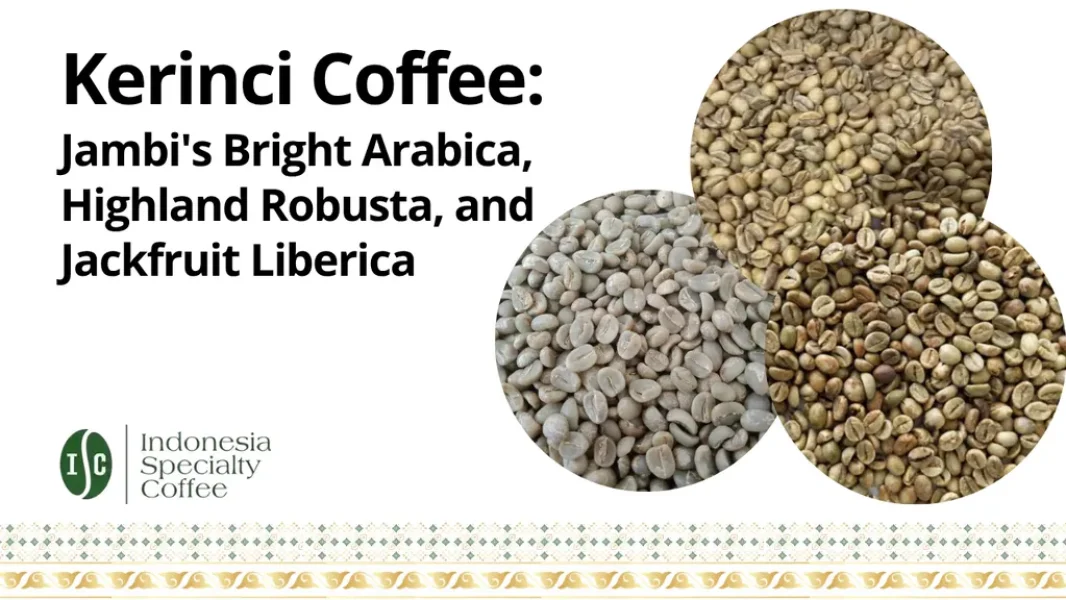
Most Sumatra coffee tastes like Sumatra: heavy, earthy, low-acid, the taste of wet-hulling and humidity. Kerinci is the origin that argues with that. Kerinci coffee comes from Kerinci Regency in Jambi Province, on the western spine of Sumatra, and it splits into two crops worth knowing. The high-grown arabica from Kayu Aro is bright, floral, and citrus-forward, closer to a washed African cup than to classic earthy Sumatra. The robusta below it is cleaner and sweeter than most, because the same volcano feeds both. One regency, two genuinely good coffees, plus a third Jambi cousin, Tungkal liberica, worth knowing. Here is how they differ and where the label gets loose.
Last updated: August 2026
What is Kerinci coffee?
Kerinci coffee is coffee grown in Kerinci Regency and the wider Jambi highlands of western Sumatra, on the volcanic soil around Mount Kerinci. It comes in two forms: a high-grown arabica from around 1,300 to 1,650 meters, known for bright acidity and floral, citrus notes, and a robusta from lower slopes, around 600 to 1,000 meters, known for heavy body and clean caramel sweetness.
That two-crop split is the first thing to understand. Kerinci is not a single flavor, it is an altitude ladder. Above roughly 1,000 meters the land grows specialty arabica; below it, highland robusta. Both sit inside the Bukit Barisan range on young volcanic soil, and both are grown by smallholders and pooled through cooperatives before export.
If your reference point for Sumatra is Mandheling or Gayo, Kerinci will surprise you. The arabica in particular does not follow the earthy, low-acid Sumatra script. It is one of the brighter, more modern-tasting origins in the country.
Where it grows: Kerinci, Jambi, and Mount Kerinci
Kerinci coffee grows on the slopes of Kerinci Regency in Jambi Province, below Mount Kerinci, which at 3,805 meters is the highest volcano in Indonesia and Southeast Asia. The best-known arabica sits around Kayu Aro and Gunung Tujuh, near Lake Gunung Tujuh, the highest volcanic lake in the region at about 1,950 meters. Robusta occupies the warmer ground lower down.
The terroir is the whole story. Young volcanic soil, high altitude, cool nights, and steady mountain rain slow the cherries as they ripen, and slow ripening builds sweetness and structure. Much of the coffee also grows inside or beside Kerinci Seblat National Park, a protected forest, so shade and biodiversity are part of the growing environment rather than an afterthought.
This is smallholder country. Farms run a couple of hectares, and cooperatives do the aggregating: one Kerinci cooperative reports hundreds of member families across several hundred hectares, shipping green coffee as far as the United States and Egypt. For a buyer that means you are almost always buying a cooperative lot, not a single farm, so consistency depends on who sorted and processed it.
Kerinci arabica: the bright side of Sumatra

Kerinci arabica is a specialty-grade, high-grown arabica with bright acidity and a floral, citrus-forward cup, unusual for Sumatra. Grown around Kayu Aro at 1,300 to 1,650 meters, it shows tangerine and lime citrus, floral top notes, and sweetness like molasses or honey, with a cleaner, lighter body than the heavy earthiness most people expect from the island.
The varieties tell you why. The dominant plants are Sigararutang (a Caturra crossed with Timor hybrid) and Andung Sari (a dwarf Catimor selection), both developed by Indonesia’s coffee research institute for productivity and rust resistance. These are not heirloom rarities, they are modern, hardy cultivars, and grown this high they cup far better than their commercial reputation suggests.
What makes Kerinci arabica interesting to a roaster is range. The same beans behave very differently by process. Washed and traditionally wet-hulled lots lean savory and balanced, with sandalwood and dried cherry. Natural lots swing sweet and fruity, into cocoa, black tea, lime, and watermelon. Anaerobic naturals push further still, into dried strawberry and pear drops. If you want a Sumatran arabica that can carry a light-to-medium single-origin filter program, this is one of the few that genuinely can.
Kerinci robusta: highland robusta worth buying

Kerinci robusta is highland robusta grown on the lower Jambi slopes, roughly 600 to 1,000 meters, and it cups cleaner and sweeter than typical lowland robusta. Expect a heavy body, low acidity, caramel and toffee sweetness, and a gentle spice, without the rubbery, ashy bite of cheap commercial robusta. It grades out as EK1 or Grade 1 for export.
The reason is the same altitude that lifts the arabica. Cooler mountain temperatures slow the robusta cherry too, so it builds more sugar and less of the harsh, over-extracted character robusta is known for. Many Jambi farmers also grow robusta under shade and alongside black pepper, which moderates the microclimate and tends to clean up the cup further.
This does not make it arabica, and it should not be priced or judged like one. What it makes is a genuinely good blend robusta: body, a heavy crema, and caramel sweetness for an espresso base, plus a low-acid backbone that holds up through milk. Set against other Indonesian robusta like Lampung, Jambi highland robusta sits at the sweeter, cleaner end of the scale.
Kerinci’s Jambi neighbor: Tungkal liberica

Tungkal liberica is not a Kerinci coffee, and that is worth saying plainly. It grows on the opposite side of the province, in the coastal lowland peat of Tanjung Jabung Barat, not the highlands. But it is Jambi’s most distinctive coffee, so if you are sourcing from the province you should know it. Liberika Tungkal Komposit, or Libtukom, is a geographical-indication-protected liberica with a jackfruit aroma and a sweet, herbal, long-finishing cup.
Liberica is a third coffee species, alongside arabica and robusta, with big, uneven beans and a bold, low-acid, heavily aromatic profile. The Tungkal version leans hard into ripe jackfruit, so characteristic that liberica is nicknamed jackfruit coffee, over a sweet and herbal base. It grows where arabica and robusta will not: hot, wet, acidic peatland close to sea level, which is exactly why lowland Jambi made it a specialty.
Two honest cautions. Production is small and largely household-scale, much of it historically shipped to Malaysia, so volume and consistency are limited. And because it is rare and priced high, Tungkal liberica is among the most counterfeited coffees in Indonesia, easy to fake once it is roasted and ground. If you want the real thing, buy it green and traceable. For the fuller picture, see our guide to Indonesian liberica.
How Kerinci coffee is processed and graded
Kerinci coffee is processed in two steps, like the rest of Sumatra. Step one is the cherry method: washed, honey, or natural for arabica, and semi-washed or natural for robusta. Step two is the hulling method: often wet-hulling, or Giling Basah, where the parchment is stripped while the bean is still wet at 30 to 50 percent moisture, then sun-dried to 11 to 13 percent. Better arabica lots increasingly skip wet-hulling for a fully washed or natural dry-hull to protect clarity.
That processing choice is the lever behind Kerinci’s flavor range. Traditional wet-hulling gives the heavier, savory, classic Sumatra character. A cleaner washed or natural dry-hull preserves the bright citrus and floral notes that make Kerinci arabica stand out. When you buy, the full two-step description tells you more about the cup than the region name does.
On grade, arabica sells as Grade 1 specialty and robusta as EK1 or Grade 1. EK1 stands for Eerste Kwaliteit, Dutch for “first quality,” a colonial-era term still used for the top robusta defect tier. Every one of these is a defect count under the Indonesian grading standard, not a cupping score. A clean grade tells you the beans were sorted, not that the coffee tastes good. With Kerinci especially, cup the sample.
What Kerinci coffee tastes like
Kerinci coffee tastes like two different drinks depending on the crop. The arabica is bright and clean, with citrus, floral notes, and sweet molasses or honey, and a medium body. The robusta is heavy and low-acid, with caramel, toffee, dark chocolate, and gentle spice. Both are cleaner than the earthy Sumatra stereotype, and both shift with processing.
This table lines up the two Kerinci crops and sets them against familiar Sumatran reference points.
| Coffee | Type | Elevation | Body | Signature notes |
|---|---|---|---|---|
| Kerinci arabica (Kayu Aro) | Arabica | 1,300-1,650 m | Medium | Tangerine, lime, floral, molasses, black tea |
| Kerinci / Jambi robusta | Robusta | 600-1,000 m | Heavy | Caramel, toffee, dark chocolate, gentle spice |
| Tungkal liberica (Jambi lowland) | Liberica | Near sea level, peat | Bold | Ripe jackfruit, sweet, herbal, long aftertaste |
| Gayo arabica | Arabica | 1,400-1,800 m | Full | Brown sugar, cedar, herbal, low-medium acidity |
| Mandheling arabica | Arabica | 1200-1,500 m | Heavy, syrupy | Deep earth, dark chocolate, licorice |
Read across it and Kerinci arabica is the outlier: brighter, more citric, and lighter-bodied than its north Sumatran cousins. That is exactly its selling point, and, for some buyers, exactly the surprise they need to be warned about.
The honest part: “Kerinci” is a regional label
Here is what most sellers leave off the bag. “Kerinci” is a regional name, not a farm-level guarantee, and it covers a lot of ground. Coffee grown across the wider Jambi highlands, including the neighboring robusta strongholds around Merangin, often ships under the Kerinci name because Kerinci is the one buyers recognize. That is fine when it is priced as Jambi highland coffee. It is a problem when you pay a single-origin premium for a province-wide blend.
We would argue Kerinci arabica is one of the more exciting Indonesian origins of the last decade, precisely because it refuses the earthy Sumatra template. But that refusal is also the honest trade-off. If your customers buy Sumatra for heavy body and low acidity, a bright, citric Kerinci will read as wrong to them, not better. It is a different style, and it needs to be sold as one. Put a floral, tangerine-forward coffee in front of someone expecting Mandheling and you will get complaints, not converts.
And clarity in the cup is not automatic here. Wet-hulling, humidity, and cooperative-level pooling all work against consistency, so the same “Kerinci arabica” can arrive clean and bright one crop and muddy the next. The good lots are very good. Getting them reliably means sampling every crop year, not trusting the name.
What this means for roasters and buyers
For roasters, treat Kerinci as two separate tools. The arabica is a single-origin play: a bright, floral Sumatran that can anchor a light-to-medium filter offering and give your Indonesian lineup something other than earthy body. The robusta is a blend component: body, crema, and caramel sweetness for espresso, and a low-acid base for milk drinks. Do not expect either one to do the other’s job.
Before you commit past a sample, ask any supplier five things: the crop year, whether it is arabica or robusta, the specific district and elevation, the full two-step process, and the grade. Then cup it. A good Kerinci arabica should show real citrus and clean sweetness without a musty or fermented off-note; a good Jambi robusta should show caramel and body without a rubbery, ashy edge. If the arabica tastes flat and earthy, someone wet-hulled the brightness out of it, or it was not grown as high as the label claims.
Frequently asked questions
What is Kerinci coffee?
Kerinci coffee is grown in Kerinci Regency, Jambi Province, in western Sumatra, on volcanic soil around Mount Kerinci. It includes a bright, high-grown arabica from around 1,300 to 1,650 meters and a heavier highland robusta from roughly 600 to 1,000 meters. Both are cleaner than the typical earthy Sumatra profile.
Is Kerinci coffee arabica or robusta?
Both. Kerinci grows specialty arabica on its higher slopes, especially around Kayu Aro, and robusta on the warmer ground below. The arabica is prized for bright, floral, citrus notes, while the robusta is valued for clean body and caramel sweetness in blends.
What does Kerinci arabica taste like?
Kerinci arabica is bright and clean, with tangerine and lime citrus, floral top notes, and sweetness like molasses or honey, over a medium body. It is unusually bright for Sumatra. Natural and anaerobic lots push further into fruit, cocoa, and black tea.
What does Kerinci robusta taste like?
Kerinci robusta has a heavy body, low acidity, caramel and toffee sweetness, dark chocolate, and gentle spice, with a cleaner finish than lowland robusta. It suits espresso blends and milk drinks rather than black filter coffee.
How high is Kerinci coffee grown?
Kerinci arabica is grown mainly between about 1,300 and 1,650 meters around Kayu Aro and Gunung Tujuh, near Mount Kerinci. Robusta grows lower, generally 600 to 1,000 meters. The high altitude slows ripening, which builds the sweetness and clarity both crops are known for.
How is Kerinci coffee processed?
In two steps. First the cherry is washed, honey, or natural processed. Then it is usually wet-hulled (Giling Basah), meaning the parchment is stripped while the bean is still wet at 30 to 50 percent moisture, before sun-drying to 11 to 13 percent. Cleaner washed or natural lots protect the arabica’s brightness.
Is Jambi liberica the same as Kerinci coffee?
No. Jambi’s famous Tungkal liberica (Liberika Tungkal Komposit) grows in the coastal lowland peat of Tanjung Jabung Barat, not the Kerinci highlands. It is a separate coffee species with a jackfruit aroma and a sweet, herbal cup. Kerinci grows arabica and robusta; liberica comes from lowland Jambi.
Sourcing Kerinci coffee: where to start
Whatever supplier you use, decide first whether you want the arabica or the robusta, then ask for the crop year, the district and elevation, the full two-step process, and the grade, and cup a sample before buying volume. If you want to compare Sumatran arabica and robusta side by side, Indonesia Specialty Coffee exports Grade 1 arabica and EK1 robusta from our Medan mill and can send cupping samples: request a sample or browse the green coffee range.