
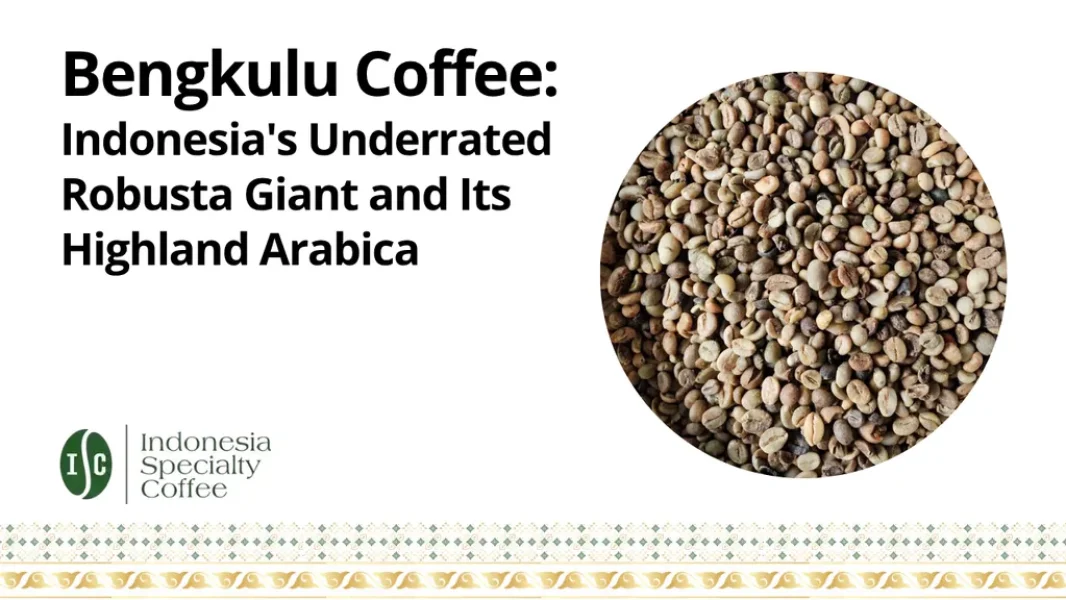
The British planted coffee here before there was Indonesia. Bengkulu was Bencoolen, an East India Company outpost on Sumatra’s west coast, and coffee has been a cash crop on these slopes ever since. Today Bengkulu coffee is one of the largest robusta origins in the country, the third biggest producer by volume, and almost nobody outside Indonesia can name it.
Most of it is robusta, grown by smallholders on the Bukit Barisan foothills and sold anonymously into blends. A smaller share is genuinely good: geographical-indication Kepahiang robusta, and a young highland arabica coming off the slopes of Mount Kaba. Here is what Bengkulu coffee actually is, and why you have probably drunk it without knowing.
Last updated: August 2026
What is Bengkulu coffee?
Bengkulu coffee is coffee grown in Bengkulu Province on the southwest coast of Sumatra, on the volcanic slopes of the Bukit Barisan range. It is overwhelmingly robusta, heavy-bodied and low-acid with dark chocolate and caramel notes, grown from roughly 700 to 1,200 meters. A smaller volume is highland arabica from above about 1,200 meters, brighter and sweeter, grown mostly around Kepahiang and Rejang Lebong near Mount Kaba.
The scale is lopsided, and worth stating up front. In a recent production year, Bengkulu grew around 59,000 tons of robusta against under 800 tons of arabica. This is a robusta province with an arabica sideline, not the other way around. Together with Lampung and South Sumatra, it anchors the southern Sumatra robusta belt that supplies over half of Indonesia’s robusta.
So when people talk about Bengkulu coffee, they mostly mean robusta. That is where the volume, the history, and the geographical-indication recognition sit. The arabica is the newer, smaller, more exciting story, and we will get to it.
Where it grows: Bencoolen, the Bukit Barisan, and Mount Kaba
Bengkulu coffee grows along the Bukit Barisan mountains that run behind the province’s coast, with the best highland coffee clustered inland around Kepahiang and Rejang Lebong. The landmark is Mount Kaba, an active stratovolcano rising to 1,952 meters between those two regencies, whose volcanic soil feeds the higher-altitude farms. Robusta dominates the mid-slopes; arabica sits up top.
The history here is older than most Indonesian origins markets. Under the name Bencoolen, this coast was a British pepper and coffee post for over a century, centered on Fort Marlborough. Coffee never left. The Rejang people have farmed these volcanic highlands for generations, and coffee has been part of that landscape long enough to be ordinary rather than fashionable.
That long, quiet history is part of why Bengkulu stays invisible. It is a working farmer’s crop, grown at smallholder scale and sold into the commodity chain, not a marketed single origin with a story on the bag. The raw material has been good for two hundred years. The naming and the specialty ambition are only now catching up.
Bengkulu robusta: the province’s real crop

Bengkulu robusta is the heart of the province’s coffee: a heavy-bodied, low-acid robusta with dark chocolate, caramel, and a woody, herbal depth, and a long aftertaste. Grown across the Bukit Barisan foothills, the better highland lots from Kepahiang carry a cleaner sweetness and even some fruit and lemon, enough that Kepahiang robusta holds geographical-indication status and has won national specialty robusta contests.
That contest pedigree matters, because it puts a number on something roasters underestimate. Robusta grown with care at altitude is not the harsh, rubbery filler of instant-coffee reputation. A well-processed highland Bengkulu lot can carry real cocoa and caramel, with the bitterness dialed down to a savory backbone rather than an ashtray. Set beside a bulk Lampung robusta, a good Kepahiang lot is a cleaner, sweeter cup.
Here is the honest catch. The GI Kepahiang material is a thin slice of what Bengkulu ships. Most of the province’s 59,000-odd tons is ordinary commercial robusta, picked less selectively and blended away. The province is capable of excellent robusta. It mostly sells average robusta, because that is what the commodity market pays for.
Bengkulu arabica: the young highland upstart
Bengkulu arabica is a small, young highland crop grown above roughly 1,200 meters around Kepahiang and Rejang Lebong, near Mount Kaba. It shows a fruity, lemony brightness, chocolate, and a brown-sugar sweetness over a smooth, moderate acidity. The dominant plant is Sigararutang, a hardy variety brought down from North Sumatra and planted here through a local government program from around 2007.
That 2007 date tells you what to expect. This is a coffee scene barely old enough to have found its feet. The trees are relatively young, the processing is still developing, and consistency lot to lot is not yet a given. When it is grown high and processed cleanly, Bengkulu arabica cups like a lighter, sweeter cousin of the north Sumatran highland coffees, with more citrus lift than the earthy stereotype.
For a roaster, that makes it a coffee to watch rather than a settled staple. The ceiling is real: volcanic soil, good altitude, a proven variety. The floor is still uneven. If you want it, buy by the specific highland lot and cup every crop year, because the average and the best are further apart here than in a mature origin.
How Bengkulu coffee is processed and graded
Bengkulu coffee is processed in two steps, like the rest of Sumatra. Step one is the cherry method: mostly semi-washed, where the fruit is depulped and fermented off, though dry natural is common for robusta. Step two is the hulling method: often wet-hulling, or Giling Basah, where the parchment is stripped while the bean is still wet at 30 to 50 percent moisture, then sun-dried to 11 to 13 percent. Cleaner washed and natural lots are used for the better arabica.
For grading, Bengkulu robusta sells as Grade 1, EK1, or a lower Grade B for commercial material. EK1 stands for Eerste Kwaliteit, Dutch for “first quality,” a colonial-era term still used for the top robusta defect tier. Arabica sells as Grade 1 specialty. Every one of these is a defect count under the Indonesian grading standard, not a taste score.
The supplier-side reality is the usual one, and it bites harder in a high-volume commodity origin. A clean Grade 1 or EK1 spec tells you the beans were sorted, screened, and dried to spec. It says nothing about whether they were picked ripe, grown at 800 meters or 1,200, or handled cleanly through Bengkulu’s humid coastal climate. Two honest EK1 lots can cup a full point apart. Grade is your floor here, never your answer.
What Bengkulu coffee tastes like
Bengkulu coffee tastes like two different drinks. The robusta is heavy and low-acid, with dark chocolate, caramel, a woody herbal depth, and a long finish, and the better highland lots add a clean sweetness and a hint of lemon. The arabica is lighter and brighter, with citrus, chocolate, and brown-sugar sweetness over a smooth acidity. Both are cleaner than the harsh robusta reputation suggests.
This table sets the two Bengkulu crops against familiar reference points.
| Coffee | Type | Elevation | Body | Signature notes |
|---|---|---|---|---|
| Bengkulu robusta (Kepahiang) | Robusta | 700-1,200 m | Heavy | Dark chocolate, caramel, woody, hint of lemon |
| Bengkulu arabica | Arabica | 1,200 m+ | Medium | Lemon, chocolate, brown sugar, smooth acidity |
| Lampung robusta | Robusta | 100-800 m | Full | Woody, earthy, bittersweet, big volume |
| Gayo arabica | Arabica | 1,400-1,800 m | Full | Brown sugar, cedar, herbal, low-medium acidity |
Read across it and Bengkulu’s strength is a cleaner-than-average robusta, with an arabica that is promising but still lighter and less established than its northern neighbors. Judge the robusta against other robusta and it looks good. Judge the arabica against Gayo and you are comparing a newcomer to a veteran.
The honest part: most Bengkulu coffee is sold without its name
Here is what the commodity chain will not put on a label. The great majority of Bengkulu coffee is sold anonymously. It leaves the province as generic “Sumatra robusta,” gets pooled with Lampung and South Sumatra lots, and reaches roasters and instant-coffee factories with no mention of Bengkulu at all. One of Indonesia’s biggest robusta origins is effectively invisible by design.
We would argue that is a missed opportunity, not a quality verdict. The GI Kepahiang robusta and the highland arabica prove the province can produce distinctive coffee. But distinctive coffee needs traceability and a premium to survive, and most Bengkulu farmers get neither. They sell into a market that pays for tonnage and defect grade, not origin character, so that is what most of them grow.
Now the trade-off, stated plainly. If you buy “Bengkulu robusta” at a commodity price, you are usually buying solid, clean, blend-grade robusta, and that is fine value for a blend base. If you want the contest-grade Kepahiang lot or the highland arabica, you have to ask for it specifically, pay more, and accept smaller, less predictable volume. The cheap default and the good stuff are not the same coffee wearing the same name.
What this means for roasters and buyers
For roasters, treat Bengkulu as two very different buys. Commercial Bengkulu robusta is a dependable, low-cost blend base: body, crema, and chocolate for espresso, with clean enough sorting at EK1 or Grade 1 to behave predictably. The GI Kepahiang robusta and the Mount Kaba arabica are small-lot specialty plays, worth sampling if you want an unusual, story-rich single origin your competitors are not pouring.
Before you commit past a sample, ask any supplier five things: the crop year, whether it is robusta or arabica, the specific regency and elevation, the full two-step process, and the grade. Then cup it. A good highland Bengkulu robusta should show cocoa and caramel without a rubbery or ashy edge; a good Bengkulu arabica should show citrus and clean sweetness without a musty, over-fermented note. If the robusta tastes flat and bitter, it was grown low and handled fast, whatever the label says.
Frequently asked questions
What is Bengkulu coffee?
Bengkulu coffee is grown in Bengkulu Province on the southwest coast of Sumatra, on the volcanic slopes of the Bukit Barisan range. It is mostly robusta, heavy-bodied and low-acid with chocolate and caramel notes, plus a smaller highland arabica crop grown around Kepahiang and Rejang Lebong near Mount Kaba.
Is Bengkulu coffee robusta or arabica?
Overwhelmingly robusta. Bengkulu is one of Indonesia’s largest robusta producers, growing tens of thousands of tons a year, against a much smaller volume of highland arabica. The robusta is the province’s main crop; the arabica is a newer, small-scale specialty.
What does Bengkulu robusta taste like?
Bengkulu robusta is heavy-bodied and low-acid, with dark chocolate, caramel, and a woody, herbal depth, plus a long finish. Better highland lots from Kepahiang add a clean sweetness and a hint of lemon, cleaner than the harsh robusta stereotype.
Where is Bengkulu coffee grown?
It grows across the Bukit Barisan foothills of Bengkulu Province, with the best highland coffee around Kepahiang and Rejang Lebong near Mount Kaba, an active volcano of 1,952 meters. Robusta grows from about 700 to 1,200 meters; arabica sits above roughly 1,200 meters.
Is Bengkulu robusta a specialty coffee?
It can be. The geographical-indication Kepahiang robusta has won national specialty robusta contests and cups with real cocoa and caramel sweetness. But most Bengkulu robusta is ordinary commercial-grade coffee sold into blends, so specialty lots have to be sourced specifically.
How is Bengkulu coffee processed?
In two steps. First the cherry is usually semi-washed or dry-natural. Then it is often wet-hulled (Giling Basah), meaning the parchment is stripped while the bean is still wet at 30 to 50 percent moisture, before sun-drying to 11 to 13 percent. This gives the heavy body typical of Sumatran coffee.
Sourcing Bengkulu coffee: where to start
Whatever supplier you use, decide first whether you want commercial robusta, a GI Kepahiang lot, or the highland arabica, then ask for the crop year, the regency and elevation, the full two-step process, and the grade, and cup a sample before buying volume. If you want to compare southern Sumatran robusta side by side, Indonesia Specialty Coffee exports graded Sumatra robusta and arabica from our Medan mill and can send cupping samples: request a sample or browse the green coffee range.