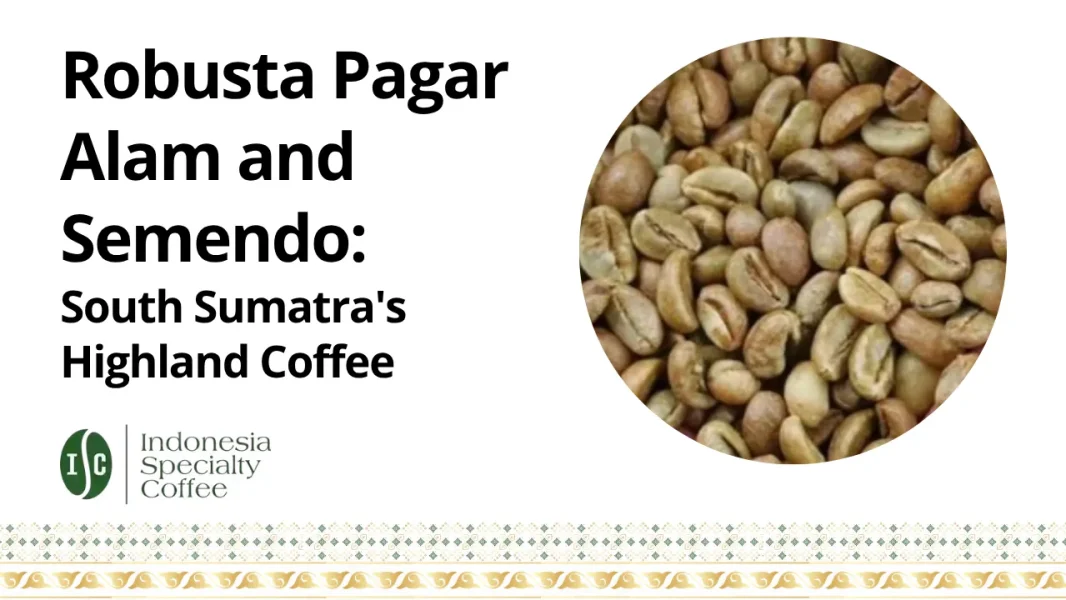
There is a good chance you have already drunk South Sumatra robusta this week without knowing it. This one province grows more coffee than anywhere else in Indonesia, almost all of it robusta, and a lot of it disappears into instant coffee and espresso blends under no name at all. Pagar Alam and Semendo are the two names that do get spoken, and they are where the more interesting version of this coffee lives.
So here is the direct answer. Robusta Pagar Alam is a highland robusta grown on the slopes of Mount Dempo in Pagar Alam, South Sumatra, while Semendo (Semende) robusta comes from the Bukit Barisan highlands of neighboring Muara Enim. Both grow higher and cooler than the lowland robusta stereotype, and when the cherry is ripe-picked and carefully dried, they cup thick, chocolatey, and clean rather than harsh. This piece covers where they grow, the history that turned this into robusta country, the varieties in the ground, and why good robusta is not a contradiction.
Last updated: September 2026
What are Pagar Alam and Semendo coffee?

Pagar Alam and Semendo are South Sumatra’s two best-known robusta coffees. Pagar Alam robusta grows on the volcanic slopes of Mount Dempo around the city of Pagar Alam, and Semendo robusta grows in the Bukit Barisan highlands of Muara Enim regency. Both are highland-grown robusta, thick-bodied and low in acidity, and both come from the province that produces more coffee than any other in Indonesia.
The important word is robusta. This is not the earthy wet-hulled arabica of Gayo or Mandheling, and it is not the bright washed arabica of Bali or Java. It is Coffea canephora, the tougher, more caffeinated species that most of the world drinks in blends and instant coffee. What makes Pagar Alam and Semendo worth naming is that they are among the origins showing what robusta can do when it is grown high and handled with care, rather than farmed purely for tonnage.
Where they grow: Mount Dempo, Semendo, and South Sumatra’s highlands
Pagar Alam robusta grows on Mount Dempo, South Sumatra’s highest volcano at about 3,173 meters, on the Besemah plateau, while Semendo robusta grows across the Bukit Barisan range in Muara Enim. Both sit in cool, high country on volcanic soil, higher than the 400 to 700 meters where most Indonesian robusta is grown. That extra elevation is the whole reason these two names stand out.
Robusta is usually a lowland crop, and that is a big part of why it has the reputation it does. Grown hot and fast at low altitude, it tends toward the rubbery, woody, bitter profile people complain about. Pagar Alam and Semendo are different because the mountains push the coffee up into cooler air, and cooler air slows the cherry down. The same thing that makes high-grown arabica taste better makes high-grown robusta taste better: slower ripening, more sugar development, more in the cup than just strength.
This matters at the provincial scale, because South Sumatra is not a small player. It is the largest coffee-producing province in Indonesia, ahead of Lampung, and the bulk of that is robusta from regencies like Pagar Alam, Muara Enim, Empat Lawang, OKU Selatan, and Lahat. When people say Indonesia is one of the world’s biggest robusta exporters, they are talking, in large part, about these hills. Most of that volume is ordinary. The highland pockets are where the quality conversation happens.
From Dutch arabica to robusta country: the history
South Sumatra did not start as robusta country. The Dutch planted arabica on Mount Dempo’s slopes back in the eighteenth century, the same colonial coffee push that seeded the rest of Sumatra. What changed here is what changed almost everywhere in Indonesia: leaf rust and hard economics made delicate arabica a losing bet at these altitudes, and after independence the farmers moved to robusta, which shrugged off the disease and yielded more.
That switch stuck, and it stuck harder here than in the arabica highlands further north. Where Gayo and Lintong rebuilt their arabica, Pagar Alam and Semendo became committed robusta regions, and robusta became the backbone of the local farm economy for generations. This is smallholder coffee, grown in modest gardens and sold into a bulk supply chain that never much cared what the lot tasted like, only what it weighed and what it cost.
Here is the shift worth watching now. In the last few years, programs and individual farmers around Pagar Alam have started treating robusta as something that can be improved rather than just harvested, with better picking, cleaner drying, new processing, and a push toward export markets. We would argue this is the most interesting moment South Sumatra coffee has had in a century. It is a bulk robusta region deciding, in places, to find out how good its coffee can actually be. That does not rewrite the whole province overnight, but it is where the good lots are coming from.
The variety: robusta clones and Pagar Alam’s Yellow Canephora
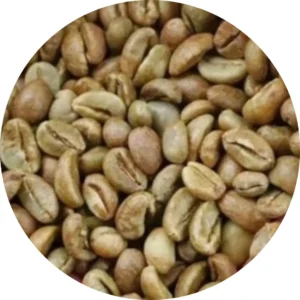
The coffee here is Coffea canephora, the robusta species, and in practice that means clones rather than the named heirloom varieties you get with arabica. South Sumatra’s gardens are planted mostly with government-released robusta clones such as the BP series (BP 42, BP 358, BP 409) and Tugusari, selected over the years for yield, disease resistance, and how well they handle the local highlands.
Robusta being clonal changes how you think about variety. Farmers propagate these plants from cuttings and grafts, not seed, so a well-managed garden is often a deliberate mix of clones chosen to pollinate each other and spread the harvest. It is less romantic than a Typica heirloom story, but it is closer to how a serious robusta farm actually runs. The clone matters for the farmer’s yield and resilience more than it announces itself in the cup.
The exception, and the one to watch, is a local yellow-cherry canephora that growers around Pagar Alam have been developing as a signature variety for the region. Yellow-fruited selections turn up in both arabica and robusta, and the interest here is the same everywhere: a distinctive, identifiable lot that can carry a place name instead of vanishing into the bulk pile. Whether it becomes Pagar Alam’s calling card or stays a curiosity is still an open question, and worth asking a supplier about directly.
Why good robusta is not a contradiction
Robusta has a bad name, and it earned most of it honestly, but the harshness people associate with it is mostly a picking-and-processing problem, not a fact about the species. Strip a branch of ripe, half-ripe, and green cherries all at once, dry them in a rough heap on a tarp, and you get the rubbery, bitter, woody cup that gave robusta its reputation. Do the opposite, and the same species can taste clean.
The species will never be arabica, and it does not need to be. Robusta brings things arabica cannot: nearly double the caffeine, a heavier body, thick crema in espresso, and a deep chocolate-and-nut base with very low acidity. Grown high on Dempo or in Semendo and handled well, it holds those strengths while shedding the worst of the harshness. That is what “fine robusta” means, and it is a real category with its own quality standards, not a marketing invention.
So when a Pagar Alam lot cups thick, sweet, and chocolatey with a soft finish, nothing strange has happened. The altitude gave it a slower, sweeter cherry, and someone picked it ripe and dried it properly. Would you serve it as a delicate single-origin filter? Probably not. Would it build a serious espresso blend with body and crema that a soft arabica can’t match? That is exactly the job it is best at.
How it’s processed, and what it tastes like
Most South Sumatra robusta is natural (dry) processed, the whole cherry dried in the sun and then dry-hulled once it reaches about 12 to 13 percent moisture, which is the cheap, high-volume default across the province. The better Pagar Alam and Semendo lots take the same two-step idea but do each step with care: pick only ripe red cherry, dry it slowly and evenly on raised beds or clean patios rather than in deep heaps, then hull. Some producers now run fully washed and honey lots too, chasing a cleaner cup.
Think of it as a two-step choice, the same framework that governs all Indonesian coffee. Step one is the cherry method: usually natural here, sometimes washed or honey on the specialty lots. Step two is the hulling method: these highland robustas are dry-hulled at roughly 12 to 13 percent moisture like a normal dried coffee, not wet-hulled green the way Sumatran arabica is. The care in step one is what separates a clean Dempo lot from commodity robusta, far more than the choice of method itself.
On the table, a good highland South Sumatra robusta reads thick and low-acid, with dark chocolate, roasted nuts, a little earthy spice, and a soft, lingering finish. Pagar Alam Dempo lots tend to show that balanced bitter-and-savory weight with a strong aroma; Semendo tends darker and heavier still. Here is the detail a supplier learns fast: robusta punishes rushed drying more visibly than arabica hides it, so a musty, rubbery, or sharply bitter cup almost always traces back to cherry dried too wet or too fast, not to the beans being beyond help.
Because Pagar Alam and Semendo are close neighbors with different profiles, and because Lampung is the robusta most buyers already know, this table places them side by side:
| Origin | Region | Altitude | Cup |
|---|---|---|---|
| Pagar Alam (Dempo) | Pagar Alam, S. Sumatra | Highland, Mt Dempo | Chocolate, balanced bitter-savory, strong aroma, soft finish |
| Semendo | Muara Enim, S. Sumatra | Highland, Bukit Barisan | Darker, heavier body, thick texture |
| Lampung robusta | Lampung | Mostly lowland | Bold, woody, classic bulk-robusta profile |
| Fine robusta (benchmark) | Various | Higher, ripe-picked | Clean, sweet, chocolate, very low harshness |
The point of the table is that “robusta” is not one thing. Move from Lampung bulk up to a ripe-picked highland Dempo lot and you are moving across a real quality range, not just swapping labels.
The honest part: commodity by the shipload, fine robusta by the exception
Here is what a straight supplier will tell you. The large majority of South Sumatra robusta, Pagar Alam and Semendo included, is still commodity coffee: strip-picked for speed, dried rough for volume, and sold on price into blends and instant. It cups the way bulk robusta cups, and no origin story changes that. If you buy a container of generic “Sumatra robusta,” this is very likely what you are getting.
The fine, clean, ripe-picked lots are the exception, not the default, and you have to ask for them specifically. That means talking to a supplier who separates ripe-picked, carefully dried lots from the general pile, and it usually means a higher price than commodity robusta, though still well below specialty arabica. Do not assume the name Pagar Alam or Semendo on a bag guarantees the careful version. It guarantees the region, not the handling.
And keep the ceiling honest. Even the best fine robusta from these hills is a body-crema-and-chocolate coffee. It will not give you the acidity, floral aromatics, or delicate complexity of a good arabica, and it is not trying to. What it will do, and do better than most arabica, is anchor an espresso blend with weight and crema, hold up under milk, and deliver strength and value. Buy it for what it is, and it is very good. Buy it expecting arabica in disguise, and you will be let down.
What this means for roasters and buyers
For a roaster, highland South Sumatra robusta is a blend and espresso tool first. A clean Pagar Alam or Semendo lot brings body, crema, and a chocolate-nut base that fills out an espresso blend and stands up in milk drinks, and taken to a medium or medium-dark roast it gives you that classic Indonesian robusta weight without tipping into ashy or rubbery. As a fine-robusta single origin it is a talking point for a bar that wants to show customers what good canephora can do.
If you are buying green, the questions are different from arabica but just as sharp. Ask whether the lot is ripe-picked and how it was dried, because with robusta that is the entire difference between clean and harsh. Ask the grade and defect level, since robusta grades on defects and screen size. And cup it yourself against a commodity robusta and a soft arabica, so you know exactly where it sits and what job it will do in your blend. Which are you actually buying it for, a cheaper filler or a genuine fine robusta? The answer decides how much you should be willing to pay and what to demand.
One planning note. Commodity robusta is available in volume year-round, but the carefully processed fine-robusta lots are limited and move fast, so if you cup a clean Dempo or Semendo lot you like, treat it as a specific lot to secure rather than a grade you can reorder on demand.
Frequently asked questions
What is Pagar Alam coffee?
Pagar Alam coffee is a highland robusta grown on the slopes of Mount Dempo in Pagar Alam, South Sumatra. It grows higher and cooler than typical lowland robusta, and good lots cup thick and low-acid with dark chocolate, roasted nuts, a balanced bitter-savory weight, and a soft finish. Most of it is natural (dry) processed.
Where is Semendo coffee from?
Semendo (Semende) coffee comes from the Semendo highlands in Muara Enim regency, South Sumatra, in the Bukit Barisan mountains. It is mainly robusta, known for a dark, heavy, thick-textured cup, and it is one of the province’s largest producing areas and a staple in Palembang coffeehouses.
Is South Sumatra coffee arabica or robusta?
Almost entirely robusta. South Sumatra is Indonesia’s largest coffee-producing province, and the overwhelming majority is robusta from regencies like Pagar Alam, Muara Enim, and Empat Lawang. Small amounts of arabica exist at the highest elevations, including around Semendo, but the region’s identity and volume are robusta.
Why does robusta taste harsh, and does Pagar Alam robusta?
Robusta often tastes harsh because it is strip-picked with unripe cherries and dried roughly, not because the species is bad. Ripe-picked, carefully dried highland robusta from Pagar Alam or Semendo cups much cleaner: chocolatey, thick, and low in harshness. The handling matters more than the species.
What is fine robusta?
Fine robusta is high-quality robusta grown, picked, and processed to a defined quality standard, the robusta equivalent of specialty arabica. It cups clean and sweet with chocolate and nut notes and very low harshness, while keeping robusta’s body and high caffeine. Highland lots from Pagar Alam and Semendo are among Indonesia’s candidates for it.
What is Pagar Alam robusta used for?
Highland Pagar Alam robusta is used mainly in espresso blends and darker roasts, where its body, crema, and chocolate-nut base add weight and hold up in milk drinks. Clean fine-robusta lots are also roasted as single origins to show what good canephora can do, and bulk lots go into instant coffee.
Sourcing South Sumatra robusta: where to start
Whatever supplier you use, the two questions that matter most for robusta are whether the lot was ripe-picked and how it was dried, so ask those before you ask anything else, then confirm the grade, defect level, and crop year, and cup the lot against a commodity robusta so you can hear the difference for yourself. If you want to compare highland South Sumatra robusta against Indonesia’s other origins, Indonesia Specialty Coffee can send green samples of the lots we export, so you can taste a Pagar Alam or Semendo robusta next to the arabicas on your own table and decide where it fits in your blend.