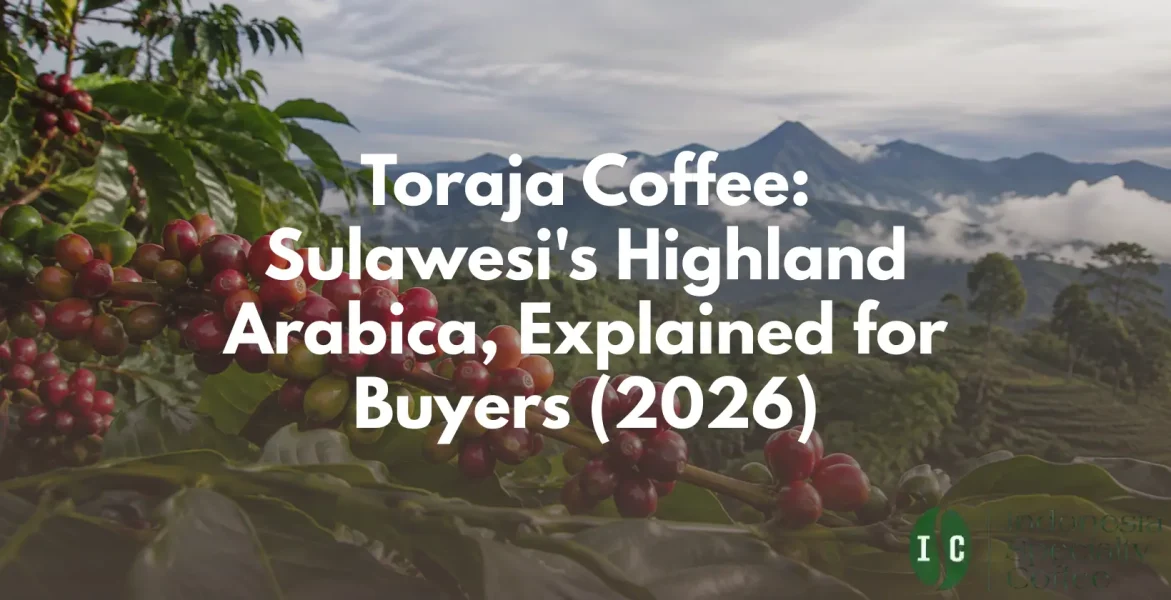
Toraja coffee is high-altitude Arabica from the South Sulawesi highlands, grown between roughly 1,400 and 2,100 metres and processed semi-washed then wet-hulled. It gives you Sumatran body without Sumatran earthiness, which is why roasters reach for it when a blend needs weight but the cup still has to read clean. This guide covers where it grows, the named lots, how it cups, and when to buy.
Last updated: 26 August 2026
What Is Toraja Coffee?
Toraja coffee takes its name from the Toraja people of the South Sulawesi highlands. The word traces to To Riaja, a Bugis term for people of the uplands. You will also see the beans traded as Celebes coffee, after the old colonial name for Sulawesi, which still appears on price lists and in older contracts.
The coffee itself sits in the middle of the Indonesian map, which is what makes it useful to you. It is semi-washed and wet-hulled (Giling Basah) like Sumatra, so it carries real body, but the altitude holds far more acidity and aromatic lift through that process than Gayo or Mandheling manage.
| Sulawesi Toraja | |
|---|---|
| Island | Sulawesi (South Sulawesi) |
| Altitude | 1,400 to 2,100 masl |
| Species | Arabica |
| Step 1: Cherry | Semi-washed, some full-washed |
| Step 2: Hulling | Wet-hulled, selective |
| Screen size | 18 to 20 |
| Acidity | Low to medium |
| Body | Full, creamy, rounded |
| Flavor | Warm spice, cocoa, dried fruit, subtle floral |
| Harvest peak | May to September |
Where Toraja Coffee Grows
The growing area covers Tana Toraja and North Toraja regencies, inland and north of Makassar, on the slopes around Mount Sesean. The terrain does most of the work, and it explains what you get in the cup.
Volcanic soil supplies the mineral base. Altitude supplies the rest: cool nights slow cherry maturation, and slower maturation builds the sugars and acids that survive into the cup. The highest lots on Sesean reach the top of that 2,100 metre band, which puts Toraja among the highest-grown coffee in Indonesia.
Farms are small. Most Torajan growers work plots of a few hectares, with coffee intercropped alongside spice trees and food crops rather than planted as monoculture estate. That structure limits volume, and it is part of why the named Toraja lots you want stay scarce relative to Sumatran origins.
The Named Toraja Lots: Sapan, Kalosi, and Pulu-Pulu
This is where buyers get confused, because the names on your offer sheet mix growing areas with trade designations.
| Name | What it actually refers to | What to expect |
|---|---|---|
| Toraja Sapan | A specific high-elevation area, often sold as Sapan Minanga | The brightest Toraja profile, more acidity and aromatic clarity |
| Toraja Kalosi | A trade name from the historical collection point | Rounder and more chocolate-forward, medium body |
| Pulu-Pulu | A smaller producing area | Scarce, sold in limited volume as a rotating single origin |
Sapan is the one worth knowing. Lots from that area cup noticeably brighter than generic Toraja, with a fresh acidity closer to apple or grapefruit sitting on top of the usual spice and cocoa base. If your customers say Indonesian coffee is too heavy for them, Sapan is the lot to hand over.
Kalosi is a trade designation rather than a distinct terroir, so treat the name as an indication of style and supplier rather than a guarantee of a specific plot. Ask your supplier for the actual collection area.
Comparing Toraja lots for a single-origin slot? See our pricelist or contact our team for current lot specifications and samples.
Why Toraja Is Arabica Country
Worth correcting a claim that circulates widely, including in an earlier version of this page: the Toraja highlands do not produce meaningful Robusta, and the two species do not share this altitude band.
Robusta grows best between roughly 200 and 800 metres, where it gets the warmth and humidity it needs. Arabica wants 1,000 to 2,000 metres and cool nights. At 1,400 to 2,100 metres, Toraja sits squarely in Arabica territory and well above where Robusta performs.
Indonesia does produce large volumes of Robusta, and some of the world’s better Fine Robusta. It comes from Lampung, southern Sumatra, and lowland Java, not from the Sulawesi highlands. Our own Sulawesi Toraja lots are 100% Arabica, as is essentially everything traded under the Toraja name.
If an offer sheet lists Robusta Toraja at highland elevations, ask where it was actually grown.
What Toraja Coffee Tastes Like
Expect warm spice, cocoa, and dried fruit over a full, creamy body, with low to medium acidity and a long clean finish. On the table it reads sweet and earthy with herbal edges rather than the cedar and tobacco of Sumatra.
The comparison that helps most: Toraja is Mandheling’s body with a good deal of Mandheling’s earthiness traded away for aromatic lift. Against a washed Bali or Java it reads heavier and rounder. Against Gayo it reads cleaner and slightly more acidic.
That middle position is the commercial argument for your menu. Toraja works as an espresso base that survives milk, as a filter single origin that does not tire the palate, and as the Indonesian component in a blend that needs weight without the earthy floor taking over.
One roasting note for first-time buyers. Toraja is wet-hulled, so it behaves like Sumatra in the drum rather than like a washed Central American: lower bulk density, more open cell structure, and a tendency to take surface heat fast. Drop your charge temperature 5°C to 8°C below your washed baseline. The high-grown Sapan lots tolerate slightly more heat than generic Toraja, but start low and work up.
Harvest Timing and Buying Fresh Crop
Sulawesi harvests peak May through September, which puts Toraja slightly behind the Sumatran Arabica window and makes the two complements in your buying calendar rather than competitors.
Practical points for contracting:
- Order fresh crop within three to six months of harvest peak for the lowest moisture loss and the most intact aromatics.
- Volume is limited. Smallholder plots and intercropping cap what any given area yields, so named lots like Sapan sell out rather than restock.
- Ask for the moisture reading before the container ships, since wet-hulled lots spend longer in a high-moisture state than dry-hulled coffee.
- Confirm the collection area, not just the trade name on the offer.
Frequently Asked Questions
What is Toraja coffee?
Toraja coffee is high-altitude Arabica grown in the Tana Toraja and North Toraja highlands of South Sulawesi, Indonesia, between roughly 1,400 and 2,100 metres. It is semi-washed and wet-hulled, producing a full-bodied cup with warm spice, cocoa, and low to medium acidity.
What does Toraja coffee taste like?
Expect warm spice, cocoa, and dried fruit over a full, creamy body, with a long clean finish and low to medium acidity. It carries Sumatran weight with noticeably less earthiness, because the high altitude preserves more acidity and aroma through wet-hulling.
Is Toraja coffee Arabica or Robusta?
Toraja is Arabica. The growing area sits between 1,400 and 2,100 metres, well above the 200 to 800 metre band where Robusta performs. Indonesian Robusta comes from lowland areas such as Lampung, southern Sumatra, and Java, not the Sulawesi highlands.
What is the difference between Toraja Sapan and Toraja Kalosi?
Sapan is a specific high-elevation growing area and cups brighter, with more acidity and aromatic clarity. Kalosi is a trade name from the historical collection point rather than a distinct terroir, and generally cups rounder and more chocolate-forward with medium body.
How does Toraja coffee compare to Sumatra coffee?
Both are semi-washed and wet-hulled, so both carry heavy body and low acidity. Toraja grows higher, which preserves more acidity and aromatic lift, so it cups noticeably cleaner and less earthy than Gayo or Mandheling while keeping a comparable creamy mouthfeel.
When is the Toraja coffee harvest?
The Sulawesi harvest peaks from May through September, running slightly later than the main Sumatran Arabica window. Buying within three to six months of that peak gives you the freshest cup profile and the least moisture loss in transit and storage.
Buy Sulawesi Toraja Green Coffee from Indonesia Specialty Coffee
Indonesia Specialty Coffee supplies Sulawesi Toraja as Grade 1 Specialty green coffee, 82 to 88 SCA points, graded against SNI 01-2907-2008 with a defect value of 11 or lower and moisture at or below 12.5%. We ship FOB Belawan from Medan, Halal certified, with Organic and Rainforest Alliance available on request.
Toraja sits between our Sumatran and our washed lots, so the useful test is a comparative one. Our guide to Indonesian coffee regions sets out how the origins differ on paper. Order tiers run 1 kg cupping samples, 60 kg microlot, 350 kg wholesale, and container loads from 9 MT. Take a Toraja sample alongside a Gayo and cup them side by side. Browse our green coffee beans.