
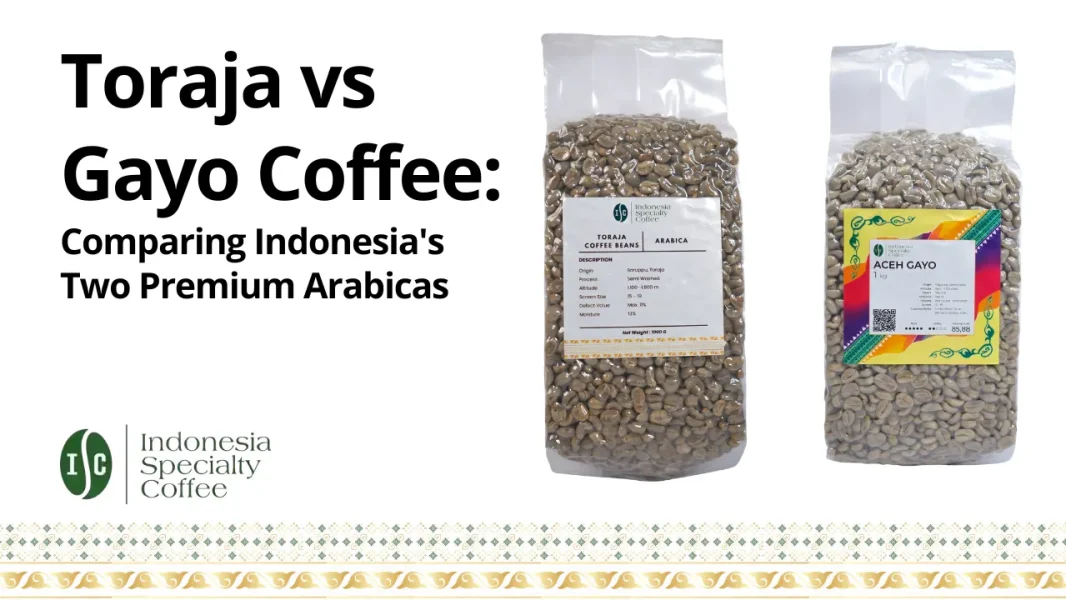
Toraja and Gayo are Indonesia’s two most internationally traded Grade 1 Arabica origins. Both grow above 1,400 metres above sea level, both cup at 82 SCA points or above, and both carry the full-body, low-acidity character that defines Indonesian specialty Arabica. However, they differ on altitude ceiling, varietal genetics, flavor direction, process range, and price per kilogram FOB Belawan. This guide gives you the data to choose the right origin, or both, for your roastery.
Last updated: April 2026
Toraja vs Gayo at a Glance


The table below summarises both origins across the attributes that matter most to specialty buyers and importers.
| Attribute | Toraja (Sulawesi) | Gayo (Aceh, Sumatra) |
|---|---|---|
| Island | Sulawesi | Sumatra |
| Altitude | 1,400–2,100 m ASL | 1,400–1,800+ m ASL |
| Key Arabica varietals | Sapan, Yale, Pulu-Pulu | Typica, Bourbon, Catimor, Tim Tim, Gayo 1, Gayo 2 |
| Flavor character | Dark chocolate, ripe fruit, cedar, spice | Dark chocolate, cedar, brown sugar, herbal |
| Step 1 — Cherry process | Semi-washed | Semi-washed, full-washed, honey, natural, wine |
| Step 2 — Hulling | Wet-hulled (Giling Basah) | Wet-hulled or dry-hulled (by process) |
| Grade (ISC) | Grade 1 Specialty | Grade 1 Specialty |
| SCA score range | 82–85+ points | 82–88 points |
| ISC price (Apr 2026, FOB Belawan) | $9,500/MT | $9,500/MT |
Toraja Coffee: Origin, Growing Conditions, and Character
Toraja Arabica grows in the Tana Toraja and Toraja Utara regencies of South Sulawesi, across the Sesean and Latimojong mountain ranges. At 1,400 to 2,100 metres above sea level, Toraja reaches a higher altitude ceiling than Gayo, and that extra elevation contributes directly to the spice-forward complexity roasters associate with the origin.
The dominant Arabica cultivars are local landraces: Toraja Sapan, Toraja Yale, and Toraja Pulu-Pulu. Specifically, these cultivars are genetically distinct from the Typica and Catimor lineages common in Sumatra, which is why Toraja cups differently from Gayo even when both undergo wet-hulling. In the cup, Toraja Arabica delivers full body and low acidity, with core notes of dark chocolate, ripe fruit, and cedar, and a secondary layer of cinnamon and clove. The finish tends to be long and earthy. Toraja carries the historical name “Celebes Coffee,” dating to the Dutch colonial period when Sulawesi was called “Celebes.”
Indonesia Specialty Coffee sources Sulawesi Toraja directly from smallholder farms in Tana Toraja, with Grade 1 lots cupping at 82–85+ SCA points. For a full origin overview, see the guide to Toraja coffee.
Gayo Coffee: Origin, Growing Conditions, and Character
Gayo Arabica grows across three highland districts in Aceh province at the northern tip of Sumatra: Aceh Tengah, Bener Meriah, and Gayo Lues, with Takengon as the trading hub near Lake Tawar. ISC sources Gayo from partner farms at 1,400 to 1,800+ metres above sea level, on volcanic andisol soils along the slopes of Burni Telong.
Unlike Toraja’s local landraces, Gayo Arabica covers a wider varietal range: Typica, Bourbon, Catimor, Tim Tim (Hibrido de Timor), Gayo 1, and Gayo 2. That genetic breadth, combined with 2,000–3,000 mm of annual rainfall and consistent 18–22°C temperatures, produces a wider spectrum of achievable cup profiles.
In the cup, Gayo Arabica delivers earthy base notes, dark chocolate, cedar, and brown sugar or molasses, with a quiet herbal top note. Higher-altitude lots from Bener Meriah add cleaner citrus brightness, a pattern ISC documents in detail in Gayo Arabica coffee flavor by altitude. ISC’s Grade 1 Gayo lots consistently cup at 82–88 SCA points.
View ISC’s current Gayo selection on the pricelist or contact the team for a wholesale quote.
Processing Methods: How Both Coffees Are Made
Both Toraja and Gayo use a two-step processing sequence. Each step affects the cup independently, so roasters need both to brief their profiles correctly.
Step 1: Cherry Processing
In Step 1, the coffee cherry is processed before the parchment is removed. ISC’s Toraja lots use semi-washed processing: the cherry is pulped and partially washed before drying with mucilage remaining on the bean. ISC’s Gayo lots cover a wider range: semi-washed, full-washed, honey process, natural process, and seasonal wine process. Because Step 1 is the primary flavor driver, Gayo’s wider process selection gives buyers more distinct flavor targets within a single origin. See also: Gayo coffee processing methods.
Step 2: Wet-Hulling (Giling Basah)
In Step 2, the parchment layer is removed. ISC’s semi-washed Toraja and semi-washed Gayo lots both undergo wet-hulling, known locally as Giling Basah: parchment removal at 35–40% moisture, followed by additional drying. Unlike dry-hulling at 12–13% moisture, Giling Basah produces the heavy body, low acidity, and earthy depth buyers expect from both origins. ISC’s Gayo honey, natural, and wine process lots use dry-hulling instead, delivering a cleaner texture in the roaster.
Grading and Quality Standards
ISC grades both Toraja and Gayo to SNI 01-2907-2008, Indonesia’s national green coffee standard. Under the SCA cupping protocol, Grade 1 Specialty lots must carry a defect value of 11 or below, moisture content at or below 12.5%, and an SCA cupping score of at least 82 points. ISC ships Grade 1 only from both origins; commercial Grade 2 lots (defect value up to 25, SCA 79–81 points) are not part of ISC’s export range.
At the grade level, both origins are equivalent. However, Gayo’s wider varietal base and process range create more room to target specific flavor profiles within Grade 1. By contrast, Toraja’s consistent semi-washed process produces a more uniform cup from lot to lot: an advantage for roasters who need predictable seasonal supply.
Price Per Kilogram: Toraja vs Gayo
The following prices reflect ISC’s pricelist as of April 2026, FOB Belawan.
| Origin | Process (Steps 1 + 2) | ISC Price (FOB Belawan) |
|---|---|---|
| Sulawesi Toraja | Semi-washed + wet-hulled (Giling Basah) | $20.13/kg |
| Aceh Gayo | Semi-washed through wine process + wet-hulled or dry-hulled | $19.71–$24.71/kg |
At the base semi-washed level, both origins start at similar price points. Gayo’s wider process range means buyers can access lower entry pricing on semi-washed lots or pay a significant specialty premium for natural or wine process variants. Toraja carries a single price point at $20.13/kg, consistent regardless of lot.
Which Origin Is Right for Your Roastery?
The right choice depends on what you are sourcing for.
Choose Toraja if you want a bold, spice-forward, full-body Indonesian Arabica with consistent lot-to-lot character. Toraja performs well as a single-origin espresso and responds well to medium-to-dark roast profiles where the cinnamon and cedar notes develop. The single process and price point make seasonal ordering straightforward.
Choose Gayo if you want flexibility. Gayo’s multiple cherry process options let you source the same origin in four distinct flavor directions, from earthy, heavy semi-washed wet-hulled to the fruit-forward natural and wine process lots. Gayo’s wider SCA ceiling (up to 88 points) also makes it the stronger choice for high-end single-origin filter programs.
Choose both if you are building an Indonesian single-origin range. ISC supplies Grade 1 lots from the same FOB point on the same shipping terms. One practical note: Toraja’s main harvest runs June to October, while Gayo’s runs May to September. Buyers who want the freshest crop from each origin should plan arrivals across two successive quarters rather than one combined shipment.
Frequently Asked Questions
What is the difference between Toraja and Gayo coffee?
Toraja grows in South Sulawesi at 1,400–2,100 m ASL using local Arabica landraces (Sapan, Yale, Pulu-Pulu) with one standard process: semi-washed, wet-hulled. Gayo grows in Aceh, Sumatra, at 1,400–1,800+ m ASL with broader varietal diversity and multiple cherry process options. Both are Grade 1 Indonesian Arabicas: Toraja is spice-forward and consistent; Gayo is more variable and flexible.
Is Toraja coffee specialty grade?
Yes. ISC’s Sulawesi Toraja Arabica meets Grade 1 Specialty under SNI 01-2907-2008, with a defect value of 11 or below and an SCA cupping score of 82 points or above. ISC does not export commercial-grade Toraja. Each lot ISC ships cups against the SCA protocol before export to confirm it meets the 82-point threshold.
Which is more expensive, Toraja or Gayo?
At the base semi-washed, wet-hulled level, Toraja ($20.13/kg FOB) and Gayo ($19.71/kg FOB) start at comparable price points. Because Gayo offers premium process variants, the Gayo range extends to $24.71/kg for wine process lots. Toraja carries a single price regardless of lot. Both prices are current as of April 2026, FOB Belawan.
Do both Toraja and Gayo use the Giling Basah process?
Both use Giling Basah (wet-hulling) as Step 2 on their semi-washed lots. However, ISC’s Gayo honey, natural, and wine process lots use dry-hulling in Step 2 instead. Giling Basah is always the hulling step. It works alongside a separate cherry processing method (Step 1) and is not a complete processing description on its own.
Can I order samples of both Toraja and Gayo from Indonesia Specialty Coffee?
Yes. ISC accepts sample orders from 1 kg for both origins. Standard wholesale starts at 350 kg per origin, and container loads (9 MT+) carry a custom per-MT rate. Contact ISC at [email protected] or via the form at specialtycoffee.id/contact-us/.
Order Toraja and Gayo Coffee Beans from Indonesia Specialty Coffee
Indonesia Specialty Coffee is a direct exporter of Grade 1 Arabica green coffee beans from both Sulawesi and Aceh. ISC sources Sulawesi Toraja from smallholder farms in Tana Toraja and Aceh Gayo from partner farms across Aceh Tengah, Bener Meriah, and Gayo Lues. All lots ship FOB Belawan, Halal certified. ISC provides Organic and Rainforest Alliance certification on request.
Both origins ship under the same MOQ tiers: 1 kg sample, 60 kg microlot, 350 kg standard wholesale, and 9 MT+ container loads quoted per MT.
View current pricing on the ISC wholesale pricelist or contact the team for a custom quote. Sample orders for new buyers are available for both Toraja and Gayo.