
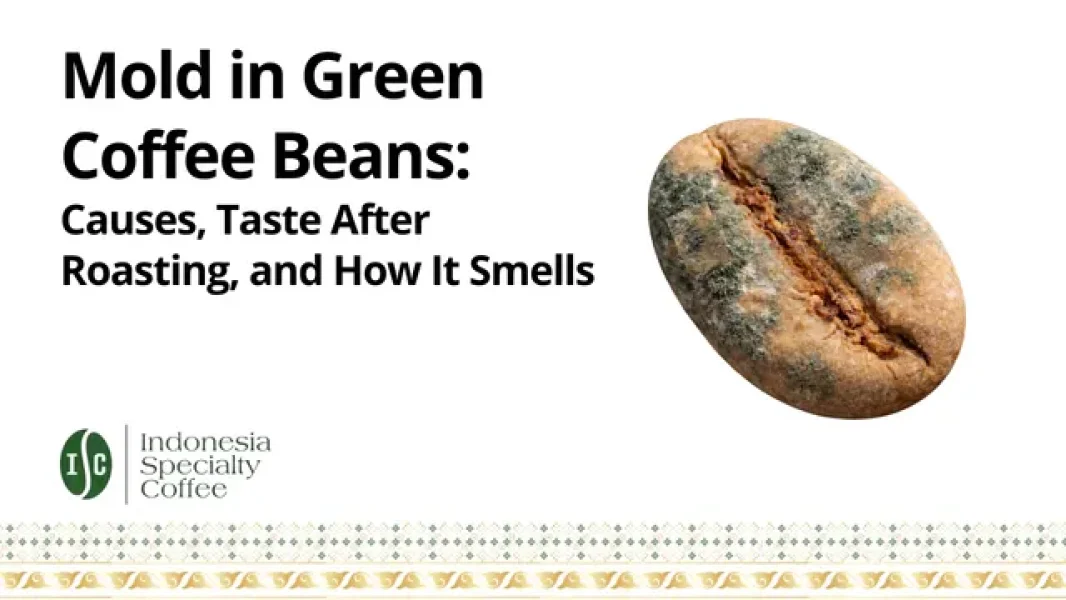
Mold in green coffee beans is a storage and processing defect caused by excess moisture, and it ruins both the safety and the flavor of a lot before it ever reaches the roaster. As a green coffee supplier, we cup and grade against this defect on every shipment. This guide explains what causes mold in green coffee beans, how moldy beans smell in their raw and roasted state, and how they taste after roasting, so you know exactly what you are screening for when you evaluate a sample.
Last updated: June 2026
What Causes Mold in Green Coffee Beans?
Mold in green coffee beans is driven by one factor above all others: moisture. Green coffee must be dried to between 10% and 12% moisture content for safe storage. Anything above 12.5% becomes a breeding ground for Aspergillus, the fungus most often responsible for mold and the mycotoxin ochratoxin A. The water activity inside an under-dried bean gives mold spores everything they need to colonize the seed.
Several points in the supply chain create that excess moisture:
- Incomplete drying. Cherries or parchment pulled off the patio or raised beds too early carry water deep inside the bean, even when the surface feels dry.
- Humid storage. Green beans stored in poorly ventilated warehouses, or in jute bags resting on damp concrete, reabsorb moisture from the air.
- Processing missteps. During wet-hulling (Giling Basah), parchment is removed at 35% to 40% moisture, so the beans spend longer in a vulnerable, high-moisture state before final drying. A stalled or rushed drying stage in any process invites fungal growth.
- Transit and shipping. Temperature swings inside a container cause condensation, and a single wet bag can spread mold to others.
The fungi involved are mainly Aspergillus, Penicillium, and Fusarium, and they can take hold at any stage from harvest to storage. The cherry processing method (Step 1: full-washed, semi-washed, natural, or honey) sets the starting moisture, while the hulling method (Step 2: dry-hulled or wet-hulled) and the drying that follows determine whether the bean reaches a safe, stable state.
How to Identify Moldy Green Coffee Beans
Moldy green coffee beans usually give themselves away visually before you ever smell or roast them. Spread a sample on a flat tray under good light and look for fungal growth and discoloration across the lot.
The most common visual signs of mold in green coffee beans:
| Sign | What it looks like |
|---|---|
| Fuzzy or powdery coating | White, green, grey, or black film on the bean surface |
| Discoloration | Yellow, reddish-brown, or dark patches not native to the bean |
| Texture change | A slimy or sticky surface instead of a dry, firm feel |
| Clustering | Affected beans concentrated where moisture pooled in the bag |
Not all contamination is visible. Mold can sit inside a bean with no surface coating, and ochratoxin A can be present with no warning sign at all. That is why a visual check alone is never enough. Cupping the lot and, for high-volume buyers, independent lab testing are the only reliable ways to confirm a clean lot. We treat any visible mold as an automatic rejection at the grading table, in line with SNI 01-2907-2008 defect rules.
Want to source green coffee that is graded and cupped against these defects before it ships? See the ISC wholesale catalog or request a sample.
How Moldy Coffee Beans Smell
Moldy coffee beans smell musty, sour, and fermented, and the odor is one of the earliest cues that a lot has a problem. Mold releases volatile organic compounds as it grows, and those VOCs sit in the bean and the surrounding air. In green coffee, the smell reads as damp basement, wet cardboard, or old earth rather than the clean, grassy aroma of sound green beans.
A specific defect worth knowing is the stinker bean. Stinkers are individual beans damaged by microbial or fungal activity during processing or drying, often from over-fermentation or trapped moisture. They look close to normal but release a sharp, foul, rotten odor when you crush or grind them. A single stinker can taint the aroma of an entire batch, which is why graders crush suspect beans by hand to check.
Here is a supplier detail roasters often miss: the musty smell intensifies once you grind the beans and again once you add hot water, because grinding exposes more surface area and heat volatilizes the off-aromas. If a green lot smells faintly musty in the bag, it will smell far worse on the cupping table.
How Moldy Coffee Beans Taste After Roasting
Moldy coffee beans taste musty, fermented, and harsh after roasting, with a sour or phenolic edge that no roast profile can hide. The fungal compounds that built up in the green bean survive into the cup as distinct off-flavors: a damp, earthy mustiness, a dirty fermented note, and a medicinal bitterness on the finish. These are classed as taint defects that pull a lot below specialty grade.
Roasting does kill the live mold itself, since the high heat destroys the fungal cells. It does not erase the consequences. The mycotoxin ochratoxin A is only partially degraded by roasting, with studies showing reductions of roughly 65% to 100% depending on roast level and bean size. Darker roasts and longer roast times remove more, but a portion can survive into the brewed cup. So killing the mold does not make a moldy lot clean or safe.
This is the core reason mold is a disqualifying defect rather than a cosmetic one:
- It cannot be roasted out. The off-flavors and a share of the mycotoxins persist.
- It is contagious within a lot. Affected beans drag down the whole batch on the cupping table.
- It signals a deeper problem. Visible mold usually means the lot was under-dried or badly stored, so other hidden defects are likely.
For a roaster, the practical takeaway is simple: screen for mold at the green stage, because once it is in the bean, the roaster cannot fix it.
Grading and Prevention: How Suppliers Keep Mold Out
Preventing mold in green coffee beans is a grading and storage discipline, not a roasting fix. Under the SNI grading standard, mold counts toward the defect value, and Grade 1 Specialty lots must hold a defect value of 11 or lower with moisture at or below 12.5%. Beans that fail on mold are graded out before export.
At Indonesia Specialty Coffee, we control moisture from farm to FOB: cherries are dried to a stable 11% to 12%, lots are cupped against SCA protocol, and green beans are stored in ventilated conditions and shipped in GrainPro-lined bags to block reabsorption in transit. Every lot we export is screened for mold and other defects so the coffee that reaches your roastery cups clean.
Frequently Asked Questions
What causes mold in green coffee beans?
Mold in green coffee beans is caused by excess moisture, usually from incomplete drying or humid storage. When moisture rises above 12.5%, fungi such as Aspergillus, Penicillium, and Fusarium colonize the bean. Poor ventilation and condensation during shipping also trigger mold growth.
How do you know if green coffee beans are moldy?
Look for fuzzy white, green, or grey patches, yellow or reddish-brown discoloration, and a slimy surface. A musty or sour smell is another sign. Because mold and mycotoxins can be invisible, cupping and lab testing are the only fully reliable checks.
Does roasting kill mold on coffee beans?
Yes, roasting kills the live mold because the high heat destroys the fungal cells. However, it does not remove all consequences. The mycotoxin ochratoxin A is only partly degraded, with reductions of about 65% to 100%, and the musty off-flavors still survive into the cup.
What does moldy coffee taste like after roasting?
Moldy coffee tastes musty, fermented, and harsh after roasting, often with a sour or phenolic, medicinal note on the finish. These taint defects cannot be roasted out and pull the coffee below specialty grade, which is why mold is screened at the green bean stage.
Is moldy green coffee dangerous?
Moldy green coffee can carry mycotoxins such as ochratoxin A, which roasting only partially reduces. Beyond safety, mold ruins flavor and disqualifies a lot from specialty grade. Reputable suppliers reject moldy lots at grading, so sourcing from a graded supplier is the best safeguard.
Source Defect-Free Green Coffee Beans from Indonesia Specialty Coffee
Indonesia Specialty Coffee is a direct exporter of specialty-grade Indonesian green coffee beans, based in Medan and shipping FOB Belawan. Every lot is dried to a stable moisture level, cupped against SCA protocol at 82+ SCA points for Grade 1, and screened for mold and other defects before it leaves Indonesia. We supply roasters, importers, and distributors worldwide in 1 kg samples, 60 kg microlots, 350 kg wholesale, and container loads from 9 MT.
Browse the ISC wholesale catalog or contact our team for a custom quote. Sample orders are available so you can cup the quality and check for defects before committing to a wholesale order.