
Blue Batak coffee is a wet-hulled Arabica from the Batak highlands around Lintong, south of Lake Toba in North Sumatra. The “blue” in the name is literal: the green beans carry a blue-green tint that comes from hulling the parchment while the bean is still wet, the Giling Basah practice that defines Sumatran coffee. In the cup, that same process gives Blue Batak its heavy body, low acidity, and dark chocolate, cedar, and spice profile.
This guide is for roasters and importers evaluating Blue Batak coffee as a green bean, and for cafés deciding whether to put it on a single-origin menu. It covers where the coffee grows, what the name and the colour actually mean, how the cup compares to Mandheling and standard Lintong, the grading specs we ship against, and how to roast, brew, price, and buy it.
Last updated: 30 September 2026
What Is Blue Batak Coffee?
Blue Batak coffee is a trade name, not a botanical variety. It refers to selectively picked, triple-sorted Arabica from Batak smallholder farms in the Lintong growing area of North Sumatra, processed semi-washed and wet-hulled (Giling Basah). The name combines the Batak people who farm the Toba highlands with the blue-green colour of the wet-hulled green bean.
Three things separate a Blue Batak lot from ordinary Lintong coffee on our sorting tables. First, cherry selection: only fully ripe cherry, hand-picked. Second, preparation: three passes of sorting to remove defects and uneven beans, which is why the screen size sits tighter than a standard Grade 1 lot. Third, volume: Blue Batak is a small share of what the Lintong area produces each year, so it trades as a limited preparation rather than a bulk grade. Our overview of Kopi Batak explains the wider family of Batak coffees the name belongs to.
Where Blue Batak Coffee Grows: Lintong and the Toba Highlands
Lintong Nihuta sits in Humbang Hasundutan regency, on the volcanic plateau south of Lake Toba, the largest crater lake in the world. Coffee here grows at 1,200 to 1,700 metres above sea level on plots that are usually under two hectares, farmed by Batak families who have handled coffee for generations. Days are humid and cloud-cooled, nights are stable, and the cherry matures slowly, which builds bean density and sugar.
The varietal mix around Lintong is mostly Typica-derived lines, Jember (S795), Ateng (Catimor), and Sigararutang, planted under shade and mixed with other crops. That intercropping system, known locally as tumpang sari, keeps soil organic matter up and gives farming families income between coffee harvests. It is also why Lintong coffee is farmed with relatively few purchased inputs, a point that matters for buyers working through environmental sustainability requirements.
Our broader guide to Lintong coffee covers the regency’s other preparations, and the Sumatra coffee guide places Lintong alongside Gayo, Mandheling, and Sidikalang.
Evaluating a Sumatra for your single-origin lineup? See our wholesale pricelist or contact our team for a 1 kg Blue Batak cupping sample.
How Wet-Hulling Shapes the Flavor of Blue Batak Coffee
Every Indonesian coffee is described in two steps: the cherry processing method, then the hulling method. Blue Batak coffee is semi-washed, wet-hulled (Giling Basah). Farmers pulp the cherry, ferment briefly, wash, and dry the parchment only to 35 to 40 percent moisture. The parchment then comes off while the bean is still soft, and drying finishes on the bare green bean. Our wet-hulled coffee process guide walks through every stage with photos.
That soft, exposed bean is where the colour comes from. Drying without parchment leaves the bean a dark blue-green rather than the pale jade of a dry-hulled washed coffee. It is also where the cup comes from. Wet-hulling mutes the citric brightness a washed coffee would keep and amplifies body, so the profile leans to cocoa, wood, and spice instead of fruit and florals.
Cupping Notes: What We Find on the Table
| Attribute | What we find on the table |
|---|---|
| Aroma | Cedar, forest herbs, sweet earth, a nutty almond note |
| Flavor | Dark chocolate, molasses, sweet tobacco, clove-like spice |
| Acidity | Low to medium, rounded and integrated |
| Body | Full to very full, syrupy |
| Finish | Long, sweet and savoury, drying slightly at the end |
Independent cuppers read the coffee the same way. Coffee Review has scored Lintong Blue Batak lots at 93 points, describing fig, fir, tobacco, and cumin-like spice. Our own Grade 1 Lintong lots cup at 82 to 88 SCA points against SCA protocol; individual Blue Batak preparations sit at the upper end of that range.
Blue Batak vs Mandheling vs Standard Lintong
Buyers often ask whether Blue Batak coffee is worth the premium over a standard Sumatra. The honest answer depends on what the coffee is for. All three are semi-washed and wet-hulled (Giling Basah), so the family resemblance is strong; the differences are in preparation and consistency.
| Blue Batak | Standard Lintong Grade 1 | Sumatra Mandheling Grade 1 | |
|---|---|---|---|
| Growing area | Lintong, south of Lake Toba | Lintong and Humbang Hasundutan | Broader North Sumatra, Tapanuli and Toba slopes |
| Altitude | 1,200 to 1,700 m | 1,200 to 1,500 m | 1,100 to 1,500 m |
| Preparation | Triple-sorted, tight screen | Standard Grade 1 sort | Standard Grade 1 sort |
| Cup | Cocoa, cedar, spice, cleaner than average | Earthy, herbal, chocolate | Earthy, heavy, tobacco, lower acidity |
| Best use | Single-origin filter and espresso | Blends and espresso base | Espresso base, dark roast blends |
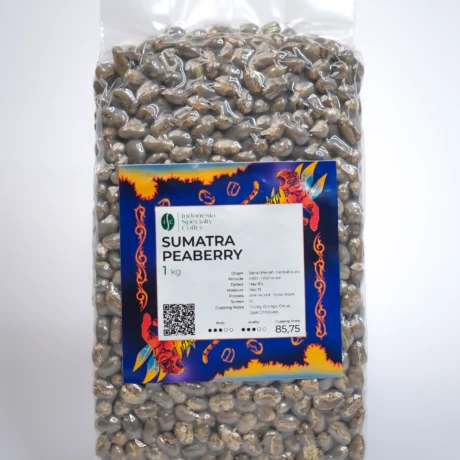
If you need a Sumatra to anchor a house blend, standard Lintong or Mandheling does the job at a lower price. If you want a Sumatra that holds up as a single origin on a filter menu, Blue Batak’s tighter sort is what you are paying for. For an even smaller-volume preparation from the same slopes, see our Sumatra peaberry page.
Grading and Quality Specs for Blue Batak Green Beans
We grade Blue Batak coffee against SNI 01-2907-2008, Indonesia’s national green coffee standard. Grade 1 Specialty requires a defect value of 11 or lower; the Blue Batak preparation we ship comes in well under that.
- Screen size: 15 to 18
- Defect value: 6 to 8 per 300 g sample
- Moisture at shipment: 12.5 percent or lower [confirm: product page lists a 13 percent maximum; align with the current lot’s certificate]
- Processing: semi-washed, wet-hulled (Giling Basah) [confirm: product page currently lists manual dry hulling; align with the actual lot]
- Cup: 82 to 88 SCA points, Grade 1 Specialty
- Certification: Halal certified; Organic and Rainforest Alliance on request
A supplier note on what the numbers do not tell you. Wet-hulled coffee carries more moisture memory than washed coffee, so a lot at 12.5 percent that was dried fast on a hot patio can behave differently in the roaster from a lot dried slowly in the highlands. Ask for drying dates, not just the moisture figure. Our guides to green coffee grading and the SCA cupping form explain how to read a spec sheet and a cupping sheet side by side.
How to Roast and Brew Blue Batak Coffee
Blue Batak coffee rewards a medium to medium-dark roast. Pull it too light and the wet-hulled character reads as vegetal; push it to a French roast and you lose the cedar and spice that justify the premium. Because wet-hulled beans are less dense than washed beans of the same origin, they take heat quickly: drop your charge temperature a little and let the drying phase run slow. Our roasting guide for Indonesian coffee has full profiles.
| Method | Dose and water | Grind | Time | What it brings out |
|---|---|---|---|---|
| Hario V60 | 18 g to 300 g at 94°C (1:16.7), bloom 45 g for 45 s | Medium-fine | 2:45 to 3:00 | Cedar aroma, focused chocolate sweetness |
| French press | 30 g to 450 g at 96°C (1:15), bloom 60 g for 30 s | Coarse | 4:00 steep, skim, press slowly | Maximum body, satin mouthfeel |
| Espresso | 1:2 to 1:2.2 ratio at 93 to 94°C | Fine | 27 to 32 s from first drip | Syrupy sweetness, dense crema |
For dialling in, our pour-over brewing time guide and French press ratio guide cover the extraction windows. If you are deciding how dark to take it for espresso, read espresso vs dark roast beans first.
Blue Batak Coffee Price and How to Buy It
Blue Batak coffee prices above standard Lintong Grade 1 because of the extra sorting and the small volume. Current FOB Belawan pricing for the Blue Batak preparation sits at [confirm current price with ISC pricelist]; for reference, our Grade 1 semi-washed, wet-hulled Sumatra lots run $8.00 to $10.00 per kg FOB Belawan, and Blue Batak carries a premium above that band. CIF to Rotterdam or Los Angeles adds roughly $0.65 to $0.85 per kg in freight and insurance.
What to check before you book:
- Traceability. Producer group, mill, harvest window, and lot ID. EU buyers need plot-level geolocation for EUDR due diligence; ask for it at contract stage, not at customs.
- Specs on paper. Screen size, defect value, moisture, and a cupping score on the SCA form, all for the specific lot, not the origin in general.
- Sample first. A 1 kg cupping sample tells you more than any spec sheet. Cup it against your current Sumatra before committing to a 60 kg microlot or a 350 kg wholesale order.
- Storage plan. Green Blue Batak keeps its aromatics for six to twelve months in hermetic bags at stable temperature; see how long green coffee beans last. Roasted, use a one-way valve coffee canister and freeze in small portions for longer holds.
Our checklist on where to buy green coffee beans covers the questions to put to any supplier, us included.
Frequently Asked Questions
What is Blue Batak coffee?
Blue Batak coffee is a wet-hulled Arabica from Batak smallholder farms around Lintong, south of Lake Toba in North Sumatra. The name pairs the Batak people with the blue-green tint of the green bean, which comes from hulling at 35 to 40 percent moisture. It cups with dark chocolate, cedar, spice, full body, and low acidity.
Why are Blue Batak coffee beans blue?
The blue-green colour comes from wet-hulling (Giling Basah). The parchment is removed while the bean is still at 35 to 40 percent moisture, and drying finishes on the exposed bean, which darkens it to a blue-green shade. Dry-hulled washed coffees keep their parchment until fully dry and stay pale jade.
What does Blue Batak coffee taste like?
Blue Batak coffee tastes of dark chocolate, molasses, cedar, forest herbs, and clove-like spice, with a full syrupy body and low, rounded acidity. Independent cuppers at Coffee Review have scored Lintong Blue Batak lots at 93 points, noting fig, fir, tobacco, and a cumin-like spice.
What is the difference between Blue Batak and Mandheling?
Both are semi-washed, wet-hulled Sumatran Arabicas. Blue Batak comes specifically from the Lintong area at 1,200 to 1,700 metres and is triple-sorted to a tight screen, giving a cleaner cup with cocoa and cedar. Mandheling is sourced across a wider area, cups heavier and earthier, and is usually the cheaper blend base.
How should Blue Batak coffee be brewed?
A medium to medium-dark roast works best. For clarity, use a V60 at 18 g to 300 g water, 94°C, finishing in 2:45 to 3:00. For maximum body, use a French press at 30 g to 450 g, 96°C, steeped four minutes. Moreover, for espresso, pull a 1:2 ratio in 27 to 32 seconds.
Where can I buy Blue Batak green coffee beans?
Indonesia Specialty Coffee supplies Blue Batak green beans direct from Lintong smallholders, graded Grade 1 under SNI 01-2907-2008, shipping FOB Belawan from Medan. Order tiers start at 1 kg for a cupping sample, then 60 kg microlot, 350 kg wholesale, and container loads from 9 MT. Contact us for a current quote.
Buy Blue Batak Green Coffee Beans from Indonesia Specialty Coffee
Indonesia Specialty Coffee sources Blue Batak green coffee beans directly from Batak smallholder farms in Lintong and ships them Grade 1 Specialty from Medan, FOB Belawan, with CIF quoted on request. Every lot is graded against SNI 01-2907-2008, cupped against SCA protocol at 82 to 88 points, and Halal certified, with Organic and Rainforest Alliance available on request. Bulk orders ship free worldwide.
Order tiers run 1 kg for a cupping sample, 60 kg for a microlot rate, 350 kg for standard wholesale, and container loads from 9 MT quoted per metric tonne.
Cup it before you commit. Ask for a 1 kg Blue Batak sample, put it on the table next to your current Sumatra, and let the cup decide. See our current wholesale pricelist or contact our team for this season’s Lintong lots.