
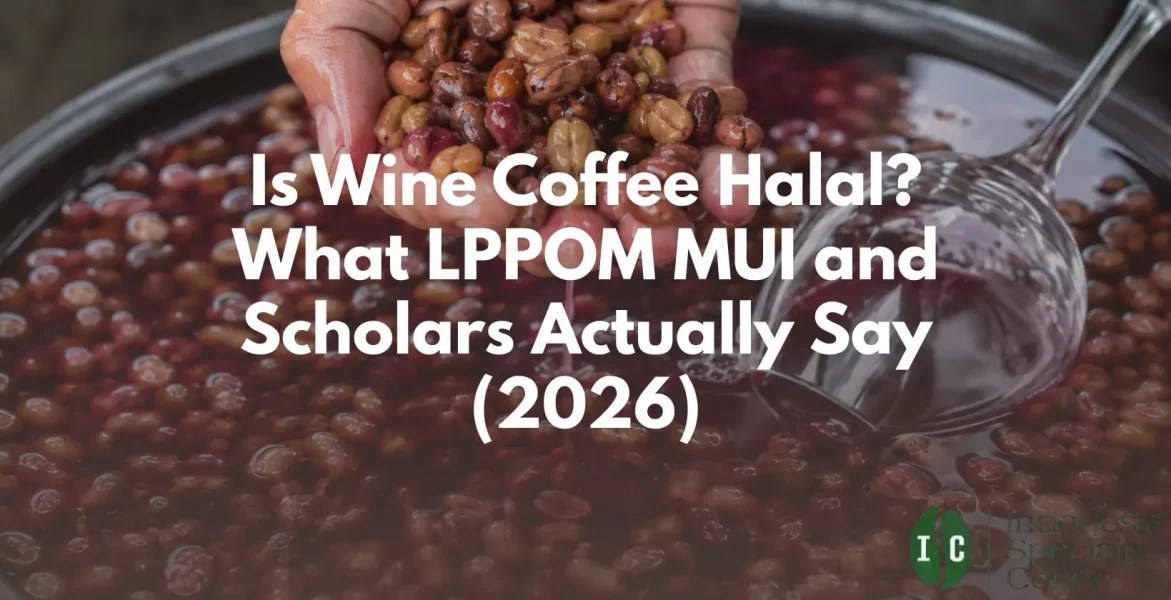
Is wine coffee halal? The question has two separate answers, and mixing them up is why the debate never settles. On the substance, LPPOM MUI treats coffee as a non-critical product and fermentation as a non-critical process, and wine process coffee contains no alcohol. On the name, a product called wine coffee cannot be halal certified in Indonesia. This guide separates the two.
Last updated: August 2026
Indonesia Specialty Coffee is a green coffee exporter, not a religious authority. What follows reports the published positions of named certification bodies and scholars. For a ruling on your own situation, consult your certifier or a qualified scholar.
Is Wine Coffee Halal? The Short Answer
Wine process coffee made by extended fermentation contains no wine and no alcohol. LPPOM MUI states plainly that coffee sits on the list of non-critical products and that fermentation of coffee is likewise not a critical process. The substance is not where the objection lies.
The objection is the word. LPPOM MUI’s Halal Partnership and Audit Services Director, Dr. Ir. Muslich, M.Si., explains that certification decisions rest with the MUI Fatwa Commission, and that even when every ingredient is halal, a product name that fails the naming criteria cannot be certified.
So a coffee can be entirely permissible to drink and still be uncertifiable under the label it is sold with. Those are two different questions, and you need both answered before you contract.
What Wine Process Coffee Actually Is
Three different production methods travel under similar names, and if you are buying, they carry very different implications for you.
| Method | What happens | Wine involved? |
|---|---|---|
| Wine process (extended fermentation) | Ripe cherries ferment 30 to 60 days before drying | None |
| Barrel-aged | Green beans rest in used wine or spirit casks | Residual contact |
| Direct infusion | Beans soaked in wine, then dried and roasted | Direct, deliberate |
Only the first is what Indonesian producers in Gayo, Bali, and Java are selling. LPPOM MUI describes the method directly: ripe red cherries are stored unhulled, then fermented and dried repeatedly over 30 to 60 days until the coffee gives off an aroma resembling alcohol or wine. The aroma is the point. There is no wine in what you receive.
The second and third methods bring the bean into contact with an actual alcoholic liquid, which raises questions of najis (ritual impurity) that extended fermentation simply does not raise. Barrel-aged and wine-infused coffee are not the same product as Indonesian wine process coffee, and treating them as one category is where most confusion starts.
What LPPOM MUI Says About the Name
This is the part most articles skip, and it is the part that will actually decide whether your product certifies.
LPPOM MUI’s criteria bar halal certification for any product whose name contains the name of an alcoholic drink. The published examples are specific: non-alcoholic wine, champagne, root beer, rum raisin flavoured ice cream, and zero percent alcohol beer. The reasoning given is prevention of tasyabuh, meaning the consumption of products resembling those that are forbidden, and the concern that normalising the label could lead Muslims to the genuine article by mistake.
Read that list again if you sell into Indonesia or Malaysia. The bar applies to the word on the pack, independent of what is inside it.
The practical consequence is straightforward: a lot you sell as “wine coffee” faces a naming obstacle to certification that the identical coffee sold as “extended fermentation” or “fermented coffee” does not.
Substance Permitted, Name Disputed
Independent scholars have reached the same split from a different direction, which is worth knowing because it is a stronger consensus than the usual lenient-versus-strict framing suggests.
Writing on the question, KH. M. Shiddiq Al Jawi concludes that kopi wine is mubah, permissible, on the grounds that it contains no alcohol. He then rules the name impermissible on two grounds: tasyabbuh bil kuffar, imitation in a matter of custom, and istihaanah, treating lightly something the Shariah has forbidden.
So the certification body and this scholar disagree on almost nothing. Both accept the drink. Both object to the label.
Where genuine disagreement remains is barrel-aged and wine-infused coffee, where the bean has touched an alcoholic liquid. Positions there vary by school and by certifier, and we are not in a position to summarise them fairly for you. Ask your own certifier.
Sourcing Indonesian fermented lots and need the process documentation for a halal audit? See our pricelist or contact our team.
How Halal Certification Works in Indonesia Now
The system changed, and a lot of published guidance still describes the old one.
Under Law No. 33 of 2014 on Halal Product Assurance, certificates are now issued by BPJPH (Badan Penyelenggara Jaminan Produk Halal) under the Ministry of Religious Affairs, which began issuing them in October 2021. LPH bodies, including LPPOM, carry out the technical inspection, and the MUI Fatwa Commission issues the religious determination. The three functions are split across three institutions.
Here is who does what, because buyers routinely ask the wrong body for the wrong document.
| Body | Role | What you ask them for |
|---|---|---|
| BPJPH | Government agency, Ministry of Religious Affairs | The halal certificate itself |
| LPH (including LPPOM) | Technical inspection and audit | Audit scope and process records |
| MUI Fatwa Commission | Religious determination | The ruling behind the certificate |
Halal certification became mandatory for food and beverages on 17 October 2024, with consumer goods following in later phases. Registration runs through the SIHALAL system, and certificates are verifiable at bpjph.halal.go.id.
For importers, your check is simple. A pack carrying only an old MUI logo, with no traceable BPJPH certificate, warrants verification rather than assumption.
What This Means If You Buy or Sell Wine Process Coffee
Four practical points, in the order they will affect you.
- Ask what the process actually was. Extended fermentation, barrel-aging, and infusion are three different products. Get it in writing on the process summary, not from the product name.
- Treat the name as a separate question from the coffee. If your market is Indonesia, Malaysia, or the Gulf, the label may block certification even when the lot is clean.
- Verify certificates rather than logos. Check the BPJPH certificate reference, not the badge on the bag.
- Do not rely on a supplier for a ruling. We can document what happened to the coffee. Whether that satisfies your obligations is for your certifier or scholar to determine.
Every lot Indonesia Specialty Coffee ships is Halal certified, and our fermented lots use extended fermentation of whole cherry with no wine, spirits, or alcohol at any stage. When buyers ask us to confirm that in writing for an audit, we do.
Frequently Asked Questions
Is wine coffee halal to drink?
Wine process coffee produced by extended fermentation contains no wine and no alcohol, and LPPOM MUI classifies coffee and coffee fermentation as non-critical. Scholars who have addressed it directly have found the drink permissible. The dispute concerns the product name, not the coffee itself.
Why can wine coffee not get halal certification in Indonesia?
LPPOM MUI criteria bar certification for products whose names contain the name of an alcoholic drink. Published examples include non-alcoholic wine, champagne, root beer, and zero percent alcohol beer. The stated reason is preventing tasyabuh, the consumption of products resembling forbidden ones.
Does wine process coffee contain alcohol?
No. Extended fermentation of coffee cherry produces aromas resembling wine, which is where the name came from, but LPPOM MUI states this coffee does not contain alcohol the way wine does. No wine, spirits, or alcohol are added at any point in the process.
Is barrel-aged coffee the same as wine process coffee?
No. Barrel-aged coffee rests in casks that previously held wine or spirits, so the bean contacts residues of an alcoholic liquid. Wine process coffee ferments in its own fruit with nothing added. The two raise different questions and should not be assessed together.
Who issues halal certificates in Indonesia now?
BPJPH, under the Ministry of Religious Affairs, has issued halal certificates since October 2021 under Law No. 33 of 2014. LPH bodies including LPPOM perform technical inspection, and the MUI Fatwa Commission issues the religious determination. Verify certificates through the official BPJPH system.
How can I verify that Indonesian green coffee is halal certified?
Ask for the BPJPH certificate reference and check it against the official register rather than relying on a logo. Request the process summary for any fermented lot, confirming no wine, spirits, or other non-permitted inputs were used at any stage.
Buy Halal Certified Indonesian Green Coffee
Indonesia Specialty Coffee supplies Grade 1 Specialty green coffee at 82 to 88 SCA points, graded against SNI 01-2907-2008 with a defect value of 11 or lower and moisture at or below 12.5%. Every lot is Halal certified, with Organic and Rainforest Alliance available on request, FOB Belawan from Medan.
Our extended fermentation lots come mainly from Arabica Gayo in Aceh, alongside Bali and Java. If certification naming is a constraint in your market, tell us at enquiry stage and we will document and label the lot accordingly.
Order tiers run 1 kg cupping samples, 60 kg microlot, 350 kg wholesale, and container loads from 9 MT. Browse our green coffee beans or ask for the process documentation before you commit.