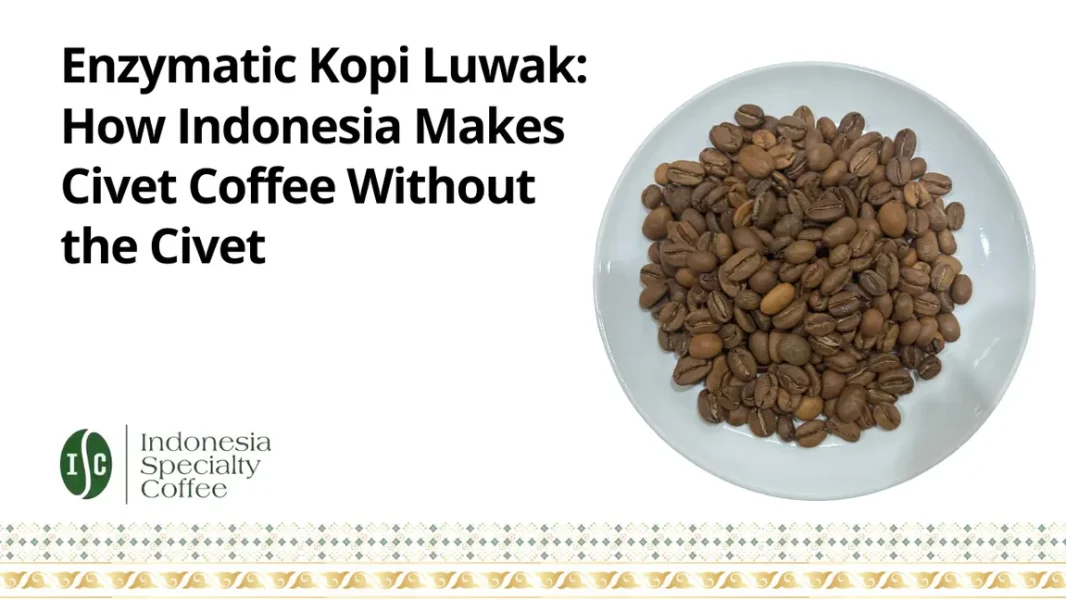
Enzymatic Kopi Luwak is civet coffee produced without a civet. Indonesian producer Rani Mayasari, working with Prof. Erliza Noor at IPB University in Bogor, ferments coffee using bacteria originally isolated from the Asian palm civet’s digestive tract, cultured in a laboratory and applied directly to the cherry. No animal is involved in production.
This guide covers how the process works, what the IPB research measured, how it cups, and how it compares to the wild-certified Kopi Luwak we supply at Indonesia Specialty Coffee.
Last updated: July 2026
What Is Enzymatic Kopi Luwak?

Enzymatic Kopi Luwak is green coffee fermented with cultured bacteria isolated from the Asian palm civet (Paradoxurus hermaphroditus), reproducing the enzyme activity of civet digestion in a controlled tank instead of an animal. No civet eats, digests, or excretes the coffee at any stage.
Conventional Kopi Luwak carries two supply problems certification has never solved: caged civets, and fraud. Removing the animal removes both. The term is still new, and as of 2026 only a handful of roasters worldwide list it, all sourcing from one West Java producer.
Who Is Rani Mayasari?
Rani Mayasari is a Q Grader certified by the Coffee Quality Institute and the producer in Gununghalu, West Bandung. From 2016 she taught cultivation, roasting, and green grading to West Java farmers before moving into production herself.
Java Halu farm specifications:
- Altitude: 1,350 to 1,600 metres above sea level
- Varietals: Sigararutang, Ateng, S795, and Typica
- Community: more than 160 smallholder farming families, majority women
- Waste stream: cherry pulp converted into briquettes and biochar
Java Halu exports to Europe and beyond, and Rani Mayasari developed the enzymatic process with an Indonesian university, not a foreign biotech firm.
How the Enzymatic Kopi Luwak Process Works
The enzymatic Kopi Luwak process replaces the traditional Luwak coffee process with a controlled fermentation on the farm. Prof. Erliza Noor of the Faculty of Agricultural Technology at IPB University isolated the working microbes from civet digestive material. Those cultures are propagated in a laboratory, so the animal is needed once, at isolation, and never again.
- Selective harvest. Pickers take fully ripe cherry only, substituting for the one useful thing a wild civet does: eat only the ripest fruit.
- Inoculation. The cultured bacteria are introduced to the coffee cherry.
- Controlled fermentation. IPB describes the method as solid-state fermentation. Roasters selling the coffee describe an anaerobic ferment in a temperature-controlled dark room, with duration steering the profile: longer runs push fruit-forward, shorter push floral. Treat that last detail as producer-supplied, not published.
- Drying. Export lots are finished as natural process, with the whole cherry dried intact.
- Dry hulling. Parchment comes off once the coffee reaches roughly 12 to 13 percent moisture. Java Halu is dry-hulled, unlike the wet-hulled (Giling Basah) lots from Gayo, Mandheling, and Lintong hulled at 35 to 40 percent moisture.
- Resting, sorting, and grading.
Ratios, pH, and fermentation hours remain proprietary.
The Three Enzyme Groups and What Each One Does
IPB University isolated three functional groups of bacteria from the civet: cellulolytic, xylanolytic, and proteolytic.
- Cellulase and xylanase degrade mucilage and cell wall polysaccharides, opening the bean structure
- Protease cleaves storage proteins into shorter peptides and free amino acids
Protease decides the cup. Free amino acids are Maillard precursors, so more of them means more caramel and chocolate development in the roast, and less of the bitter edge undeveloped Arabica carries.
Sourcing Kopi Luwak for a single-origin program? See our current wholesale pricelist or contact our team for a quote on wild-certified lots.
Why the Enzymatic Process Was Developed
Animal welfare is the headline reason, but four commercial problems pushed the research just as hard.
Welfare. Global demand turned Kopi Luwak from a wild-foraging curiosity into a caging industry. Civets on wire-floor cages, force-fed cherry, show stereotypic behaviour and self-mutilation.
Consistency. A civet’s gut is not a controlled vessel. Every animal, diet, and day gives a different result. A cultured fermentation is repeatable, which is what you need when reordering the same lot.
Seasonality. Wild-collected Kopi Luwak is a small, unpredictable, seasonal volume. Enzymatic production runs year-round.
Fraud. Kopi Luwak is one of the most adulterated categories in coffee. A documented in-house fermentation is auditable. A forest collection story is not.
Raw material. Traditional Kopi Luwak is often applied to ordinary, sometimes off-grade coffee, because the story carries the price rather than the cup. Java Halu applies the process to specialty-grade beans grown above 1,350 metres.
What the IPB Research Measured
Prof. Erliza Noor presented these results at IPB University’s Research and Innovation Week in December 2024. The benchmark below is commercial civet coffee, not untreated green coffee.
| Measure | Enzymatic fermentation | Commercial civet coffee |
|---|---|---|
| Caffeine reduction | 48 to 69 percent | approximately 9 percent |
| Lactic acid | Increased | Baseline |
| Butyric acid | Increased | Baseline |
| Ascorbic acid | Increased | Baseline |
| Oxalic acid | Decreased | Baseline |
The caffeine figure is the one that matters commercially. A 48 to 69 percent reduction puts the coffee in naturally lower-caffeine territory with no solvent and no water decaffeination, a category with very few specialty-grade options. One commercial enzymatic lot is graded at 89 SCA points.
One caveat: IPB developed those figures on beans from Pangalengan, West Java. Equivalent data has not been published for other Indonesian origins.
What Enzymatic Kopi Luwak Tastes Like
Four independent roasters and reviewers have published cupping notes on the Java Halu lots, which gives you a triangulated picture before you commit to a sample.
| Roaster or reviewer | Cupping notes |
|---|---|
| Coffee Wallas, Toronto | Baked apple, sticky orange jam acidity, cacao finish |
| The Bean Geek listing | Pomelo, blueberry, pu’er |
| Beaneka Coffee | Melon, champagne, dried fruit skin, raw strawberry, jasmine |
| A Case For Coffee, Skylark lot | Papaya, watermelon, coffee blossom |
The pattern across all four: heavy syrupy body, low bitterness, loud fruit, an unusually long finish.
Here is the contrast that matters on your table. Authentic wild Kopi Luwak cups smooth but muted, because the smoothness comes partly from flavour compounds stripped out in digestion. Enzymatic lots cup smooth and loud at once, holding the low-bitterness, heavy body while carrying the aromatics of a well-run anaerobic natural process.
One thing we tell every roaster taking a Luwak lot for the first time: drop your charge temperature. Beans through proteolysis, whether by civet gut or cultured bacteria, carry less intact protein and colour faster in the drum. Run your standard natural profile and you will scorch the surface before first crack.
Enzymatic Kopi Luwak vs Wild-Certified Kopi Luwak
These are two answers to the same ethical problem, suiting different buyers. Indonesia Specialty Coffee supplies wild-certified Kopi Luwak, so read the table as our informed view, not a neutral one.
| Enzymatic Kopi Luwak | Wild-certified Kopi Luwak | |
|---|---|---|
| Animal involvement | None in production | Wild civets forage freely, beans collected from the forest floor |
| Supply volume | Year-round, scalable | Seasonal, limited by wild foraging |
| Batch consistency | High, controlled fermentation | Varies by collection |
| Verification | Producer process records | Local government wild certification |
| Origins available | One West Java producer | Multiple Indonesian origins |
| Caffeine reduction | 48 to 69 percent | approximately 9 percent |
| Market position | New, thin trading history | Established, recognised by buyers |
If you need volume, repeatability, and a story that removes the animal question outright, enzymatic Kopi Luwak answers that well. If your customers want the original article with verified wild provenance, wild-certified Kopi Luwak remains the only thing that qualifies.
Neither option requires a caged civet. That is the part worth carrying to your customers.
Frequently Asked Questions
What is enzymatic Kopi Luwak?
Enzymatic Kopi Luwak is coffee fermented with bacteria originally isolated from the Asian palm civet’s digestive tract and now cultured in a laboratory. The fermentation reproduces the enzyme activity of civet digestion with no animal involved. Indonesian producer Rani Mayasari developed the process with IPB University.
Is enzymatic Kopi Luwak real Kopi Luwak?
No civet processes the coffee, so it is not Kopi Luwak in the traditional sense. Roasters label it as enzymatic Kopi Luwak or Luwak Reimagined rather than Kopi Luwak alone. The fermentation mechanism is genuinely derived from civet gut microbes, but the animal is absent.
Does enzymatic Kopi Luwak have less caffeine?
Yes. IPB University research recorded a caffeine reduction of 48 to 69 percent, against approximately 9 percent in commercial civet coffee. Those figures were measured on West Java beans from Pangalengan and have not been published for other Indonesian origins.
Is enzymatic Kopi Luwak cruelty-free?
Yes in ongoing production. The bacteria were isolated once from civet digestive material and are now propagated as laboratory cultures, so no civet is caged, fed, or handled to make the coffee. Wild-certified Kopi Luwak is the other cage-free option open to buyers.
Where can I buy Kopi Luwak green beans wholesale?
Indonesia Specialty Coffee supplies wild-certified Kopi Luwak green beans from Medan, shipping FOB Belawan. Order tiers start at 1 kg for cupping samples, then 60 kg microlot, 350 kg wholesale, and container loads from 9 MT. Contact us for a current quote.
Buy Wild-Certified Kopi Luwak Green Beans from Indonesia Specialty Coffee
Indonesia Specialty Coffee supplies 100% wild-certified Kopi Luwak green beans, collected from free-roaming Asian palm civets and certified by local government authority. No caged animals anywhere in our supply chain. We grade every lot against SNI 01-2907-2008 and ship Grade 1 Specialty only, 82 to 88 SCA points, FOB Belawan from Medan, North Sumatra. All lots are Halal certified, with Organic and Rainforest Alliance available on request.
Your order tiers run 1 kg for a cupping sample, 60 kg microlot, 350 kg standard wholesale, and container loads from 9 MT quoted per metric tonne. Current Kopi Luwak pricing sits at [confirm current price with ISC pricelist].
Evaluating Kopi Luwak for your single-origin program? Start with a 1 kg sample and cup it on your own table before you commit. See our Kopi Luwak green beans or contact our team for a wholesale quote.