
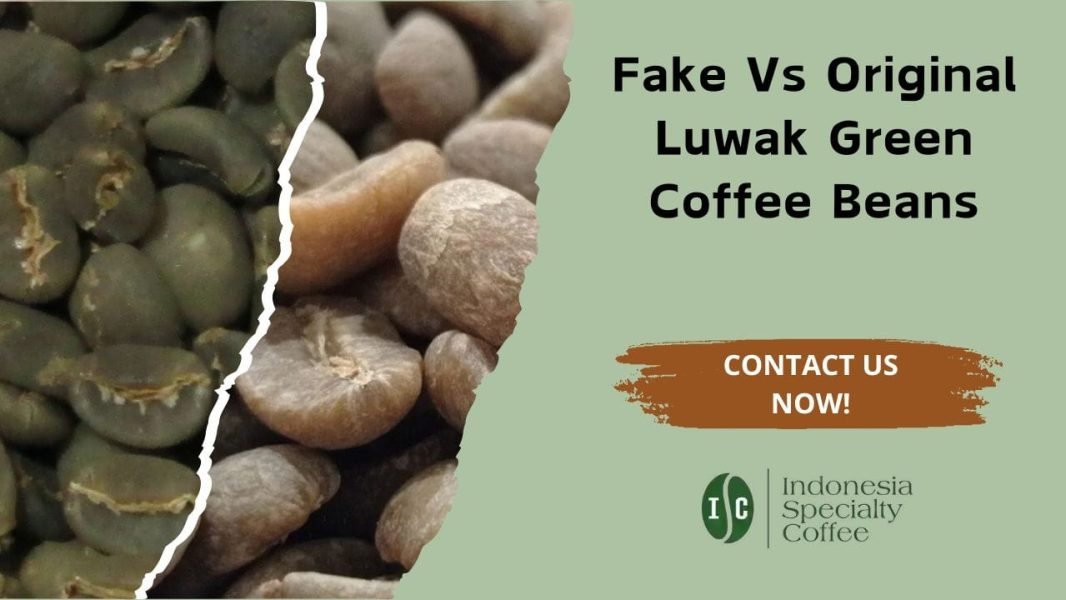
Fake kopi luwak takes two forms, and buyers usually only screen for one. The first is ordinary coffee sold as civet coffee. The second is real civet coffee from caged animals sold as wild. Visual inspection catches some of the first and none of the second.
This guide covers what your eyes can prove, what the laboratory can prove, and what only supply chain documentation can.
Last updated: 09 September 2026
The Two Kinds of Fake Kopi Luwak
Treating fraud as one problem is why so many buyers get caught. There are two, they fail different tests, and the lot in front of you can pass one while failing the other.
| Substitution fraud | Provenance fraud | |
|---|---|---|
| What is sold | Regular Arabica sold as Kopi Luwak | Real civet coffee sold as wild |
| Typical substitute | Aceh Gayo Arabica, sometimes blended in | Caged-civet Luwak |
| Detectable by eye? | Sometimes, on green beans only | No |
| Detectable by lab? | Yes, validated markers exist | No |
| Detectable how? | Metabolite testing | Supply chain documentation only |
| Cup impact | Loses the whole character | Usually flatter, less complex |
Provenance fraud is the harder problem, and the one more likely to reach you. Caged-civet coffee is chemically genuine Kopi Luwak, so no test distinguishes it from wild-collected. The animals are force-fed cherry rather than selecting ripe fruit themselves, which is why the cup usually suffers, but that is a quality judgement rather than proof.
If a supplier answers your authenticity question by describing bean appearance, they have answered the smaller half.
What Visual Inspection Can and Cannot Tell You
Green beans carry usable signals. Roasted beans mostly do not, because roasting flattens the surface differences that matter. Inspect before you roast, or not at all.
<!– IMAGE: Macro shot showing silverskin remnants and surface texture on wild Kopi Luwak green beans | Alt: Real kopi luwak green bean texture and silverskin compared to fake kopi luwak –>
| Signal | What to look for | How much it proves |
|---|---|---|
| Silverskin (kulit ari) | Fragments clinging to the bean surface | Suggestive, not proof |
| Colour | Duller, browner, less uniform than bright green Arabica | Suggestive |
| Uniformity | Natural variation in size and shape | Suggestive |
| Aroma | Softer and less grassy than regular green coffee | Weak |
| Machine-perfect uniformity | A red flag rather than a green one | Useful negative signal |
Here is the part most guides leave out. None of these signals is diagnostic on its own. Silverskin retention varies with hulling and handling. Colour varies with drying and storage. A skilled counterfeiter who knows what you are looking for can produce beans that pass a photograph.
Use visual inspection to reject, not to accept. Machine-uniform beans in a bright uniform green almost certainly are not Luwak. Beans that look right are merely beans that have not failed yet.
The Laboratory Test That Actually Works
Substitution fraud has a real answer, and it has existed since 2013. Researchers at Osaka University working with Indonesian collaborators published the first validated method for authenticating Kopi Luwak in the Journal of Agricultural and Food Chemistry.
The team profiled 21 coffee samples by GC-MS and screened 26 candidate compounds, then narrowed them statistically to three discriminant markers:
- Citric acid
- Malic acid
- The inositol to pyroglutamic acid ratio
Those three separated genuine Kopi Luwak from fake Kopi Luwak, from regular coffee, and, most usefully, from blends containing 50% Kopi Luwak. That last capability matters commercially, because dilution is a more profitable fraud than outright substitution and a far harder one to taste.
The limitation is practical rather than scientific. This is GC-MS work requiring a proper analytical laboratory, so it is not a check you run on arrival. For a container-scale purchase it is worth commissioning. For a 60 kg microlot it usually is not, which pushes your burden back onto documentation.
Evaluating a Kopi Luwak supplier? See our pricelist or contact our team for collection records and lot specifications.
Supply Chain Verification: The Only Answer for Wild Sourcing
Since no test distinguishes wild from caged, wild sourcing can only be verified upstream. That means asking questions a genuine wild collector can answer specifically and a reseller cannot. Send these before you send a purchase order.
Ask for these, and treat vagueness as the answer:
- Where the collection happens. A named forest or plantation area, not a region.
- Who collects. In-house teams or subcontracted buyers. Subcontracting is where caged coffee enters most supply chains.
- The rejection rate. Wild collection produces material that fails sorting. A supplier who cannot tell you what percentage fails probably is not sorting.
- Seasonality. Genuine wild collection is seasonal and limited. Year-round unlimited availability is a warning.
- Volume offered against volume possible. Ask how many kilos the stated collection area yields annually, then compare it to what is on offer.
Indonesia Specialty Coffee collects from a 1,200-acre plantation in Merah Mege, Atu Lintang, in Central Aceh. Three in-house teams totalling 18 people handle all collection, with no subcontractors, and roughly 50% of collected parchment fails post-harvest sorting. That rejection rate is the honest reason wild-certified Luwak costs what it costs.
One structural point worth knowing. Kopi Luwak is not a coffee variety, it is a processing route, so the underlying bean is ordinary Arabica from a real origin. Ours is Aceh Gayo. A supplier who cannot name the origin beneath the Luwak is describing a story, not a lot.
What Certification Actually Certifies
Certification helps, but the labels do different jobs and buyers routinely read more into them than they carry.
| Body | What it is | What it actually tells you |
|---|---|---|
| Local government, Central Aceh | Regional authority wild-collection certification | The most direct wild-sourcing assurance available |
| AEKI-AICE | Indonesian coffee exporters and industries association | The exporter is registered and recognised. Not a lot-level authenticity certificate |
| MPKG | Masyarakat Perlindungan Kopi Gayo | Gayo origin protection and farming standards |
| SNI 01-2907-2008 | Indonesian national grading standard | Defect count, moisture, and grade. Says nothing about civets |
That second row deserves emphasis, including for anyone reading our own older pages. AEKI-AICE membership is exporter credentialing, not proof that a specific lot came from wild civets. Any supplier presenting association membership as an authenticity certificate is stretching it, and buyers should ask what the certificate covers rather than accepting the logo.
Certification schemes for wild sourcing have also been criticised more broadly, since a paid one-time farm inspection cannot govern what happens across a season. Treat certification as one input among several in your decision, not as the answer.
A Buyer’s Screening Checklist
Run these in order. Each step costs more than the last, so stop as soon as something fails.
- Request green bean photographs in consistent lighting, not roasted product shots.
- Ask for the origin beneath the Luwak, the collection area, and the collection team structure.
- Ask for the sorting rejection rate and the annual volume the area yields.
- Order a 1 kg cupping sample and evaluate it on your own table before committing.
- Ask what each certificate covers, rather than which logos appear.
- Commission metabolite testing for container-scale purchases where the value justifies it.
The alternative worth knowing about: enzymatic Kopi Luwak reproduces the fermentation with cultured bacteria and no animal, which removes the provenance question entirely. It answers a different brief, but it is a legitimate option if verification is the obstacle blocking your program.
Frequently Asked Questions
How can you tell if kopi luwak is fake?
Inspect green beans rather than roasted ones, since roasting hides surface differences. Look for silverskin fragments, duller colour, and natural size variation. Those signals are suggestive rather than conclusive, so pair them with supply chain documentation and, for large purchases, laboratory testing.
Is there a scientific test for real kopi luwak?
Yes. Researchers at Osaka University published validated GC-MS markers in 2013: citric acid, malic acid, and the inositol to pyroglutamic acid ratio. The method distinguishes genuine Kopi Luwak from counterfeits, from regular coffee, and from blends containing 50 percent Kopi Luwak.
Can you tell wild kopi luwak from caged civet coffee?
Not by testing. Caged-civet coffee is chemically genuine Kopi Luwak, so no laboratory marker separates it from wild-collected. Wild sourcing can only be verified through supply chain documentation: named collection areas, in-house collection teams, seasonal limits, and regional government certification.
What is commonly sold as fake kopi luwak?
Regular Arabica, often Aceh Gayo, sold outright as Kopi Luwak or blended into genuine lots to stretch volume. Dilution is the more profitable fraud and the harder one to detect by taste, which is why blend detection was a specific goal of the published authentication research.
Does AEKI certification prove kopi luwak is real?
No. AEKI-AICE is the Indonesian coffee exporters and industries association, and membership credentials the exporter rather than authenticating any specific lot. Wild-collection assurance in Aceh comes from regional government certification instead. Ask any supplier what each of their certificates actually covers before you rely on it.
Why is fake kopi luwak so common?
Kopi Luwak sells at a large premium over ordinary Arabica while being visually similar once roasted, so substitution is highly profitable and hard to detect. Wild collection is also genuinely scarce and seasonal, so demand exceeds authentic supply by a wide margin.
Buy Wild-Certified Kopi Luwak from Indonesia Specialty Coffee
Indonesia Specialty Coffee supplies 100% wild-certified Kopi Luwak green beans, collected from free-roaming Asian palm civets in Central Aceh and certified by regional government authority. No caged animals appear anywhere in our supply chain, and no collection is subcontracted.
Every lot ships Grade 1 Specialty at 82 to 88 SCA points, graded against SNI 01-2907-2008 with moisture at or below 12.5%, Halal certified, FOB Belawan from Medan.
Order tiers run 1 kg cupping samples, 60 kg microlot, 350 kg wholesale, and container loads from 9 MT. Ask us for the collection records and green bean photographs before you commit, because a supplier who cannot produce them is telling you something. See our Kopi Luwak green beans.