
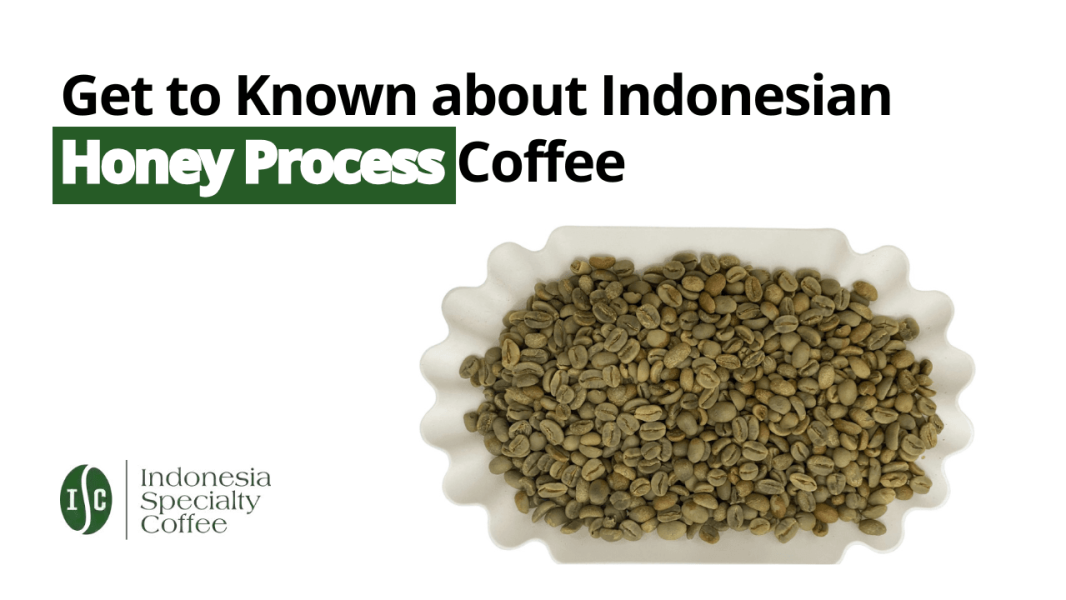
Honey process coffee is pulped like a washed coffee but never rinsed. The skin comes off, the sticky sugar-rich mucilage stays on, and the bean dries wearing it. That one decision moves the cup between the fruit of a natural and the clarity of a washed lot, and how much mucilage stays decides exactly where your cup lands. No honey is involved at any point, only the look of the drying parchment.
Last updated: 26 August 2026
What Is Honey Process Coffee?
Honey processing sits deliberately between the two classic methods. A washed coffee has its mucilage fermented and rinsed off before drying. A natural coffee dries inside the whole cherry. Honey process pulps the cherry, keeps the mucilage, and dries the parchment sticky.
The method was developed in Costa Rica, building on Brazil’s pulped natural, and reached Indonesia through specialty-focused farms rather than through tradition. In the Gayo highlands, farmers call it kupas kismis, raisin peel, after how the drying parchment looks.
| Honey process coffee | |
|---|---|
| Step 1: Cherry | Pulped, mucilage retained, no wash |
| Step 2: Hulling | Dry-hulled at 11% to 13% moisture |
| Drying time | Roughly 8 to 20+ days, by subtype |
| Parchment appearance | Amber to dark brown, slightly sticky |
| Risk level | High: mold and over-fermentation if mismanaged |
| Cup position | Between natural sweetness and washed clarity |
Note the Step 2 row. Honey lots are dry-hulled, never wet-hulled (Giling Basah), because the mucilage has to dry down on the parchment. A Gayo honey therefore cups nothing like a standard wet-hulled Gayo from the same farms, and that contrast is most of your reason to buy one.
Yellow, Red, and Black Honey: What the Colours Mean
One term covers a family of styles, and the colour names describe how much mucilage stays on and how slowly it dries. More mucilage plus slower drying means more sugar working on the bean, deeper fruit, heavier body, and considerably more risk.
| Subtype | Mucilage retained | Drying | Cup direction |
|---|---|---|---|
| Yellow honey | Roughly half | Fast, full sun, about 8 to 10 days | Closest to washed: clean, mild sweetness |
| Red honey | Most of it | Slower, partial shade, around 12 to 15 days | Rounder, caramel and ripe fruit |
| Black honey | Effectively all | Slowest, shaded or covered, 2 to 3+ weeks | Deepest fruit, syrupy, closest to natural |
The percentages vary by producer, so treat the colour as a direction rather than a specification, and ask for the actual protocol on any lot you are pricing. Your offer sheet will rarely volunteer it. A black honey costs more than a yellow for a reason: it occupies drying beds two to three times longer and fails more often.
Indonesian producers trade the full range. Black honey lots from Gayo areas such as Atu Lintang and Jagong Jeget now appear on specialty menus internationally, alongside honey lots layered with anaerobic fermentation.
How the Honey Process Runs, Step by Step
- Selective picking. Only fully ripe cherry, since the mucilage sugar content is the entire point of the method.
- Pulping. The skin comes off mechanically, calibrated to leave the target amount of mucilage.
- Drying with mucilage on. Parchment spreads on raised beds and gets turned constantly. This stage decides everything.
- Moisture to 11% to 13%. Slow and even, with airflow managed and rain kept off.
- Dry hulling, resting, sorting, grading.
Stage three is where the skill lives and the losses happen. Sticky parchment clumps, and clumps trap moisture and grow mold, so farmers turn honey beds far more often than natural or washed lots. Too much sun crusts the mucilage before the bean underneath dries; too little invites over-fermentation.
Gayo farmers have a low-tech success indicator that we have always liked: ants on the drying beds. Properly developing honey parchment smells sweet enough to draw them, and their arrival is read as a sign the sugars are doing their work rather than souring.
Honey vs Natural vs Washed
The three methods answer the same question differently: how much fruit contact should the bean get?
| Washed | Honey | Natural | |
|---|---|---|---|
| Fruit contact during drying | None | Mucilage only | Whole cherry |
| Sweetness | Moderate | High | Highest |
| Acidity | Brightest | Softer, structured | Softest |
| Body | Lightest | Syrupy | Heaviest |
| Ferment character | Minimal | Gentle | Loudest |
| Batch risk | Lowest | High | High |
Honey is the compromise position, and that is its commercial appeal for you: it delivers natural-style sweetness while keeping the cup clean enough for customers who find full naturals too fermented. If your customers hover between those camps, honey lots are the answer that offends neither of them.
Pricing honey lots against washed and natural from the same origin? See our pricelist or contact our team for current lot specifications.
Indonesian Honey Process: Where It Happens and Why It Works
Honey processing arrived in Indonesia recently relative to wet-hulling, and it concentrated where specialty infrastructure already existed.
Our own Gayo Honey production runs across Aceh, in Takengon, Bener Meriah, Angkup, Sukarame, Bies, Jagung, Sabun, and Pondokbaru, alongside lots from Tabanan in Bali and the Tlogosari and Argopuro areas of East Java. Bali Kintamani producers run honey alongside washed and natural as standard options.
The conditions genuinely suit the method. Highland Aceh sits at 18°C to 28°C with strong sun and volcanic soil, which lets mucilage dry steadily without cooking, and altitude-grown cherry carries the sugar the process depends on. The constraint is labour rather than climate: honey beds need constant turning, so volume stays limited and the lots you can actually book sell as micro and small lots rather than containers of a single process.
Not every Indonesian producer runs it. The failure rate keeps most farms on the methods they know, which is exactly why the honey lots on your offer sheet price above standard Grade 1 from the same region.
What Honey Process Coffee Tastes Like
Expect caramel first, then fruit: tropical notes toward pineapple and mango on Indonesian lots, with floral edges and a mild, rounded acidity over a syrupy body. Yellow honeys lean cleaner and lighter, black honeys deeper and heavier, with red in between.
It suits pour over and filter brewing, where the sweetness and structure both show, and it earns a place on your espresso menu when you want sweetness without a natural’s ferment. Our regions guide covers how the base origins differ underneath the process.
One roasting note. Honey lots carry more residual sugar on and near the bean surface than washed coffee, so they colour early and scorch if you run your washed profile on them. Drop the charge temperature modestly, watch the drying phase, and expect first crack to arrive with the bean looking darker than a washed lot would at the same stage.
Frequently Asked Questions
What is honey process coffee?
Honey process coffee is pulped to remove the cherry skin but dried with the sticky mucilage layer left on the parchment, without washing. The sugars in that layer feed into the bean during drying, producing a cup between a natural’s sweetness and a washed coffee’s clarity.
Does honey process coffee contain honey?
No. No honey is used at any stage. The name comes from the appearance and stickiness of the mucilage-coated parchment during drying, which looks and feels like a honey glaze. Gayo farmers call the method kupas kismis, meaning raisin peel, for the same visual reason.
What is the difference between yellow, red, and black honey coffee?
The colours indicate how much mucilage stays on and how slowly the parchment dries. Yellow honey keeps roughly half and dries fast in full sun. Red keeps most and dries slower. Black keeps effectively all of it, dries slowest under shade, and cups deepest.
Is honey process coffee sweet?
It cups noticeably sweeter than washed coffee from the same origin, with caramel and ripe fruit character, though no sweetener is present and the coffee contains no added sugar. The retained mucilage feeds sugar activity during drying, which develops sweetness and body in the roasted cup.
How long does honey process coffee take to dry?
Between roughly 8 and 20 or more days depending on the subtype, climate, and altitude. Yellow honey dries fastest in full sun, while black honey can hold drying beds for two to three weeks or longer under shade, which is part of why it costs more.
Is honey process the same as pulped natural?
They are close relatives. Pulped natural, developed in Brazil, removes the skin and dries with mucilage on, and Costa Rican producers refined the idea into the graded honey styles. In practice honey processing controls mucilage quantity and drying speed more deliberately across its subtypes.
Buy Gayo Honey Green Coffee from Indonesia Specialty Coffee
Indonesia Specialty Coffee supplies Gayo Honey Green Coffee Beans from highland Aceh, graded against SNI 01-2907-2008 as Grade 1 Specialty with cupping scores of 82 to 88 SCA points and moisture at or below 12.5%. FOB Belawan from Medan, Halal certified, with Organic and Rainforest Alliance available on request.
Honey lots are produced in limited volume because of the drying labour involved, so availability follows the harvest rather than a stock list.
Order tiers run 1 kg cupping samples, 60 kg microlot, 350 kg wholesale, and container loads from 9 MT. The most useful first order is a paired one: a Gayo Honey next to a wet-hulled Gayo, cupped side by side, so the process difference shows on your own table. Browse our green coffee beans.