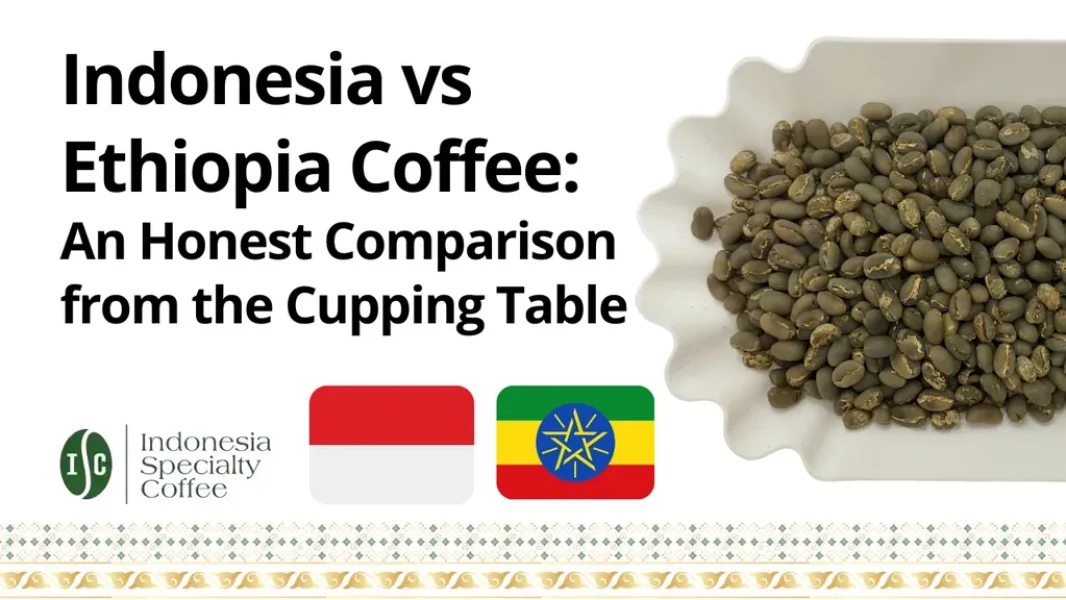
Put a washed Yirgacheffe and a wet-hulled Gayo in the same cupping flight, and you will wonder how both are called arabica. That is the short version of Indonesia vs Ethiopia coffee: Ethiopia gives you florals, citrus, and tea-like clarity at 87 to 92 SCA points on its best washed lots. Sumatran arabica gives you weight, dark chocolate, cedar, and earth at 82 to 88 points, with a body Ethiopia cannot produce. Neither is the better coffee. They answer different questions, and this article explains which question each one answers.
Last updated: July 2026
The Short Answer: How They Differ
Ethiopian coffee is bright, floral, and fruit-driven with a light, tea-like body. Indonesian arabica, at its best from the Sumatran highlands, is heavy, low-acid, and earthy, with dark chocolate and cedar in place of jasmine and bergamot. The difference comes from genetics, altitude, and above all, processing: Ethiopia dries its coffee slowly, while Sumatra hulls it wet because the weather allows nothing else.
Here is the comparison in one table:
| Ethiopia | Indonesia (Sumatran arabica) | |
|---|---|---|
| Typical profile | Jasmine, lemon, bergamot, berries | Dark chocolate, cedar, earth, brown sugar |
| Body | Light, tea-like, silky | Heavy, syrupy |
| Acidity | High, citric and floral | Low, muted |
| Top cupping range | 87-92 (washed Grade 1) | 82-88 (Grade 1) |
| Altitude | 1,500-2,200+ m | 1,400-1,800+ m |
| Varieties | Thousands of heirloom landraces | Typica, Bourbon, Catimor, Tim Tim, local selections |
| Processing | Washed or natural, then dry-hulled at ~12% moisture | Semi-washed, then wet-hulled (Giling Basah) at 35-40% moisture |
| Best use | Filter, pour-over, single origin | Espresso, blends, French press, cold brew |
However, a table cannot tell you why these profiles exist, and the why is what keeps buyers from making expensive mistakes. So let’s take each origin on its own terms.
Why Ethiopian Coffee Tastes the Way It Does
Ethiopian coffee tastes floral and fruity because Ethiopia is where Arabica comes from. Wild coffee still grows in its forests, and farms cultivate thousands of local heirloom varieties that exist nowhere else. Combine that genetic range with altitudes reaching 2,200 meters and slow drying on raised beds, and you get the aromatics that made Yirgacheffe famous.
Because the plant evolved there, Ethiopia holds a card no other origin can play: variety. A washed lot from Yirgacheffe and a natural from Guji are almost different beverages. The washed coffee is stripped of its fruit and fermented clean, then dried slowly in parchment, which is why it cups with jasmine, lemon, and bergamot clarity. The natural is dried inside the whole cherry, which pushes blueberry, strawberry, and wine notes into the seed.
Altitude does the rest. Cool nights at 2,000 meters slow cherry maturation, and slower maturation builds the dense, sugar-rich seed that high cupping scores are made of. In practice, that is why washed Grade 1 Yirgacheffe routinely lands between 87 and 92 points, a range Indonesian arabica does not reach.
If you’re roasting Ethiopian coffee, you are buying acidity and aromatics. Roast it light, brew it as a filter, and stay out of its way.
Why Indonesian Coffee Tastes the Way It Does
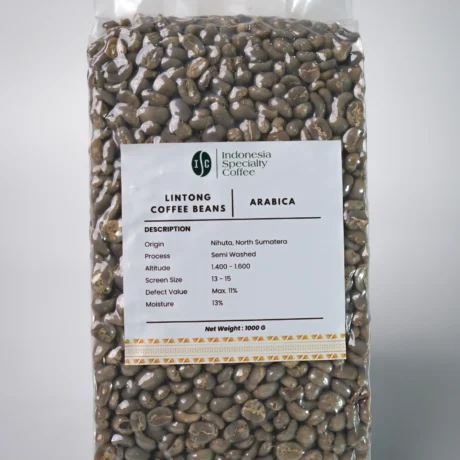
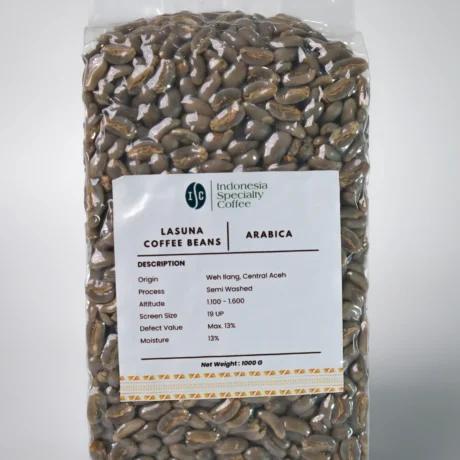
Sumatran arabica tastes heavy and earthy because of how it is dried, not because of any flaw in the plant. The signature process is two steps: the cherry is usually semi-washed (Step 1), then the parchment is stripped off while the bean is still soft and wet, at 35 to 40 percent moisture (Step 2: wet-hulling, or Giling Basah). Exposed green beans finish drying naked in the sun. That shortcut builds the body, mutes the acidity, and writes the earthy signature into the cup.
Why hull wet at all? Weather. Drying coffee in the Gayo highlands of Aceh is a negotiation with the sky. A good day on a Takengon patio gives the crew four hours of real sun; most days give less, and someone is dragging tarps before the afternoon rain lands. Asking a Sumatran farmer to slow-dry parchment for two weeks like an Ethiopian washing station is asking them to gamble the harvest on weather that will not cooperate.
By contrast with Ethiopia’s genetic lottery, Sumatra’s quality game is sorting. Grade 1 under the Indonesian grading standard (SNI 01-2907-2008) means a defect value of 11 or fewer per 300 grams, and the good exporters hand-sort past that threshold. A clean Grade 1 Gayo cups at 82 to 88 points: dark chocolate, cedar, brown sugar, a quiet herbal note, and citrus brightness in the highest lots.
One thing roasters consistently misjudge: wet-hulled beans arrive with a bluish-green color and a softer bean structure than washed coffee. They take heat differently, charge to first crack faster, and punish roast profiles copied from a washed African lot.
Treat the origin on its own terms and it rewards you.
Four Species, Two Very Different Portfolios
Ethiopia grows one commercial coffee species; Indonesia grows four. Ethiopian production is effectively 100 percent arabica, spread across an estimated 6,000 to 15,000 heirloom varieties that exist nowhere else. Indonesia grows arabica, robusta, liberica, and excelsa commercially, which makes it one of the very few origins on earth where a buyer can source all four from a single country.
Ethiopian varieties, by contrast, are landraces rather than named cultivars: farmers plant what has always grown there, and lots are traded by region and grade rather than by variety. Indonesian arabica is the opposite, planted from a documented cultivar list of Typica, Bourbon, Catimor, Tim Tim, Gayo 1, Gayo 2, Sigararutang, and S795.
Start with total output. Both countries produce a similar volume today, but they arrived there very differently: Ethiopia has grown steadily by replanting more than half its cultivated area with higher-yielding varieties, while Indonesia swung hard with the weather.
Coffee production by year, in 60 kg bags (USDA):
| Marketing year | Ethiopia | Indonesia |
|---|---|---|
| 2022/23 | ~8.3 million | ~11.3 million |
| 2023/24 | ~8.3 million | ~9.7 million |
| 2024/25 | ~11.1 million | ~10.9 million |
| 2025/26 | ~11.6 million | ~12.5 million |
| 2026/27 (forecast) | Growth expected | ~11.4 million (-8%) |
| Exports 2025/26 | ~7.8 million | ~7.8 million |
Now the part that matters more than the totals: what species those bags actually contain.
Indonesia coffee production by species:
| Species | Share of national production | Where it grows | Buyer relevance |
|---|---|---|---|
| Robusta | ~87% | Lampung, South Sumatra, Java, Bali lowlands | Volume, instant, blend filler, espresso base |
| Arabica | ~12% | Gayo, Mandheling, Lintong, Toraja, Java, Bali, Flores | The entire specialty story |
| Liberica | ~1% (combined) | Jambi, Bengkulu, Riau, West Kalimantan peatlands | Rare origin, jackfruit and smoky notes |
| Excelsa | Under 1%, inside the liberica figure | Jambi, Riau, East Java, Temanggung | Very rare, tart and fruit-forward |
Ethiopia coffee production by species:
| Species | Share of national production |
|---|---|
| Arabica | ~100% |
| Robusta | Not grown commercially |
| Liberica | None |
| Excelsa | None |
One honest caveat on the Indonesian numbers. Official sources disagree: USDA’s green-bean split works out to roughly 87 to 88 percent robusta, while some Ministry of Agriculture figures have cited 72 percent robusta and 27 percent arabica, likely measuring planted area rather than exported green bean. Neither BPS nor USDA breaks excelsa out from liberica at all, so anyone quoting you a precise excelsa tonnage is estimating. Treat the roughly 1 percent figure as the honest ceiling for both species combined.
Those numbers explain a lot. Ethiopia’s arabica-only profile is why its national reputation and its specialty reputation are the same thing. Indonesia’s numbers look worse on paper, because arabica is barely an eighth of the crop, but that eighth is concentrated in the Sumatran highlands and is where the entire specialty story lives.
What Only Ethiopia Has
Ethiopia’s monopoly is genetic and structural. It is arabica’s birthplace, so wild coffee still grows in its forests, and roughly 10 percent of national output is still literally forest coffee harvested from indigenous shade trees. Another 35 percent comes from semi-forest systems, 50 percent from smallholder garden plots, and only about 5 percent from formal plantations. No other origin produces at this scale with that little planted agriculture behind it.
What Only Indonesia Has
Indonesia’s monopoly is in processing and species breadth. Sumatran arabica is semi-washed and then wet-hulled at 35 to 40 percent moisture, a two-step method used nowhere else at scale, and it is the reason “Sumatra” is a flavor descriptor rather than just a place name. Beyond arabica, Indonesia farms liberica on Jambi and Kalimantan peatlands, where arabica cannot survive, and excelsa in Jambi and East Java. Both species together account for well under 2 percent of world coffee. And then there is wild civet Luwak, which no other country produces at commercial, certified scale.
So if you’re sourcing for genetic novelty and floral cup character, Ethiopia has no substitute. If you’re sourcing across species, or need body that only wet-hulling produces, Indonesia has no substitute either.
Side by Side on the Cupping Table
On a shared cupping table, Ethiopian coffee wins aroma, flavor complexity, and acidity, while Sumatran arabica wins body, mouthfeel, and aftertaste weight. Cup them blind against the same form and the Ethiopian scores higher almost every time. Cup them for purpose, as espresso base or filter feature, and the answer flips depending on the slot you are filling.
We cup every export lot in our Medan lab, and we occasionally run an Ethiopian sample in the same flight for calibration [confirm with ISC: do you keep Ethiopian reference samples on the table]. The contrast is educational. The Yirgacheffe empties the aroma column: florals, stone fruit, perfume. Then the spoons hit the Gayo and the room changes; less to smell, far more to chew, and a finish that is still sitting on the palate two coffees later.
That contrast maps directly onto use:
| Attribute | Winner | Why it matters |
|---|---|---|
| Fragrance/aroma | Ethiopia | Sells single-origin pour-over |
| Acidity | Ethiopia | Brightness in filter brews |
| Body | Indonesia | Carries milk drinks and espresso |
| Aftertaste weight | Indonesia | Blend persistence |
| Cup complexity | Ethiopia | Competition and showcase lots |
| Consistency across a container | Indonesia | Fewer surprises in volume buying |
Have you ever tasted a blend where the fruit disappeared the moment milk hit the cup? That is what an all-Ethiopia espresso does. A Sumatran base is the traditional fix, which is why the two origins meet in blends more often than they compete on shelves.
The Trade-Off Nobody Selling Coffee Will Admit
Here is the honest version. On aromatics and cupping score, a washed Grade 1 Yirgacheffe beats a Grade 1 Gayo every time, and an exporter who tells you otherwise is selling, not cupping. The 87-92 range Ethiopian washed lots reach is simply beyond what wet-hulled coffee can score on the SCA form, because the form rewards clarity and acidity that wet-hulling trades away.
You do not buy Sumatran arabica to win that contest. You buy it because nothing else delivers its body and earth, because it anchors blends that florals cannot, and because a container of it behaves predictably. The reverse warning also applies: buy Ethiopia for a creamy, low-acid espresso profile and you will be disappointed by a coffee that did nothing wrong.
Judge each origin by the other’s standard and you will always buy badly. That is the position of this article, and thirty years of blend recipes back it up.
Supply and Price in 2026: The Part the Flavor Guides Skip
Flavor is only half the buying decision in 2026, because the two origins are in very different supply positions. Ethiopia is having a strong export year on paper, with record coffee revenue above US$3 billion, but washed specialty lots are scarce: cherry prices in the south ran 190 to 230 ETB per kilogram this season, roughly four times recent years, and strong natural prices pulled farmers away from washing stations. As a result, clean washed Yirgacheffe is harder to find and priced accordingly.
Indonesia tells the opposite story. USDA already forecasts total production down 8 percent next season on excess rain during flowering. However, the Sumatran arabica harvest runs long, June through August at its peak inside a May-to-September season, because the climate gives no single picking window. Pickers work the same trees weekly for months, which spreads supply and steadies quality across the year.
For a buyer, the practical numbers look like this. Current FOB Belawan pricing for Gayo arabica runs about $8.00-10.00/kg for semi-washed wet-hulled Grade 1 and $9.50-11.00/kg for full-washed dry-hulled lots, with honey and natural processes above that. Comparable washed Ethiopian Grade 1 is trading at a premium this season, when it can be secured at all.
That said, prices move. Treat these as July 2026 reference points and ask any supplier, in either origin, for a current offer sheet before you plan a roast calendar around it.
What This Means for Roasters and Importers
If you’re building a single-origin filter program, Ethiopia is the easier sell: the aromatics do the marketing for you. Budget for this season’s washed-lot premium, or lean into naturals, which dominate Ethiopian availability this year and bring their own fruit-bomb audience.
If you’re building an espresso blend or a milk-forward cafe menu, start from a Sumatran base. A Gayo or Mandheling at 40 to 60 percent of the blend carries the body, and a smaller Ethiopian component restores the top notes. This is the oldest recipe in specialty coffee because it works.
If you’re importing at container scale, the Indonesia vs Ethiopia coffee question is really a supply question, so weigh availability as heavily as cup score. Ethiopian quality peaks higher; Sumatran supply is steadier and cheaper this cycle. Plenty of serious buyers hold positions in both, for exactly that reason.
And whichever side you buy, cup a sample from the actual lot before you commit. Both origins are famous precisely because their best lots are far above their averages.
For more of this series, see how Indonesian coffee stacks up against Colombian coffee and Vietnamese coffee.
Frequently Asked Questions
Is Ethiopian coffee better than Indonesian coffee?
Neither is better; they are opposites. Ethiopian coffee scores higher on the SCA form, with washed Grade 1 lots reaching 87-92 points against 82-88 for Sumatran Grade 1. Indonesian arabica wins on body, low acidity, and blend performance. The right choice depends on whether you need aromatics or weight.
Why does Indonesian coffee taste earthy compared to Ethiopian coffee?
The earthiness comes from wet-hulling. Sumatran coffee is usually semi-washed, then hulled at 35-40 percent moisture so the bare bean finishes drying in a rainy climate. Ethiopian coffee dries slowly inside parchment or cherry to about 12 percent, which preserves florals and acidity instead of building body.
Which is better for espresso, Indonesia or Ethiopia?
Indonesian arabica is the safer espresso choice. Its heavy body, low acidity, and chocolate-earth profile survive milk and pressure, which is why Sumatran coffee anchors classic espresso blends. Ethiopian coffee can make striking straight espresso, but its delicate florals often disappear in milk drinks.
Does Ethiopia grow robusta, liberica, or excelsa?
No. Ethiopia grows arabica almost exclusively and does not produce robusta, liberica, or excelsa commercially. Indonesia produces all four species: about 11 million bags of robusta, 1.5 million bags of arabica, plus small commercial volumes of liberica on Jambi and Kalimantan peatlands and excelsa in Jambi and East Java.
What percentage of Indonesian coffee is arabica?
Arabica is roughly 12 percent of Indonesian coffee production, about 1.5 million 60 kg bags out of 12.5 million in 2025/26. Robusta accounts for around 87 percent, and liberica plus excelsa together make up about 1 percent. Indonesia’s specialty reputation rests almost entirely on that 12 percent.
Are Indonesian and Ethiopian coffee both arabica?
Yes, the specialty lots from both origins are arabica. Ethiopia grows thousands of heirloom arabica varieties and almost no robusta. Indonesia grows mostly robusta by volume, but its specialty reputation rests on highland arabica from Sumatra, notably Gayo, Mandheling, and Lintong, plus Java, Bali, Toraja, and Flores.
Cupping Both Origins Yourself
Whichever origin you lean toward, ask the supplier for the crop year, the full two-step process description, and a recent cupping score before committing to a bag, let alone a pallet. If you want the Indonesian side of the flight, Indonesia Specialty Coffee ships 1 kg cupping samples of the Sumatran and other Indonesian lots we export: request a sample or see the current pricelist.