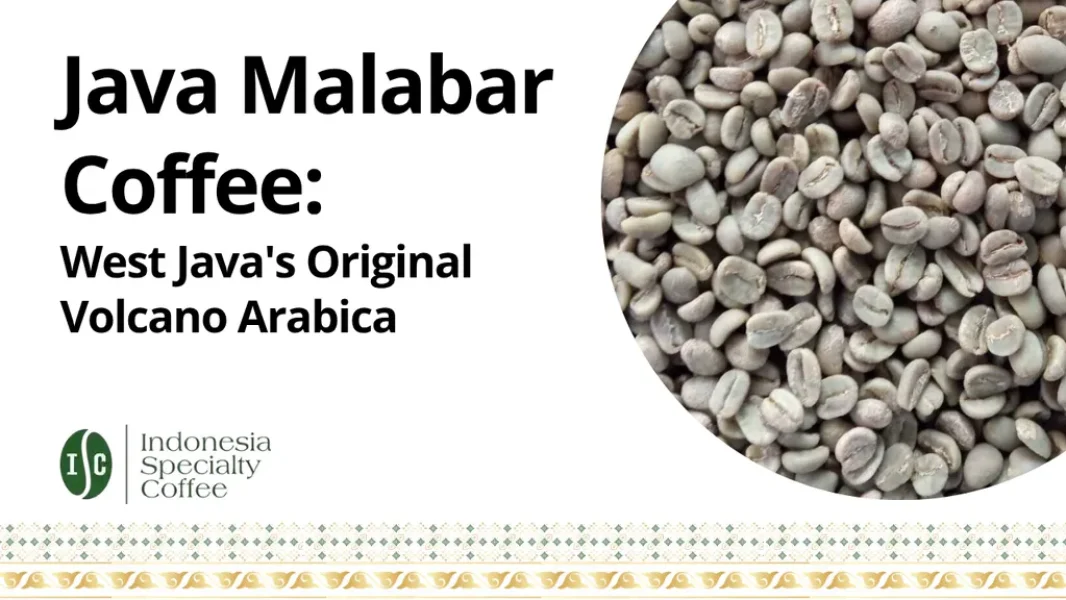
When someone calls coffee “a cup of Java,” this is roughly where the phrase was born. Java Malabar coffee is Arabica grown on the slopes of Mount Malabar, above Pangalengan in the West Java highlands, part of the historic Java Preanger region where the Dutch planted some of Indonesia’s first coffee three centuries ago. Grown at 1,400 to 1,800 meters on volcanic soil, it is best known today for clean, sweet, fruity cups from natural, honey, and wine processing, chocolate and citrus with a winey edge, a long way from the earthy Java stereotype. Here is what makes Malabar coffee both the oldest story in Indonesian coffee and one of its most modern.
Last updated: August 2026
What is Java Malabar coffee?
Java Malabar coffee is specialty arabica grown on Mount Malabar, a volcano south of Bandung in West Java, around the town of Pangalengan at roughly 1,400 to 1,800 meters. It sits within the Java Preanger highlands, a historic arabica region. The cup is clean and sweet, with chocolate, almond, citrus, and a fruity, sometimes winey character, more like a bright washed or natural coffee than the heavy earthy Java of old.
The setting is textbook high-grown arabica. Cool temperatures of 15 to 21 degrees, around 2,000 millimeters of rain a year, near-constant cloud cover, and mineral-rich volcanic soil all slow the cherry as it ripens, which concentrates sugar and complexity. On a clear day the coffee grows in and around the tea gardens that also blanket these slopes.
Malabar is one of a handful of West Java origins, alongside the wider Java Preanger name, that has pulled Indonesian Java coffee toward clean, fruit-forward specialty and away from its dusty commodity reputation.
Where it grows: Mount Malabar and the Preanger highlands
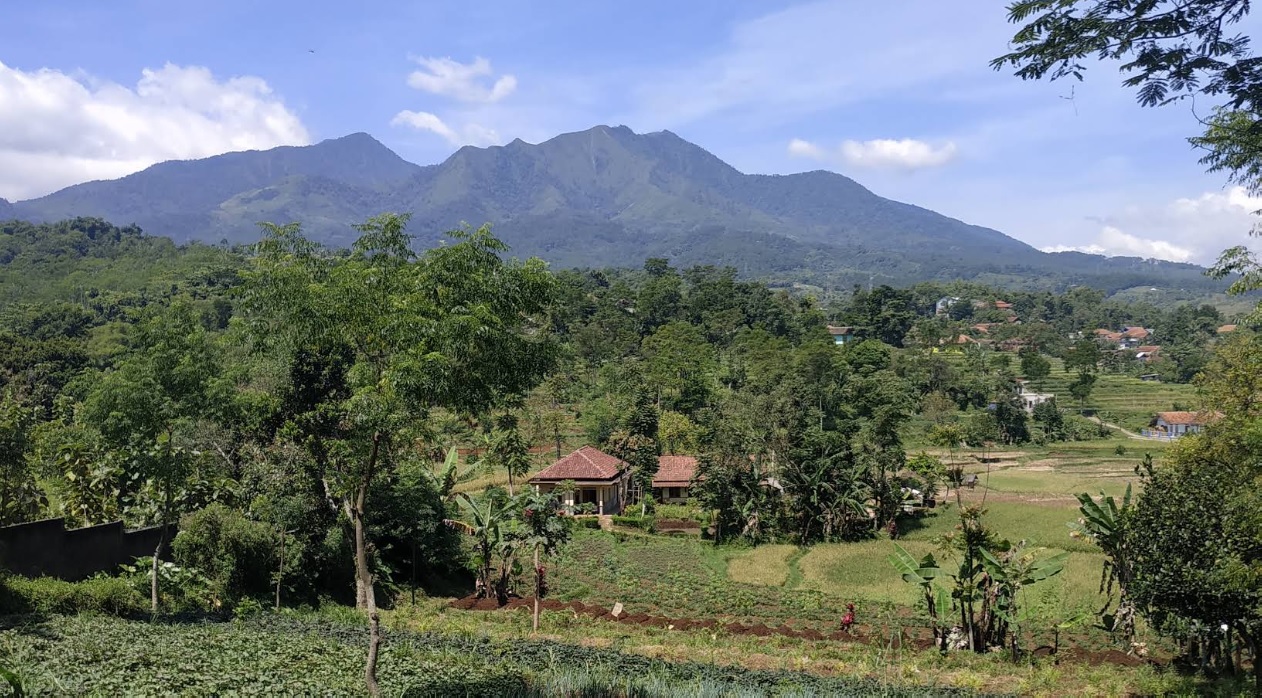
Java Malabar coffee grows on the slopes of Mount Malabar, a stratovolcano rising to about 2,343 meters just south of Bandung, in the Pangalengan highlands of West Java. This is the heart of the Preanger, or Priangan, the mountainous interior of West Java that has grown arabica since the colonial era. Nearby volcanoes like Papandayan, Tilu, and Wayang-Windu share the same terroir.
The volcanic ground here is the real asset. Unlike some Indonesian origins that grow on non-volcanic mountains, Malabar sits on classic young volcanic soil, deep, mineral-rich, and free-draining, which gives the coffee a clean, structured body. Add the altitude and the persistent highland cloud, and you get slow maturation and the concentrated sweetness that Malabar lots are known for.
This is also a landscape of estates as much as smallholders. The Malabar slopes carry a long plantation history, coffee and tea both, and today a mix of cooperatives, estates, and small farms supply the green. That estate structure means some Malabar coffee is more carefully and consistently processed than the Indonesian smallholder average, which matters for the experimental processing the region has become known for.
Why it’s called Malabar: the India connection
The name Malabar is a small history lesson in itself. The Dutch brought Java’s first arabica seed from the Malabar coast of southwest India, and that stock had its own remarkable path: it descended from seeds carried out of Yemen decades earlier by the pilgrim Baba Budan, then grown on in India. The first shipment reached Batavia, now Jakarta, in 1696 and was lost in a flood almost at once. A second shipment in 1699 survived, and from those few trees, Java coffee was born.
Those trees turned out to matter far beyond Java. A single seedling sent on to the Amsterdam Botanical Garden in 1706 became the grandparent stock of the coffee later planted across Brazil, the Caribbean, and Latin America. Genetic work confirms that most of the world’s cultivated arabica, the Typica line, traces back through Java to those Malabar seeds. Drink a Malabar lot and you are drinking from the trunk of the family tree that seeded half the coffee world. The same name, Malabar, now sits on this West Java volcano, a fitting echo.
That deep history is why “Java” became slang for coffee at all. The Preanger highlands, Malabar among them, were where the Dutch East India Company built the first large arabica plantations in the early 1700s, and Java coffee dominated the world trade for a century. When you drink a Malabar lot, you are drinking from one of the oldest arabica regions on earth.
The history is not all romance, and honesty matters here. For much of the 1700s and 1800s the Priangan highlands ran on the Preangerstelsel, a forced-cultivation system that compelled local farmers to grow coffee for the Dutch, one of the harsher chapters of the colonial economy. Then in the 1880s leaf rust swept through and destroyed the arabica almost entirely, and West Java replanted with robusta. The clean, fruity Malabar arabica sold today is a modern revival, arabica deliberately brought back to slopes that spent a century growing something else.
The colonial footprint is still visible on the mountain. Malabar was the site of grand Dutch estates and even the famous Radio Malabar transmitter of the 1920s. The coffee outlasted all of it.
Natural, honey, and wine: Malabar’s modern processing
What defines Malabar coffee today is processing range, not a single house style. Indonesian coffee is processed in two steps: the cherry method, then the hulling method. Older West Java coffee leaned on wet-hulling, the heavy, earthy Sumatran-style method. Modern Malabar is better known for clean, fruit-driven lots: fully washed, natural, honey, and even wine process, then dried carefully and dry-hulled to protect clarity.
That shift is deliberate, and it put Malabar on the map. A Malabar natural took Champion Filter Coffee at a Melbourne competition in 2016, exactly the kind of clean, fruity, winey cup that wet-hulling flattens. Natural and honey processing keep the fruit sugars on the bean during drying, which is where Malabar’s pomelo, apple, banana-bread, and winey notes come from. It is a West Java origin behaving more like a modern African or Central American coffee than a traditional Indonesian one.
The varieties support it. Malabar grows mostly Sigararutang, S795, and Typica, hardy, altitude-suited arabicas. S795 quietly carries a trace of liberica in its ancestry, part of where its sturdy body comes from, though almost no one selling the coffee mentions it. Grown high and processed cleanly, these workhorse varieties punch well above their reputation.
What Java Malabar coffee tastes like
Java Malabar coffee tastes clean and sweet, with a dominant chocolate note, almond, citrus, and a fruity, often winey character, over a medium body and balanced acidity. Natural and wine-processed lots push into pomelo, apple, banana bread, black tea, and even jackfruit, while washed lots stay cleaner and more classically chocolate-and-citrus. A strong caramel aroma is common across the board.
This table sets Malabar against familiar Indonesian arabica reference points.
| Coffee | Region | Elevation | Body | Signature notes |
|---|---|---|---|---|
| Java Malabar | West Java | 1,400-1,800 m | Medium | Chocolate, almond, citrus, pomelo, winey fruit |
| Java Preanger | West Java | 1,200-1,700 m | Medium | Chocolate, spice, clean, balanced |
| Gayo | Aceh | 1,200-1,800 m | Full | Brown sugar, cedar, herbal, low-medium acidity |
| Mandheling | North Sumatra | 1,100-1,500 m | Heavy, syrupy | Deep earth, dark chocolate, licorice |
Read across it and Malabar sits at the clean, sweet, fruit-forward end with the rest of West Java, a clear step away from the heavy earthiness of the Sumatran origins. Its natural and wine lots are among the fruitiest coffees Indonesia produces.
The honest part: “Java” is coffee’s most abused name
Here is the trap with this origin. “Java” is the single most abused word in coffee. It has been slang for any coffee for a century, it names a programming language, and it gets slapped on blends and pods that contain nothing from the island. So real single-origin Java Malabar has to fight through a fog of coffee called “Java” that has no connection to West Java at all. When you buy Malabar, you are buying against a name that has been diluted almost to meaninglessness.
We would argue that is exactly why the specific origin matters here more than most. Malabar, Pangalengan, Preanger: these are real places with real terroir, and naming them is how you escape the generic “Java” label. If a bag just says “Java” with no mountain, region, farm, or process, assume it is a commodity blend until proven otherwise.
Now the trade-off, stated plainly. Malabar’s strength, its adventurous natural and wine processing, is also its risk. Fermentation-forward processing is hard to control, and a winey lot done well is gorgeous while a winey lot done badly is just over-fermented and boozy. The quality range is wide. Buy the clean, well-made version and it is one of Indonesia’s most exciting cups. Buy carelessly and you get a muddled, boozy mess wearing the same label.
What this means for roasters and buyers
For roasters, Java Malabar is a single-origin showcase, especially its natural and honey lots. Its chocolate base makes it approachable, and its fruit and winey top notes give a filter or pour-over menu something distinctive. A clean washed Malabar also makes a bright, structured espresso. It is wasted as an anonymous blend filler labeled only “Java.”
Before you commit past a sample, ask any supplier four things: the crop year, the specific area or estate and elevation, the exact process (washed, natural, honey, or wine), and the variety. Then cup it. A good Malabar should show clean chocolate and defined fruit with no boozy, over-fermented, or musty off-note. If a natural or wine lot tastes sharp and alcoholic rather than sweet and fruity, the fermentation ran too far, and no origin story fixes that in the cup.
Frequently asked questions
What is Java Malabar coffee?
Java Malabar coffee is specialty arabica grown on Mount Malabar, a volcano near Pangalengan in West Java, at roughly 1,400 to 1,800 meters, within the historic Java Preanger region. It is clean and sweet, with chocolate, almond, citrus, and fruity, winey notes, especially in natural and honey processed lots.
Where is Malabar coffee grown?
Malabar coffee grows on the slopes of Mount Malabar, a stratovolcano south of Bandung, around Pangalengan in the West Java highlands. This is the heart of the Preanger, or Priangan, region, one of the oldest arabica-growing areas in Indonesia, with volcanic soil and altitudes of about 1,400 to 1,800 meters.
What does Java Malabar coffee taste like?
Java Malabar coffee is clean and sweet, with a dominant chocolate note, almond, citrus, and a fruity, often winey character over a medium body and balanced acidity. Natural and wine-processed lots add pomelo, apple, banana bread, black tea, and jackfruit. It is far less earthy than Sumatran coffee.
Why is it called Malabar coffee?
The name traces to the Malabar coast of India, from where the Dutch brought Java’s first arabica seed around the turn of the 1700s. The same name sits on this West Java volcano. The Preanger highlands, Malabar included, were where Indonesian coffee began, which is why “Java” became a global word for coffee.
How is Java Malabar coffee processed?
Increasingly with clean, fruit-forward methods. Older West Java coffee was wet-hulled, but modern Malabar is known for washed, natural, honey, and wine processing, then careful drying and dry-hulling. Natural and honey processing keep fruit sugars on the bean, which gives Malabar its winey, fruity character.
What coffee varieties grow in Malabar?
Mostly Sigararutang, S795, and Typica, hardy arabica varieties suited to the high volcanic slopes. S795, known locally as Jember, even carries a trace of liberica in its ancestry. Grown at altitude and processed cleanly, these varieties produce a sweet, structured, chocolate-forward cup.
Is Java Malabar coffee the origin of the world’s arabica?
In large part, yes. The coffee seeds sent from Malabar, India to Java in 1696 and 1699 became the Typica line, and a seedling passed to Amsterdam in 1706 seeded coffee across Brazil, the Caribbean, and Latin America. Most of the world’s cultivated arabica traces back through Java.
Sourcing Java Malabar coffee: where to start
Because “Java” is such a diluted name, insist on specifics: ask for the mountain or estate, the elevation, the crop year, and above all the exact process, since a Malabar natural and a Malabar washed are very different cups. Then taste a sample, especially with fermentation-forward lots. If you want West Java arabica alongside other Indonesian origins, Indonesia Specialty Coffee exports Grade 1 Java arabica; request a sample or browse the green coffee range.