
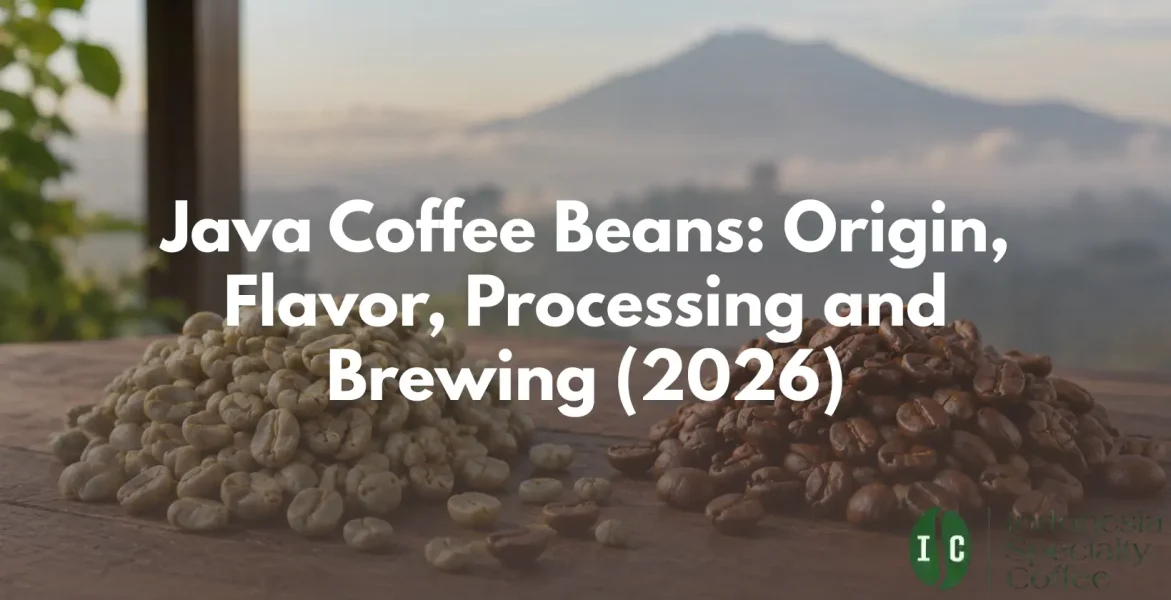
Java coffee beans are coffee grown on the island of Java, Indonesia. The name describes geography, not a roast level, a brand, or a blend, even though “java” became slang for coffee in general after Dutch Java coffee dominated European markets in the 1700s. Today Java produces both Arabica and Robusta, and its best Arabica comes from two highland areas: Preanger in West Java and the Ijen Plateau in East Java.
This guide is for roasters, cafés, and buyers comparing Java with other Indonesian origins. It covers where the coffee grows, how Java differs from Sumatra in the cup, the processing methods that matter, the grading specs we ship, and how to roast and brew Java coffee beans for clarity or body.
Last updated: 02 October 2026
What Are Java Coffee Beans?
Java coffee beans are the seeds of coffee cherries harvested on Java, Indonesia’s most populated island. Highland farms above roughly 1,000 metres grow Arabica; lower farms, especially in Central and East Java, grow mostly Robusta. When specialty buyers say “Java” they almost always mean highland Arabica.
Three labels cause most of the confusion:
- Java on its own: an origin, usually Arabica, quality not implied.
- Mocha Java: a historic blend of Yemeni Mocha with Java coffee, now a style name used by many roasters with beans from anywhere.
- Old Java: Java coffee aged in warehouses for years, a tradition from the sailing-ship era. Our aged green coffee guide explains how ageing changes the cup.
For single origin Java coffee beans, look for the region (Preanger, Ijen), the processing method, and the grade on the label.
A Short History of Java Coffee
The Dutch East India Company brought Arabica to Java at the end of the 1690s, and by the early 1700s Java coffee was shipping to Amsterdam in volumes large enough to set European prices. For more than a century, “Java” and “coffee” meant much the same thing to European and American drinkers, which is where the slang comes from.
Coffee leaf rust reached Java in the late 1870s and destroyed most of the island’s Arabica. Planters replaced it first with Liberica and then with Robusta, which is why Java is still a major Robusta producer. Highland Arabica came back later on the Ijen Plateau and in the Priangan highlands, and those are the areas specialty buyers source from today. Our history of coffee puts Java’s role in the wider story.
Where Java Coffee Beans Grow
Java’s coffee belt follows its chain of volcanoes. Volcanic soil, altitude, and a pronounced dry season give Java coffee beans more structure and sweetness than lowland coffee from the same island.
| Region | Location | Altitude | Main species | Cup character |
|---|---|---|---|---|
| Preanger (Priangan) | West Java: Ciwidey, Pangalengan, Garut | 1,200 to 1,700 m | Arabica | Floral, gentle spice, dark chocolate, caramel |
| Ijen Plateau | East Java: Bondowoso and Banyuwangi | 1,300 to 1,600 m | Arabica | Dark chocolate, citrus zest, brown sugar, light florals |
| Central Java | Temanggung, Sindoro-Sumbing slopes | 700 to 1,500 m | Robusta and Arabica | Heavier, earthy, cocoa |
| Lowland East Java | Malang, Jember and surrounding areas | Below 800 m | Robusta | Body, bitterness, crema for espresso |
Ijen is the one origin on Java where historic Dutch-era estates still operate alongside smallholders, so lot sizes there tend to be larger and more uniform. Our Java Ijen coffee guide covers the plateau in depth, and our single origin Java coffee article compares the regions as single origins.
Comparing Java with your current Indonesian origin? See our wholesale pricelist or contact our team for 1 kg samples of Preanger and Ijen.
How Processing Changes Java Coffee Beans
Processing is where Java separates from Sumatra. Indonesian coffee is described in two steps: the cherry method, then the hulling method. Much of Java’s specialty Arabica is washed and dry-hulled, while most Sumatran Arabica is wet-hulled.
| Process (step 1 + step 2) | What happens | Effect on Java coffee beans |
|---|---|---|
| Full-washed, dry-hulled | Fruit removed and fermented, parchment dried to about 12 percent before hulling | Cleanest cup, brighter acidity, citrus and florals |
| Semi-washed, wet-hulled (Giling Basah) | Parchment removed at 35 to 40 percent moisture | Heavier body, softer acidity, earthy and spicy |
| Honey, dry-hulled | Some fruit mucilage left on during drying | Extra sweetness, rounder body |
| Natural, dry-hulled | Dried as whole cherry | Fruit-forward, wine-like; see our Java wine coffee and Java honey coffee guides |
Ask for both steps on every spec sheet. “Washed Java” tells you the cherry method but not whether the bean was hulled wet or dry, and that second step changes the cup as much as the first. Our wet-hulled process guide shows the difference step by step.
Flavor Profile: Java vs Sumatra
Java coffee beans sit between Sumatra and Bali on the Indonesian flavour spectrum: more body than a Bali Kintamani, cleaner and brighter than a typical wet-hulled Sumatra.
| Java (washed Ijen or Preanger) | Sumatra (wet-hulled Gayo or Mandheling) | |
|---|---|---|
| Body | Medium to full, smooth | Full to very full, syrupy |
| Acidity | Low to medium, rounded | Low |
| Flavour | Dark chocolate, brown sugar, citrus zest, light florals, soft spice | Earthy, cedar, tobacco, dark chocolate, herbal |
| Finish | Clean, sweet | Long, savoury |
| Best roast | Medium | Medium to medium-dark |
If your customers find Sumatra too earthy but still want Indonesian body, washed Java coffee beans are the usual answer. If you want the classic heavy Indonesian cup, Sumatra does it better. Our Sumatra Mandheling guide covers the other side of the comparison.
How to Roast and Brew Java Coffee Beans
Washed Java coffee beans are denser than wet-hulled Sumatran beans, so they tolerate a higher charge temperature and a slightly longer development. A medium roast keeps the citrus and florals while building chocolate; medium-dark shifts the cup toward caramel and cocoa for espresso. Avoid very dark roasts, which flatten the sweetness that makes Java worth buying.
| Method | Recipe | What it highlights |
|---|---|---|
| Pour-over (V60, Kalita) | 15 g to 250 g water at 93 to 94°C, medium-fine, 2:30 to 3:00 | Citrus, florals, clean sweetness |
| French press | 30 g to 450 g at 95°C, coarse, 4:00 steep | Body, chocolate, spice |
| Espresso | 18 g in, 36 to 40 g out, 27 to 30 s | Chocolate, caramel, syrupy texture |
| Cold brew | 1:8 coarse grind, 16 to 18 hours chilled | Low acidity, cocoa sweetness |
For extraction timing, see our pour-over brewing time guide and French press ratio guide.
How to Buy Java Coffee Beans
Buying Java coffee beans well comes down to asking for the right specs. Here is what we ship against for our two main Java Arabicas:
| Spec | Java Ijen Arabica | Java Preanger Grade 1 |
|---|---|---|
| Region | Ijen Plateau, East Java | Ciwidey, Pangalengan, Garut, West Java |
| Altitude | 1,300 to 1,600 m | 1,200 to 1,700 m |
| Varieties | Typica, USDA, Kartika, Line S | Mixed smallholder Arabica |
| Process | Washed | Semi-washed |
| Screen size | 16 to 18 | 15 to 19 |
| Moisture | 10.5 to 12 percent | 13 percent maximum |
| Grade | Specialty grade | SNI Grade 1, defect value 11 or lower |
| Price | From $18.80 per kg, 1 kg rate; bulk on request | From $18.80 per kg, 1 kg rate; bulk on request |
Before you order, check the species (Arabica or Robusta), region, both processing steps, crop year, and a cupping score for the specific lot. Indonesian grade numbers measure defects, not flavour, so a Grade 1 lot still needs to be cupped. Buy a 1 kg sample first, then scale to a 60 kg microlot or 350 kg wholesale order once the cup is confirmed.
Frequently Asked Questions
What are Java coffee beans?
Java coffee beans are coffee grown on the island of Java in Indonesia. The name refers to origin, not to a roast or a blend. Highland farms in West Java (Preanger) and East Java (Ijen Plateau) grow Arabica at 1,200 to 1,700 metres, while lower farms grow mostly Robusta.
What do Java coffee beans taste like?
Washed Java Arabica tastes of dark chocolate, brown sugar, and soft spice, with citrus zest or light florals in higher lots. Body is medium to full and acidity low to medium. Compared with wet-hulled Sumatran coffee, Java coffee beans are cleaner and brighter, with less earthiness.
Why is coffee called java?
Coffee is called java because Dutch-grown coffee from Java dominated European and American markets in the 1700s and 1800s. The island name became everyday slang for coffee in general. Today “java” on a menu means coffee, while “Java coffee beans” on a green coffee spec sheet means beans from the island.
Is Java coffee Arabica or Robusta?
Java grows both. Specialty Java coffee beans from Preanger and the Ijen Plateau are Arabica grown above 1,200 metres. Lowland Central and East Java grow mostly Robusta, a legacy of the leaf rust that destroyed the island’s Arabica in the late 1800s. Always check the species on the label.
What is the difference between Java and Sumatra coffee?
Most Sumatran Arabica is wet-hulled, giving heavy body, low acidity, and earthy, woody notes. Much specialty Java Arabica is washed and dry-hulled, giving a cleaner cup with chocolate, citrus, and soft spice. Java suits buyers who want Indonesian body without Sumatra’s earthiness.
How should I brew Java coffee beans?
A medium roast suits most brew methods. Use pour-over at 15 g to 250 g of water, 93 to 94°C, for clarity; French press at 30 g to 450 g, steeped four minutes, for body; or espresso at a 1:2 ratio in 27 to 30 seconds for chocolate and caramel sweetness.
Buy Java Green Coffee Beans from Indonesia Specialty Coffee
Indonesia Specialty Coffee supplies Java Ijen Arabica and Java Preanger Grade 1 green coffee beans alongside Gayo, Mandheling, Bali, Toraja, and Flores. Every lot is graded against SNI 01-2907-2008, cupped at 82 to 88 SCA points, and Halal certified, with Organic and Rainforest Alliance available on request. We export from Medan, FOB Belawan, with CIF quoted on request.
Order tiers run 1 kg for a cupping sample, 60 kg for a microlot rate, 350 kg for standard wholesale, and container loads from 9 MT.
Cup Java next to your current Sumatra and see which your customers prefer. See our current wholesale pricelist or contact our team.

