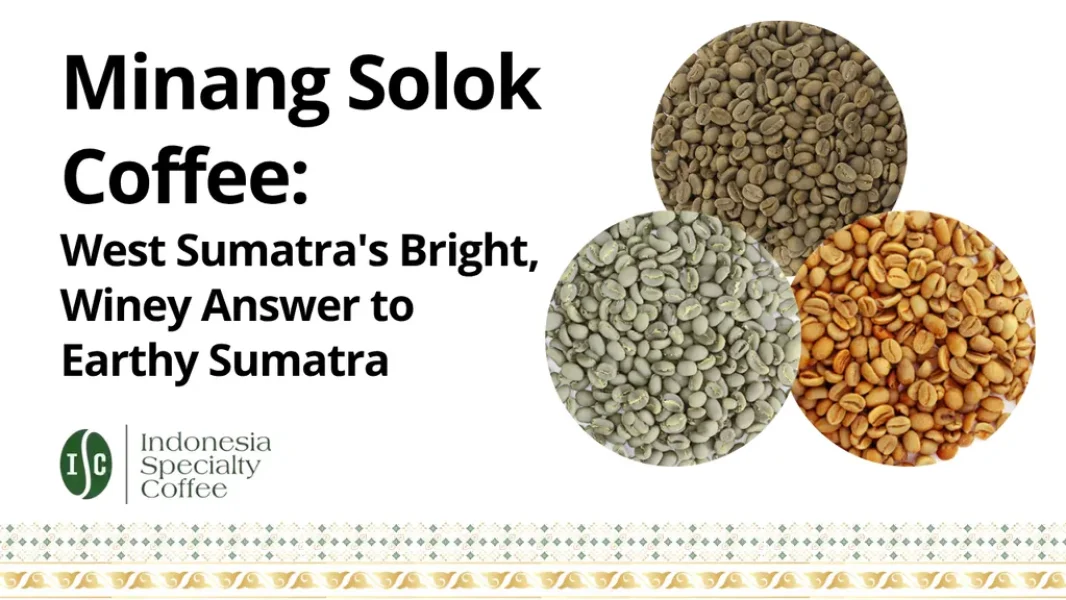
Everything you think you know about Sumatran coffee, Solok politely ignores. Minang Solok coffee is arabica grown in Solok Regency, in the Minangkabau highlands of West Sumatra, and it is bright, clean, and fruity where most Sumatra is heavy and earthy. Grown between roughly 1,400 and 1,600 meters around Mount Talang and the twin lakes, and processed washed or honey rather than wet-hulled, Solok cups closer to an African or Central American coffee than to Mandheling. It is one of Indonesia’s genuine specialty success stories, and it was built by farmers, not a colonial estate. Here is what makes it different.
Last updated: August 2026
What is Minang Solok coffee?
Minang Solok coffee is specialty arabica grown in Solok Regency, in the Minangkabau highlands of West Sumatra, at roughly 1,200 to 1,900 meters. It is known for a bright, clean, fruity cup with wine-like acidity, notes of berry, cherry, citrus, and dark chocolate, and a sweetness that comes from washed and honey processing rather than the wet-hulling used across most of Sumatra.
The “Minang” in the name is Minangkabau, the culture of West Sumatra. This is a different coffee world from the north of the island. Where Gayo and Mandheling are wet-hulled, heavy, and low-acid, Solok is one of a small group of Indonesian origins, alongside Bali Kintamani and Kerinci, that deliberately went the other way toward clarity and brightness.
If your reference point for Sumatra is a syrupy, earthy Mandheling, Solok will not fit the box. It is cleaner, more acidic, and more fruit-driven, and that is the whole point of it.
Where it grows: the Minangkabau highlands around Mount Talang
Minang Solok coffee grows in the highlands of Solok Regency, West Sumatra, on volcanic soil around the active volcano Mount Talang and the twin lakes of Danau Diatas and Danau Dibawah. The core growing area sits around Lembah Gumanti and Alahan Panjang, on the eastern edge of Kerinci Seblat National Park, at elevations of roughly 1,400 to 1,600 meters. Some lots climb toward 1,900.
The terroir is textbook high-grown arabica. Cool nights, mineral-rich volcanic soil, steady highland rain, and altitude that slows the cherry as it ripens, which builds the sugars and acidity behind the cup. Much of the coffee grows near or inside protected forest, so shade and biodiversity come with the ground rather than as an added program.
There is a cultural layer too. Minangkabau society runs on communal land and strong local institutions, and coffee here is a smallholder, family-and-cooperative crop, not a plantation monoculture. That structure turns out to matter for quality, because the story of modern Solok is really the story of one cooperative deciding to do things properly.
The Solok Radjo story: a farmer cooperative that went global
Solok’s specialty reputation traces largely to the Solok Radjo cooperative, a group of young West Sumatran farmers who organized around 2013 to grow, process, and sell their own arabica to standard. Based in Nagari Aia Dingin in Lembah Gumanti at about 1,500 meters, the cooperative put Solok on the map when its coffee cupped above 85 points and started reaching buyers in the United States.
What makes the story worth telling is who did it. This was not an importer or an estate arriving to fix the coffee. It was farmers deciding that careful picking, clean processing, and cupping to a score were worth more than selling cherry to a middleman. The cooperative reports gathering coffee from its member farmers across well over a hundred thousand trees, producing on the order of tens of tons of green a year, which by commodity standards is tiny and by specialty standards is a real, sellable program.
Solok Radjo is not the only group, Sirukam and others farm the regency too, but it set the template. When you see clean, bright, high-scoring West Sumatran arabica, this cooperative movement is usually why it exists.
Why Solok doesn’t taste like Sumatra
Solok tastes bright and clean because of how it is processed, not just where it is grown. Indonesian processing has two steps: the cherry method, then the hulling method. Most of Sumatra uses wet-hulling, or Giling Basah, stripping the parchment while the bean is still wet at 30 to 50 percent moisture, which builds the heavy, earthy body the island is known for. Solok largely does not.
Instead, Solok Radjo and its peers lean on fully washed, honey, and natural processing, then dry the bean slowly inside its parchment before hulling, closer to how Central American and African coffees are handled. The choice of process is deliberate. Washing and honey preserve the clarity and acidity that wet-hulling flattens, so the fruit and floral notes survive into the cup. The result is Sumatran terroir without the Sumatran murk.
The main varieties support that clean profile. Solok grows mostly Sigararutang and Kartika, hardy, productive arabica selections suited to the altitude. They are not rare heirlooms, but grown this high and processed this cleanly they produce a cup that punches well above their commercial reputation. For the full comparison of these methods, see our guide to natural, washed, and honey Indonesian coffee.
What Minang Solok coffee tastes like
Minang Solok coffee tastes bright, clean, and fruity, with berry and cherry notes, a citrus or orange acidity, floral hints, and a dark-chocolate base. Honey lots add apricot and nectar-like sweetness with a crisp, white-wine finish, while naturals push further into ripe berry and winey fruit. It is medium-bodied and lively, a long way from the heavy earthiness of north Sumatra.
This table sets Solok against familiar Indonesian arabica reference points.
| Coffee | Region | Elevation | Body | Signature notes |
|---|---|---|---|---|
| Minang Solok | West Sumatra | 1,400-1,600 m | Medium | Berry, cherry, citrus, floral, winey, dark chocolate |
| Gayo | Aceh | 1,400-1,800 m | Full | Brown sugar, cedar, herbal, low-medium acidity |
| Mandheling | North Sumatra | 1000-1,500 m | Heavy, syrupy | Deep earth, dark chocolate, licorice, spice |
| Bali Kintamani | Bali | 1,000-1,500 m | Medium | Citrus, floral, clean, bright |
Read across it and Solok sits at the bright, clean end with Bali Kintamani, not with the earthy northern origins. That is exactly its selling point, and, for the wrong buyer, exactly the surprise to warn them about.
The honest part: bright, not earthy, and small-batch
Here is what a Solok seller should tell you and often does not. This coffee will disappoint anyone shopping for classic Sumatra. If your customers buy Sumatran arabica for heavy body, low acidity, and that earthy, cedar-and-tobacco weight, a bright, berry-forward, winey Solok will read as wrong to them, not better. It is a different style of coffee wearing a Sumatran passport, and it has to be sold as such.
We would argue Solok is one of the most exciting things to happen to Indonesian coffee this century, precisely because it proves the earthy stereotype is a processing choice, not a law of the island. But excitement is not the same as volume. Cooperative-scale Solok is measured in tens of tons, not containers, so it is a microlot and specialty play, not a bulk commodity you can buy by the pallet on demand.
And the name covers a range. “Solok coffee” spans everything from carefully processed cooperative microlots to ordinary regional coffee riding the reputation. The Solok Radjo tier and generic Solok are not the same cup. If you are paying a specialty premium, buy the specific cooperative or lot, not just the regency name.
What this means for roasters and buyers
For roasters, Solok is a single-origin showcase, not a blend filler. Its brightness, fruit, and winey acidity make it a standout light-to-medium filter coffee, and it gives an Indonesian lineup something other than earthy body, a genuine talking point for a pour-over menu. Do not bury it in an espresso blend where its clarity is wasted.
Before you commit past a sample, ask any supplier four things: the crop year, the specific cooperative or village and elevation, the exact process (washed, honey, or natural), and the cupping score. Then taste it. A good Solok should show clean fruit and lively acidity without a musty, over-fermented, or vinegary off-note. If it tastes flat and earthy, either it was wet-hulled after all or it is generic regional coffee, not the specialty tier the name is selling.
Frequently asked questions
What is Minang Solok coffee?
Minang Solok coffee is specialty arabica from Solok Regency in the Minangkabau highlands of West Sumatra, grown at roughly 1,200 to 1,900 meters. It is bright, clean, and fruity, with berry, cherry, citrus, and chocolate notes and a wine-like acidity, unusually bright for Sumatra because it is washed or honey processed rather than wet-hulled.
Where is Solok coffee grown?
Solok coffee grows in the highlands of Solok Regency, West Sumatra, on volcanic soil around Mount Talang and the twin lakes of Danau Diatas and Danau Dibawah, near Alahan Panjang and Lembah Gumanti. The core area sits at about 1,400 to 1,600 meters on the edge of Kerinci Seblat National Park.
What does Solok coffee taste like?
Solok coffee is bright and clean, with berry and cherry fruit, citrus acidity, floral hints, and a dark-chocolate base. Honey lots add apricot and nectar sweetness with a white-wine finish; naturals lean into ripe, winey berry. It is medium-bodied and far less earthy than north Sumatran coffee.
What is Solok Radjo?
Solok Radjo is a West Sumatran farmer cooperative, formed around 2013, that grows, processes, and exports specialty Solok arabica. It put the origin on the map after cupping above 85 points and reaching buyers in the United States, and it set the quality template that most specialty Solok coffee now follows.
Which coffee varieties grow in Solok?
Solok mostly grows Sigararutang and Kartika, hardy and productive arabica selections well suited to the West Sumatran highlands. Grown at altitude and processed cleanly, they produce a bright, high-scoring cup that outperforms their modest commercial reputation.
Is Solok coffee arabica or robusta?
Solok’s specialty reputation is built entirely on arabica, grown in the cool highlands above about 1,200 meters. Any robusta from the wider region grows lower and is not what buyers mean when they talk about Minang Solok coffee.
Sourcing Minang Solok coffee: where to start
Whatever supplier you use, ask for the crop year, the specific cooperative or village and elevation, the exact process, and a recent cupping score, then taste a sample before you buy, because Solok’s quality range is wide. If you want to place it next to other Indonesian arabica, Indonesia Specialty Coffee exports Grade 1 Sumatran arabica from our Medan mill and can send cupping samples: request a sample or browse the green coffee range.