
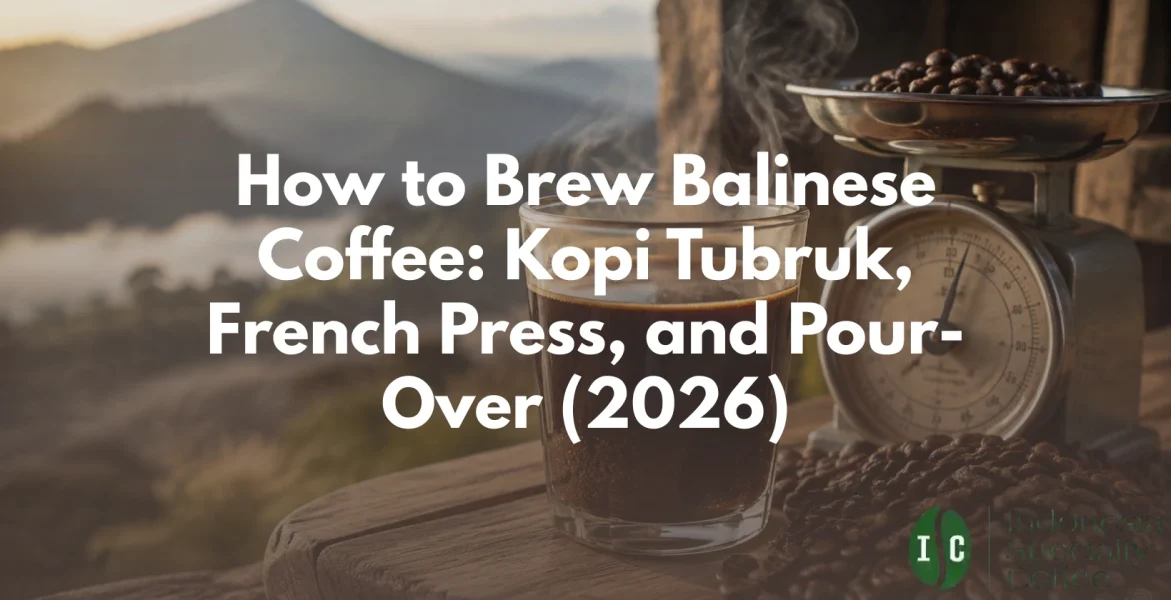
Learning how to brew Balinese coffee starts with a fact most guides get wrong: Bali Kintamani is not Sumatran coffee. Balinese coffee is dry-hulled, bright, and citrus-forward, and it needs different parameters than the earthy wet-hulled beans most drinkers associate with Indonesia. This guide covers the three methods used across Bali, with the exact ratios, grind sizes, water temperatures, and brew times we use when cupping these lots in Medan.
Last updated: 02 September 2026
Why Balinese Coffee Tastes Different from Sumatran Coffee
Bali Kintamani coffee grows in the volcanic highlands around Mount Batur, between 1,200 and 1,700 metres above sea level. Indonesia Specialty Coffee sources its Kintamani lots from smallholder farms in Ulian Village, Bangli Regency, where cherries take roughly nine months to mature at 13 to 28°C. The varietals are Typica, S-795, and Kartika, graded at screen size 15 to 17.
Processing is where Balinese coffee separates from Sumatran coffee, and it happens in two steps. Step 1 is the cherry method: Kintamani lots are natural process, full-washed, or wine process. Step 2 is hulling, and Bali is dry-hulled at roughly 12 to 13% moisture. Gayo and Mandheling from Sumatra are wet-hulled (Giling Basah) at 35 to 40% moisture, which is what strips their acidity and builds that heavy, earthy body.
Ignore any brewing guide that calls Balinese coffee earthy and low in acidity. That description belongs to wet-hulled Sumatran coffee. ISC’s Bali Kintamani Grade 1 cups at 83 to 86 SCA points, with orange and lemon in the fragrance, molasses and toast in the cup, bright acidity, and a medium body.
Choosing and Grinding Beans for Balinese Coffee
Two decisions carry most of the outcome with Balinese coffee: roast level and grind size.
Buy Balinese coffee as whole beans at a light to medium roast, and check the roast date. A dark roast flattens the orange and lemon notes you paid for. If you want the thick, syrupy cup served in Balinese warungs, use Bali Kintamani Robusta rather than over-roasting Arabica to get there.
Here is something you only notice after handling both origins: dry-hulled Bali beans are denser and less brittle than wet-hulled Sumatran beans. At an identical grinder setting, Bali produces a coarser, more uniform grind with fewer fines. Grind one or two clicks finer than your usual Sumatra setting.
| Method | Grind Size | Ratio | Water Temp | Brew Time |
|---|---|---|---|---|
| Kopi tubruk | Medium-coarse | 15 g : 200 ml | 92 to 96°C | 4 to 5 minutes |
| French press | Medium-coarse | 15 g : 250 ml | 93°C | 4 minutes |
| Pour-over | Medium-fine | 15 g : 250 ml | 93°C | 3:00 to 3:30 |
ISC roasts Bali Kintamani in Medan and ships worldwide. Browse the roasted Bali Kintamani lots or check the current pricelist.
Method 1: Kopi Tubruk
Kopi tubruk is how most of Bali actually drinks coffee: ground coffee steeped directly in the glass, unfiltered, grounds left to settle at the bottom. It needs nothing beyond a glass and a kettle.
The most common error in kopi tubruk recipes online is the instruction to boil the coffee. Do not boil it. Water at a rolling boil sits above the extraction window and pulls out bitter compounds.
- Grind 15 g of Bali Kintamani to a medium-coarse setting.
- Heat 200 ml of filtered water to 92 to 96°C. Without a temperature-controlled kettle, boil and wait 45 seconds.
- Add the grounds to a heatproof glass, then pour the water over them in a slow, steady stream.
- Stir once, then leave the glass undisturbed for 4 to 5 minutes while the grounds sink.
- Drink the top three quarters and leave the sediment behind.
Grind size here is a real judgement call. Warungs across Bali grind almost to a powder, which produces the thick, muddy texture people associate with kopi tubruk. Medium-coarse gives less sediment and a cleaner cup, at the cost of some traditional body. Start medium-coarse, then go finer for the warung version.
Method 2: French Press
The French press steeps rather than boils, so Balinese coffee extracts more evenly than in a tubruk glass while keeping the oils a paper filter would strip out. It also gives you a control kopi tubruk does not: you decide when extraction stops.
- Grind 15 g of Balinese coffee medium-coarse, the same setting as kopi tubruk.
- Boil 250 ml of water, then let it stand for about one minute to reach 93°C.
- Add the grounds to the press, pour in all the water, and stir once.
- Seat the plunger without pressing, and wait 4 minutes.
- Press down slowly, over 20 to 30 seconds, then pour immediately.
Coffee left on the grounds keeps extracting. Decant whatever you are not drinking now.
Method 3: Pour-Over
Pour-over shows Bali Kintamani Arabica at its best. The paper filter removes oils and fines, leaving the citrus brightness and clean finish that dry-hulled processing produces.
Pour-over needs a medium-fine grind, closer to table salt than to sea salt. A coarse grind under-extracts here and produces a thin, sour cup.
- Rinse the paper filter with hot water, then discard the rinse water.
- Add 15 g of medium-fine ground Balinese coffee and level the bed.
- Pour 45 g of water at 93°C and wait 30 seconds for the bloom.
- Pour the remaining water in slow circles, keeping the bed submerged, to a total of 250 g.
- The full brew should finish between 3:00 and 3:30.
Three Mistakes That Ruin Balinese Coffee
- Boiling the coffee. Water at a rolling boil is 100°C, above the 92 to 96°C window where coffee extracts cleanly. Boiling produces bitterness, not strength. Strength comes from the ratio.
- Buying or roasting too dark. Bali Kintamani earns 83 to 86 SCA points on its acidity and citrus fragrance. A dark roast erases both, and you pay specialty prices for a commodity flavour.
- Using one grind size for everything. A single setting cannot serve both kopi tubruk and pour-over. Match the grind to the method using the table above.
Frequently Asked Questions
What is kopi tubruk?
Kopi tubruk is a traditional Indonesian brewing method where ground coffee steeps directly in a glass with hot water and is served unfiltered. The grounds settle at the bottom and the drinker leaves them behind. A standard recipe uses 15 g of coffee to 200 ml of water at 92 to 96°C.
What does Balinese coffee taste like?
Bali Kintamani Arabica tastes bright and citrus-forward, with orange and lemon in the fragrance, molasses and toast in the cup, and a medium body. Balinese coffee is cleaner and more acidic than Sumatran coffee because Bali lots are dry-hulled rather than wet-hulled.
Should you boil coffee for kopi tubruk?
No. Boiling water reaches 100°C, above the 92 to 96°C window where coffee extracts cleanly, and it produces bitterness rather than strength. Pour hot water over the grounds, stir once, and leave the coffee to steep undisturbed for 4 to 5 minutes.
What grind size is best for Balinese coffee?
Grind size depends on the method. Use medium-coarse for kopi tubruk and French press, and medium-fine for pour-over. Dry-hulled Bali beans are denser than wet-hulled Sumatran beans, so grind one or two clicks finer than your usual Sumatra setting.
Where can you buy authentic Bali Kintamani coffee beans?
Indonesia Specialty Coffee supplies Bali Kintamani green and roasted beans sourced from Ulian Village, Bangli Regency. Order sizes start at 1 kg samples, with 60 kg microlots and 350 kg wholesale lots available. Contact [email protected] for current pricing.
Buy Bali Kintamani Coffee Beans from Indonesia Specialty Coffee
Indonesia Specialty Coffee is a direct exporter of Bali Kintamani green coffee beans from Ulian Village, Bangli Regency, with Grade 1 lots cupping at 83 to 86 SCA points at screen size 15 to 17. All lots are Halal certified, and Bali shipments leave FOB Tanjung Perak.
Order at the scale you need: 1 kg samples for cupping, 60 kg microlots, 350 kg standard wholesale, or container loads from 9 MT. Grade 1 Bali Kintamani green beans run $10,200 to $15,500 per MT [confirm current price with ISC pricelist].
Buying roasted instead? ISC roasts Bali Kintamani in Medan for cafes and retail buyers. Email [email protected] or contact the ISC team on WhatsApp at +62 811-6380-606 for a quote.