
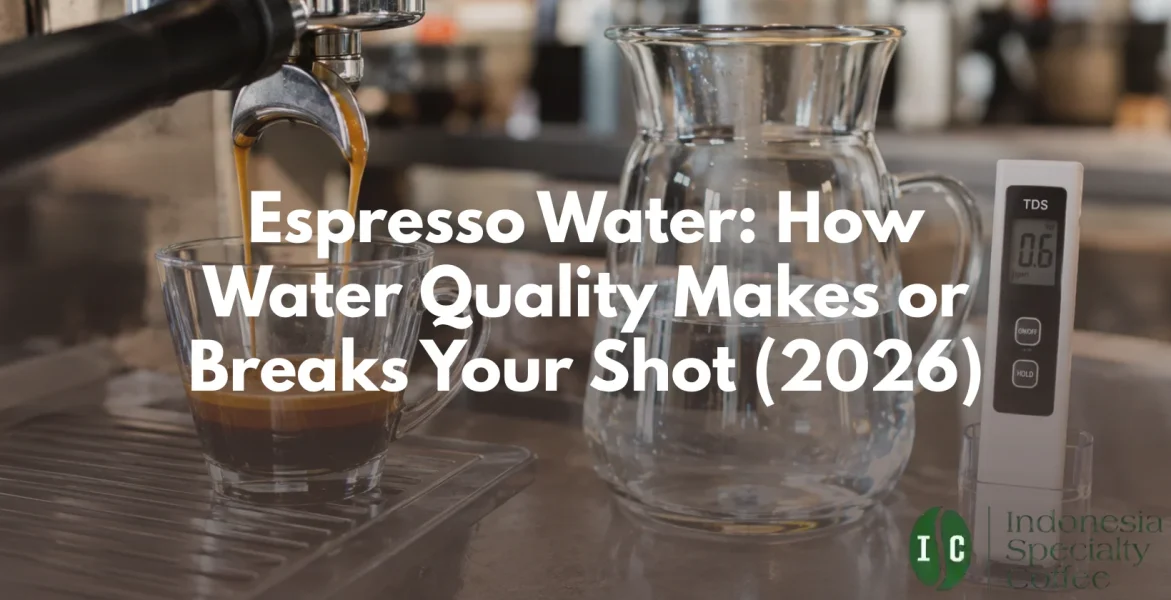
Espresso water is the water that goes into your machine, and it shapes more of the cup than most people expect. A shot of espresso is roughly 90 percent water, and the minerals dissolved in that water control both how the coffee extracts and how long the machine lasts. Water that is too hard leaves scale and tends to taste flat and chalky; water with too little mineral content tends to taste thin and sour, and can be harsh on metal parts.
The good news is that espresso water is one of the easiest variables to measure and fix. This guide covers the Specialty Coffee Association (SCA) water standard, what hardness and alkalinity actually do, how to test your water, the main ways to treat it, how to protect your machine, and how water interacts with different coffees.
Last updated: 06 October 2026
Why Espresso Water Matters
Water is a solvent, and the minerals in it change how well it dissolves the flavour compounds in ground coffee. A 2014 study by Hendon and colleagues in the Journal of Agricultural and Food Chemistry modelled how dissolved minerals bind to coffee flavour compounds. Magnesium bound most strongly, calcium came next, and sodium bound weakly, in some cases less than water itself. The authors also noted that bicarbonate acts as a buffer that reacts with coffee’s acids.
In practical terms, espresso water has two jobs:
- Flavour. The right balance of minerals extracts sweetness and clear acidity; the wrong balance gives flat, chalky, sour or bitter shots.
- Machine protection. Too much hardness leaves limescale in boilers and pipes; water with very little mineral content can attack metal parts.
These two jobs pull in slightly different directions, which is why good espresso water is a balance rather than a single “pure” ideal.
The SCA Water Standard for Coffee
The Specialty Coffee Association publishes a water quality standard for brewing coffee. The target is the most desirable point, and anything inside the acceptable range meets the standard.
| Characteristic | Target | Acceptable range |
|---|---|---|
| Odour | Clean, fresh, odour free | |
| Colour | Clear | |
| Total chlorine | 0 mg/L | 0 mg/L |
| Total dissolved solids (TDS) | 150 mg/L | 75 to 250 mg/L |
| Calcium hardness | 68 mg/L (4 grains) | 17 to 85 mg/L (1 to 5 grains) |
| Total alkalinity | 40 mg/L | At or near 40 mg/L |
| pH | 7.0 | 6.5 to 7.5 |
| Sodium | 10 mg/L | At or near 10 mg/L |
Two notes. First, this standard covers brewing water in general, and many espresso professionals fine-tune within it, for example running slightly lower alkalinity for very bright coffees. Second, your machine maker’s water specification matters too; check it before changing anything. Do not confuse water TDS with the TDS of the brewed espresso, which measures how much coffee ended up in the cup; our TDS in coffee brewing guide covers that measurement.
Hardness vs Alkalinity: The Two Numbers That Matter
TDS tells you how much is dissolved in your water, but not what. Two water samples at 150 mg/L can taste completely different in espresso depending on whether those solids are mostly calcium and magnesium or mostly bicarbonate and sodium.
- Hardness (calcium and magnesium). These are the minerals that help extract flavour. Too little and shots taste thin; too much and you get scale, and often a muted, chalky cup.
- Alkalinity (mostly bicarbonate). This is the water’s buffer against acid. Some is useful, because it rounds off harshness. Too much neutralises coffee’s acidity and makes espresso taste flat and dull. Too little lets acidity turn sharp and sour.
- Sodium. Comes in with some softeners and treatments. In excess it gives a soapy or salty edge and contributes little to extraction.
- Chlorine and chloramine. Must be zero for coffee. They give a medicinal taste and should be removed with activated carbon.
What you will usually notice in the cup:
| Water type | Typical espresso result |
|---|---|
| Distilled or pure RO water | Thin, sour, hollow; under-extracted taste |
| Very hard, high-alkalinity tap water | Flat, chalky, muted acidity; heavy scale |
| Soft water with very low alkalinity | Bright but can turn sharp or sour |
| Balanced water near the SCA targets | Sweet, clear acidity, good body and crema |
How to Test Your Espresso Water
You need two pieces of information: total dissolved solids, and the split between hardness and alkalinity.
- TDS meter. Cheap and fast, but it reads only the total. Use it to check consistency, not to diagnose problems.
- Hardness and alkalinity drop tests. Simple titration kits, often sold for aquariums as GH and KH tests, give hardness and alkalinity in degrees or in mg/L as calcium carbonate. One German degree (°dH) equals about 17.8 mg/L as CaCO₃.
- Your water utility report. Most public water suppliers publish hardness, alkalinity, sodium and chlorine or chloramine levels by district.
- Bottled water labels. Look for bicarbonate (alkalinity), calcium, magnesium and sodium figures.
Test at the tap you actually use, and test again after any filter you install.
How to Fix Your Espresso Water
| Method | What it does | Good for | Watch out for |
|---|---|---|---|
| Activated carbon filter | Removes chlorine, chloramine (with catalytic carbon) and odours | Every setup, as a first stage | Does not change hardness or alkalinity |
| Ion-exchange softener | Swaps calcium and magnesium for sodium | Very hard water, scale prevention | Raises sodium; can make shots taste flat or soapy on its own |
| Blending or alkalinity-reducing cartridge | Reduces carbonate hardness and alkalinity to a set level | Most cafés with moderately hard water | Cartridges need regular replacement |
| Reverse osmosis plus remineralisation | Strips nearly everything, then adds back a controlled mineral mix | Very hard or variable water, maximum control | Highest cost; never use RO water without remineralising |
| Recipe water | Distilled water plus a mineral concentrate | Home espresso, consistent testing | Ongoing cost and effort |
| Bottled water | Choose a low-sodium, moderate-mineral brand | Home or travel | Check bicarbonate on the label; many mineral waters are far too hard |
The single most common fix for cafés is carbon filtration plus a cartridge that reduces alkalinity, set to your local water. For home espresso, recipe water gives the most control for the least equipment.
Dialling in a new espresso blend? See our pricelist or contact our team for 1 kg samples of Indonesian espresso origins.
Protecting Your Espresso Machine
Espresso machines heat water under pressure, which makes them more sensitive to water chemistry than a kettle or drip brewer.
- Scale. Hardness plus heat deposits limescale in boilers, heat exchangers and small jets. Scale insulates heating elements and can block the narrow gicleur that controls water flow to the group. Many manufacturers exclude scale damage from warranty.
- Corrosion. Water with very little mineral content, or with high chloride levels, can be aggressive toward metal components over time. This is one reason pure RO or distilled water is not recommended on its own.
- Level sensors. Some machines detect boiler water level electrically and may not read very low-mineral water reliably. Check the manual.
- Maintenance. Descale and backflush on schedule. Our coffee machine maintenance guide covers the routine.
A practical rule: treat water to suit your machine maker’s specification first, then fine-tune within that range for flavour.
Matching Espresso Water to Your Coffee
Water does not affect every coffee the same way. As a green coffee supplier, we see how sensitive this is whenever a roaster cups our samples as espresso: the same lot can taste noticeably different on two cafés’ water.
- Low-acid, full-bodied coffees. Wet-hulled Sumatrans such as Gayo and Mandheling already have little acidity. In high-alkalinity water they can taste heavy and dull; in water nearer the SCA alkalinity target, their sweetness and cocoa come forward.
- Bright, washed coffees. Bali Kintamani and washed Java lots carry more citrus and fruit. High alkalinity strips that out quickly, so they reward softer, lower-alkalinity water.
- Espresso blends with Robusta. Robusta adds body and bitterness; very hard water can push them toward harshness.
Before blaming the beans, check the water, then the grind, dose and puck preparation. Our guides to the best coffee beans for espresso, acids in coffee and fixing espresso channeling cover the other variables.
Frequently Asked Questions
What is the best water for espresso?
The best water for espresso is clean, odour-free and close to the SCA water standard: about 150 mg/L total dissolved solids, calcium hardness around 68 mg/L, total alkalinity near 40 mg/L, a neutral pH of about 7, low sodium and zero chlorine. Balanced water extracts sweetness and clear acidity without leaving heavy scale.
What is the best water for an espresso machine?
Use filtered water that meets your machine maker’s specification and sits close to the SCA standard. Moderately hard water with controlled alkalinity protects against scale while tasting good. Avoid very hard tap water, which scales boilers, and avoid pure distilled or RO water, which can corrode parts and confuse some level sensors.
Can I use distilled water in my espresso machine?
Not on its own. Distilled water has almost no minerals, so espresso tastes thin and sour, and many manufacturers advise against it because low-mineral water can be harsh on metal parts. If you start from distilled or RO water, add a mineral concentrate to bring hardness and alkalinity back into the recommended range.
Is tap water okay for espresso?
Sometimes. It depends on your local hardness, alkalinity and chlorine levels, which vary widely. Check your water utility report or test it. Most tap water needs at least an activated carbon filter to remove chlorine, and hard water usually needs softening or an alkalinity-reducing cartridge to protect the machine and the taste.
What TDS should espresso water have?
The SCA standard targets 150 mg/L total dissolved solids, with an acceptable range of 75 to 250 mg/L. TDS alone is not enough, though: the balance of hardness and alkalinity inside that total matters more for flavour. Measure hardness and alkalinity as well as TDS.
Does water hardness affect espresso taste?
Yes. Calcium and magnesium help extract flavour, so very soft water gives thin, sour shots. Too much hardness tends to give a chalky, muted cup and heavy scale. Alkalinity matters just as much: high bicarbonate neutralises acidity and makes espresso taste flat even when hardness is reasonable.
Espresso Coffees From Indonesia Specialty Coffee
Indonesia Specialty Coffee supplies the Indonesian origins espresso roasters build blends around: syrupy, low-acid Gayo and Mandheling, chocolate-forward Java, bright Bali Kintamani, and Robusta from Lampung for crema and body. Every lot is graded against SNI 01-2907-2008, specialty lots cup at 82 to 88 SCA points, and all coffee is Halal certified, with Organic and Rainforest Alliance on request. We export from Medan, FOB Belawan.
Order tiers run 1 kg for a cupping sample, 60 kg for a microlot rate, 350 kg for standard wholesale, and container loads from 9 MT.
Cup our samples on water close to the SCA standard and judge them fairly. See our current pricelist or contact our team.


